Pages

Monday, November 26, 2012

Just a 'liberal' 'girl'?: Framing of Nurul Izzah Anwar over 'freedom of religion' remarks

Nurul Izzah. Via Refsa.org

Nurul Izzah Anwar comes from a political family. She is the current vice-president of the Malaysian political party PKR (People's Justice Party), is also the daughter of Anwar Ibrahim, a former Malaysian Deputy Prime Minister who was jailed in 1999 and banned from politics until 2008 for charges of corruption and sodomy (but arguably because he was a prominent critic of the then Prime Minister Mahathir Mohamad). Her mother Wan Azizah Wan Ismail is the President of PKR.

Nurul Izzah is the current Member of Parliament for the parliamentary constituency of Lembah Pantai. In the last few weeks, she has been facing "heavy fire" from Malaysian Islamic scholars like the mufti of the state of Perak, the chairman of the National Fatwa Council, and the ulama of the largest and most dominant political party since Malaysia's independence, UMNO (United Malays National Organisation).

What did she say that was so offensive to the dominant religio-political powers?

In a public forum entitled "Islamic State: Which Version, Whose Responsibility?" which discussed the existence of an Islamic society without an Islamic state, she was asked whether freedom of religion applies to Malays in Malaysia (the constitution conflates the indigenous ethnic category of 'Malay' with Islam, making all Malays automatically Muslim).

In her responses, Nurul Izzah quoted the main speaker of the event, who had cited a verse from Al-Baqarah (2:256). She added that this general Quranic commandment should not apply only to non-Muslims in Malaysia.
"And when you ask me, there is no compulsion in religion, even Dr Farouk quoted that verse in the Quran. How can you ask me or anyone, how can anyone really say, 'Sorry, this only apply to non-Malays.' It has to apply equally."
Reporters and other politicians rapidly implied that her remarks were "dangerous and misleading", that she trivialised the issue of belief, and that she was in fact showing "support for apostasy" of Muslims, as part of the larger "liberal ideology" of her political party.

A few days later she clarified in a statement that she was referring to the Malaysian state's enforcement of Islam as the only religion of the Malays, and that while the verse applies to everyone, Muslims fall under shariah laws once they become Muslim. She also reiterated that she supports educational and dakwah programs to strengthen faith in and understanding of Islam.

Throughout this debacle, the infantilisation of Nurul Izzah became clear. A highly-educated 32-year old woman with a Master's degree in International Relations was variously described as a "golden girl...in need of help", who was "rapped" for her remarks" and who ought to have done her "homework" and stop "politicising issues concerning the Islamic faith".

Another theme that surfaced was the labelling of her political party as being 'liberal' and 'pluralist'. These labels are used pejoratively in Malaysia's political context, which aims for a conservative and rigidly Sunni and Shafii Islamic approach to issues -- seen as the purest Islam (other self-professed Muslim groups like Shias or Ahmadiyyas are rigorously persecuted). Promoting freedom of religion or other "Western-style freedoms" such as accepting LGBT people which will lead to many problems (duh, obviously!), as argued by the former prime minister Mahathir Mohamad.
"If we are free to do this and that, in the end we end up creating films which insult other religions and as a result, fight among ourselves," he said. "So don't end up being too enamoured by Western ideologies. Men can marry men, women can marry women, and the family is destroyed," he said.
The support of political parties depend very much on the Malays who are the majority population. As they are overwhelmingly Muslim, Islam is used as a rallying ideology together with the special status of the Malays as the bumiputra ("sons of the soil") of Malaysia. The conflation of 'Malay' and 'Muslim' in the constitution creates situations that are absurd such as a non-Malay convert to Islam being legally regarded as Malay, or impossible, where a Malay apostate would also lose his/her ethnic status (what ethnic group are you then?).

Another rebuttal by a religious scholar who said that "ignorance was to blame for her statement" revealed how important the conflation of ethnicity and race is to the existing religio-political structure in Malaysia.
"How can we say religion is free and open, or place Islam on the same level as other religions. If this happens, think of why Islam is enshrined in the constitution and what is the purpose of the Malay rulers," he said.
Ruling Malay royalty such as sultan or raja still exist in Malaysia although they have limited executive powers. Nevertheless, the common idea is that these rulers traditionally have a mandate to rule by virtue of having lineage from the Prophet Muhammad.

Nurul Izzah's father, Anwar Ibrahim slammed UMNO's religious teachers for keeping mum on internal issues of tyranny, graft and corruption. Indeed, what would be the purpose of Malay royal rulers with all their corruption and oppression if they are reduced to merely rulers, without any divine mandate?

As a woman politician, Nurul Izzah is already subject to the kind of infantilising framing that male politicians would hardly be subjected to. However, the descriptions of the events that unfolded after she made her remark on 'freedom of religion' show that in Malaysia, it's more important to not upset the dominant conception of "Islam = Malay". Not only does questioning the status quo result on personal attacks instead of any "argument based on sound Islamic principles", it more dangerously questions the legitimacy of the current system of political governance in Malaysia.
--
Originally posted at Muslimah Media Watch.

Monday, November 19, 2012

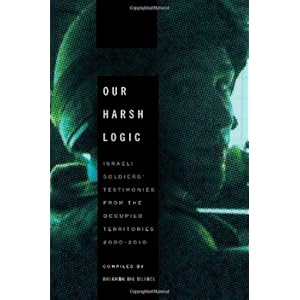
'Our Harsh Logic' by Breaking the Silence

Source: Amazon

Last month, Yehuda Shaul of the NGO Breaking the Silence came to speak at ISS and launch the book 'Our Harsh Logic', a collection of testimonies from Israeli soldiers who served in the Occupied Territories from 2000 to 2010.

What is so valuable about this collection is that it corroborates the stories that have been told countless times by Palestinians, but which have been ignored. I'm sharing the most important part of the book, which is the logic behind the air strikes, forced entry, skunk gas, intimidation of children and families, and the general insanity that the Israeli Defence Forces seems to be doing in 'peacetime' (i.e. when they're not bombing the fuck out of Gaza as they're doing now and before that in 2008-09).

The stories in the book contain lots of jargon as used by the IDF soldiers. Psychologically, this helps them to distance themselves from the gravity of what they are doing to Palestinians. The four terms used in Israeli defense policy are Prevention, Separation, Fabric of Life, and Law Enforcement. The stories in the book are arranged according to these policy terms. I am loosely copying from the book, and arranging the points to be more readable.

1. Prevention (sikkul)

The Harsh Logic
Every Palestinian (whether man, woman or child) is a potential threat. Almost every military operation or military act directed at Palestine can be considered "prevention", gradually blurring the lines between offensive and defensive actions. Deterring the Palestinian population as a whole, through intimidation, will reduce the chances of opposition and therefore prevent terrorist activity.

How to "Prevent"
Abuse Palestinians at checkpoints, confiscate property, impose collective punishments, change and obstruct access to free movement, change rules arbitrarily. The testimonies show that almost every use of military force in the Territories is considered preventive.

The Reality
All military acts are justified as defensive.

2. Separation (hafradah)

The Harsh Logic
Israelis in Israel will be defended if they are separated from Palestinian population in the Territories. After sufficient separation, Israel can withdraw.

How to "Separate"
Channel and monitor Palestinian movement. Create permits and permissions necessary for Palestinians to move around in the West Bank, to limit their freedom of movement and internally divide their communities. Create arbitrary regulations and endless bureaucratic mazes, as effective as physical barriers. Create checkpoints, close roads off to Palestinian traffic, prohibit Palestinian movement from one place to another.

The Reality
Palestinians are divided not only from Israelis, but also their agricultural land, and their own people.
Israel wants to incorporate certain areas into its jurisdiction and creates barriers based on its offensive calculations.

"Separation" is not aimed at withdrawal, but a means of control, dispossession, and annexation of the Occupied Territories.

3. Fabric of life (mirkam hayyim)

The Harsh Logic
Life under foreign occupation can be tolerable, even good. Israeli spokespeople emphasize that Palestinians in the Territories receive all basic necessities and are not subjected to a humanitarian crisis; that there is even economic prosperity in the West Bank.

Occupation is thus a justifiable means of defense, and if there is harm suffered by the population, this is regrettable. Any damage to Palestinians are merely proportionate to the security required of Israeli civilians.

How to create a "Fabric of Life"
Decide on a daily basis which goods can be transferred from city to city in the Occupied Territories, which businesses may open, who can pass through checkpoints and security barrier crossings, who may send their children to school, who will be able to reach the universities, and who will receive needed medical treatment.

Hold the private property of tens of thousands of Palestinians (for supposed security considerations, or for the purpose of expropriating land), arbitrarily confiscate houses, agricultural land, motor vehicles, electronic goods, farm animals. "Confiscate" people to use in training exercises e.g. to practice arrest procedures.

The Reality
The Palestinian fabric of life is arbitrary and changing. Palestinians require Israel's good grace to lead their lives, showing how much they are dependent on Israel. If Israel can prevent a humanitarian crisis in the Gaza Strip, it also has the power to create one when necessary.

Israel's claim to allow the maintenance of the "fabric of life" in the West Bank reveals the absolute control it has over the Palestinian people.

4. Law enforcement (akifat hok)

The Harsh Logic
Israel maintains two legal systems: 1) Palestinians are governed by military rule, enforced by soldiers and subject to frequent change, and does not represent Palestinians or their interests 2) Israeli settlers are subject to mostly civil law, passed by a democratically elected legislature and enforced by police.

How to "Enforce the Law"
Settlers play an active role in imposing Israel's military rule. They serve in public positions and are partners in military deliberations and decisions that control the lives of the Palestinians that live in their area of settlement, they work in the Ministry of Defense as security coordinator for their settlement (influencing transportation, road access, security patrols, even participate in soldiers' briefings).

The Reality
Settler violence against Palestinians is not treated as an infraction of the law. Security forces do not treat settlers as regular citizens but as partners, therefore law is not enforced on them by the Israeli police force. Even when the wishes of settlers and the military are at odds, they consider each other partners in a shared struggle and settle through compromise.Security forces also help in settlers' political aspirations of annexing large portions of the Occupied Territories for their use.

--

These are some of the terms used by the Israeli authorities, concealed under the cover of defensive jargon, with barely any connection to the reality.

Read the book for accounts of the IDF soldiers -- even if just one account -- which show that while Israel gives off the impression that it is slowly and securely withdrawing from the Territories, it is in fact tightening the country's hold on both Palestinians and Palestinian land.

There are many more ways that Israel controls the Territories. This book is just a stepping stone to helping us understand the logic behind occupation and policies of the military.

The best part was the Q&A session. When I asked Shaul to elaborate on the religious justification (the 'Holy Land' argument) used when annexing land, he replied with:

"There are Jewish people who believe the land is ours. There are non-Jewish people who believe the land is ours. There are Jewish people who don't think the land is ours. I'm a Jew and I don't think the land is ours."

Yehuda Shaul
Find their NGO on Facebook and on Twitter @BtSIsrael.

I will post some testimonies from the book in the coming days, inshallah.