Pages

Showing posts with label mmw. Show all posts

Friday, May 13, 2016

Fatal sedition: Noor Farida Ariffin kept in line with rape threats

This article was first published on Muslimah Media Watch.

I recently became aware of rape threats made on social media towards Datuk Noor Farida Ariffin, a well-respected former Malaysian ambassador to the Netherlands. Also a lawyer, she was the co-founder ofSisters in Islam, a local non-governmental organisation for women’s rights, and is the spokesperson of a local group of prominent Malays called G25.

In December 2014, G25 published an open letter to the Malaysian government calling for, among other things, “a rational dialogue on the position of Islam in a constitutional democracy“. Signed by 25 former high-ranking civil servants, including directors-general, secretaries-general, ambassadors and prominent individuals, the letter demands a second look at the position and application of Islamic laws in the country, as well as the jurisdiction and limits of the powers that religious authorities can have.

Why then, is her dissenting opinion not even tolerated, but considered an invitation to threats of murder and rape?

Among other points, the letter focused on a minister’s response to a recent court ruling that transgender women in Malaysia have the right “to dress according to their identity”. Even though this state ruling is in favour of a marginalised group — and therefore should be seen as justice, the main objective of Islamic law — the fact that it is related to women, their sexuality and/or their appearance makes it a favourite target for being a threat to Islam and society at large.

“… [Minister Datuk Seri Jamil Khir Baharom] viewed the right of the transgender community and Sisters in Islam (SIS) to seek legal redress as a ‘new wave of assault on Islam’ and as an attempt to lead Muslims astray from their faith, and put religious institutions on trial in a secular court.”

The letter also highlighted the need for marginalised populations (like the poor) to feel safe from state intrusions of an individual’s privacy. One Shariah Criminal Offenses law in particular targets low-income unmarried couples who are found to be guilty of the crime of khalwat, or ‘close proximity’. Noor Farida says that “personal sin” should not be considered a crime that is punishable by the state.

The Department of Islamic Advancement of Malaysia (JAKIM) conducts regular ambushes to catch those engaged in khalwat, which have sometimes resulted in injuries or even death. Many of these ambushes are posted on YouTube to serve the sordid purpose of a public hanging. MMW writer Alicia sums this up in her piece on sexual immorality in Malaysia:

“Too often, sexual immorality is intertwined with class: cases of close proximity (khalwat) involve couples caught in budget hotels, in cars parked in quiet places, and in public parks, couples who cannot afford to marry or hire a room at an expensive hotel, a place very rarely ventured by the moral police.”

The letter invited scornful responses from two Malay rights NGOs, Malaysian Muslim Solidarity (ISMA) and right-wing Perkasa. ISMA, a group known for its Malay-centric voice, resorted to “personal taunts” such as suggesting that the letter’s “expired” authors should “go back to masjids and repent“, while Perkasa’s secretary-general merely questioned if the authors had done anything at all for Malaysia.

During a talk on “Fighting Religious Extremism in Malaysia” in London recently, Noor Farida gave a review of recent incidents of rising religious extremism in Malaysia, as recounted by Mariam Mokhtar of Free Malaysia Today:

“But the current reality, she said, was a disturbing picture of Islamic NGOs and religious authorities wielding power over a cowed population, with the Malays being watched by a brutal and unapologetic moral police who act like thugs and the non-Malays and non-Muslims subject to intense provocation.”

She gave a laundry list of vile acts which involved body snatching, the conversion of minors, the ‘Allah’ issue, the seizure of Bibles and the actions of born-again Muslims. She also spoke of Muslims being persecuted through mindless acts perpetrated by the religious authorities.

The threat of rape serves to intimidate, and showing women their ‘proper’ place in society simply contributes to the preservation of patriarchy as the status quo

In early December this year, Noor Farida was at a G25 forum on Islam and democracy. The forum aimed at creating an inclusive Consultative Committee of Experts to advise the government on amending state shariah law, within the requirements of the Federal Constitution and National Principles (Rukun Negara).

Her call for a review on the crime of khalwat was met with threats of murder and rape on social media. Facebook user Al Mujahid Arman posted “[her blood is halal]” while another Facebook user Sharul Nizam Ab Rahim threatened to break into her house and rape her.

Despite lodging police reports, the police were slow to investigate and to date, the two men have neither been caught nor convicted. Meanwhile, Noor Farida herself is under investigation for sedition. The Sedition Act, an “outdated colonial vestige”, has been increasingly used to “suppress legitimate offline and online dissent in Malaysia“. Put simply, as her opinion is contrary to ‘official Islam’, she must be silenced.

Looking through the lenses of age, gender, class and race is essential. Since Noor Farida is Malay and Muslim, being a high-ranking government official (and an elderly woman who does not wear hijab) means that she upsets notions of a proper Malay woman. (Although being a young hijabi politician in Malaysia brings with it another set of stereotypes.) As such, she must be ideologically disciplined by both the state (Sedition Act) and the public (Facebook).

Noor Farida has many important points on religious extremism and how religious laws can coexist with secular ones. Why then, is her dissenting opinion not even tolerated, but considered an invitation to threats of murder and rape? Because the threat of rape serves to intimidate, and showing women their ‘proper’ place in society simply contributes to the preservation of patriarchy as the status quo.

Thursday, May 12, 2016

When transphobia blocks justice for survivors of sexual violence

Trigger Warning: This post contains discussion of underage rape and of transphobia


Four months ago, the Singaporean newspaper The Straits Times ran a few articles on a case involving Malay Muslim transgender man Zunika Ahmad, 39. He had been charged with 20 counts of sexually penetrating a girl, a minor who was between the age of 13 and 14 at the time of the offenses between April 2012 and December 2013, with a dildo.

Last week, the same newspaper ran several more articles to update on the decision of the High Court. High Court Senior Judge Kan Ting Chiu, acquitted Zunika of six charges (although Zunika was convicted of one charge of sexual exploitation and sentenced to eight months’ jail). The judge said that Section 376A of the Penal Code implies that only a person with a penis (i.e a man) can be guilty of sexual penetration: “The reference to a person who has a penis cannot be construed to include a woman without doing violence to common sense and anatomy.”

What’s interesting about this case is that while the offender is a man and should be considered as one, the sex he was assigned at birth was used to erase his sexual offenses.

Earlier coverage of the story in December 2015 spoke of Zunika as a person with “gender dysphoria” and describes a transgendered man as someone “who was born a woman but identifies as male“. The newspaper’s representation of Zunika as a trans person is mixed; it uses the wrong pronouns throughout, but in other ways it could even be considered sympathetic: Zunika felt “betrayed by her [sic] own body” when he entered puberty.

Not being able to express his gender identity is portrayed as a source of mental distress (“When her mother forbade her from going for a sex change operation, she cut her forearms […]”). Zunika was expected to be able to go for sex reassignment surgery and “rebuild” his life.

While a medical diagnosis of ‘gender dysphoria’ suggests that this condition is something innate and fixed, words and phrases used in the newspaper’s language, such as “bogus persona“, “disguised as man“, “fooled” and “her real gender” imply that transgendered people are also deceptive and manipulative. Furthermore, the pronouns ‘she’ and ‘her’ are used consistently throughout all articles – even if the term “transgender man” is used – to further emphasise that transgendered men are actually still women.

What is the purpose of law when it cannot bring about justice?

There is also a tone of incredulity at any type of marriage that is out of the heteropatriarchal norm. This is shown by the putting in apostrophes the words “married”, “husband” and “wives”. Such marriages cannot possibly be real or recognised because they do not involve the union of two people of opposite biological sexes.

The most important issue at hand, however, is the sexual exploitation of a minor. The first article describes the sex as “consensual” even though the victim was below 16 years old, the age of consent in Singapore. The purpose behind legal ages of consent is to protect minors, who are presumed to not be able to give informed consent due to unequal relations of power. Sex with a minor under 16 is an offence with or without the minor’s consent, let alone a 13- or 14-year-old having sex with someone more than 20 years older.

More disturbing perhaps is the squabbling over legal definitions (i.e. sexual offender must be a man, must have penis, etc) over the actual application of the law to derive justice (protecting a victim who was a minor at the time of the crime).

“If a court were to interpret A to include a woman, it would be rewriting the law, said [High Court Senior Judge Kan Ting Chiu]. [He] said the ‘better course’ was to leave it to the legislature to amend the provision to make it clear that A includes a woman, if that was indeed the intention.”

While the subject of this analysis is a Muslim transgender man, the insistence of the media on framing him as a woman raises several interesting points.

First, representing transgendered persons in the media only in relation to sexual offenses serves to strengthen the link between being a sexual minority and a moral deviant. In this case, Zunika not only committed the moral crime of deception, but also adultery (“cheats on wives“), paedophilia and deviant sex acts (“using sex toy“) in addition to a whole list of other charges.

“Besides the sexual offences, Zunika is also accused of four counts of using a forged Indonesian passport at Singapore checkpoints, and one count each of voluntarily causing hurt and permitting a false entry to be made at the registry of births and deaths. She will be dealt with on these charges separately.”

Second, we should be vigilant of the use of religion to provide a cover for sexual abuse. The victim, known as R, said: “My family trusted her because she has her own family and seemed very religious. She taught me and my siblings how to pray and made me wear a hijab.” Apparently Zunika also wore an “ankle-length robe and turban during religious occasions,” Arabised items of clothing that give the wearer more religious legitimacy.

Third, we need to be aware of the history of laws. The Penal Code was enacted in the late 19th century in British colonies, based on British law and understandings of society at that time. While British law today may have evolved through amendments, many former colonies remain with fossilised versions of colonial-era law that limit sexual offenses to sexual penetration with a human penis, for example.

As a mirror to Section 376A, the Penal Code also does not recognise men or boys as victims of rape, since Section 375 of the Penal Code states that a victim of rape must have a vagina. This eliminates many other types of sexual offenses that may not involve penetration, or that may involve the violent use of other objects.

Ultimately, such laws fail to protect the underage victim, whether it is a boy or girl. And what is the purpose of law when it cannot bring about justice?

Saturday, April 23, 2016

Does religion trump race? Yes, at least in Singapore.


One of the biggest problems that Muslim women face today is the need to deconstruct and reconstruct narratives of ourselves in the media. (That’s why Muslimah Media Watch exists, amirite?) A recent interview of Professor Jackie Ying, a Chinese Muslim scientist in Singapore, by a Singaporean Malay language news channel shows that this need can exist just as painfully among Muslims themselves.

50-year-old Professor Ying is presently the Executive Director of the Institute of Bioengineering and Nanotechnology in Singapore. Born in Taiwan, she came to Singapore at the age of seven to complete her primary and secondary school education. At the age of 15 her family moved to New York, and she attended high school and The Cooper Union to complete a bachelor’s degree in chemical engineering. Afterwards, she obtained her MA and PhD from Princeton University. In 2001, she became one of the youngest full professors at the Massachusetts Institute of Technology (MIT).

The interview was brought to my attention through a blogpost by Singaporean blogger Zaihan, in which he highlighted the problematic ‘entanglement’ of race and religion. (The blog was last accessed on 26 Feb 2016 and seems to be currently unavailable.)
“Due to her choice of converting to Islam about 15 years ago, Professor Ying is somehow now seen as a representative of the Malay/Muslim community. She was asked to comment on issues that this group faces; on how she would change or improve interest in the sciences amongst the youth of the demographic, for example. She was even prodded to share the “kemelayuan”—Malayness, in short—that she sees in herself. It’s so strange because she is Muslim, but not Malay. She was not quite able to answer so many of these queries levelled at her, because she had not lived as a Malay (…)”
In Singapore, just like in Malaysia, ethnicity and religion are deeply intertwined. To be a Malay often means to be Muslim, and Muslim converts are usually expected to adopt Malay practices. Elsewhere in MMW I wrote that “these two terms [Malay and Muslim] are often used interchangeably.” One problem with this false equivalence of terms is that it erases the experiences of Muslims of other ethnicities, like Professor Ying herself. However, this is something that is sometimes reinforced by the ehnic group itself, in this particular case, the Malay community, as highlighted by blogger Zaihan:
“The blatant manner that Berita Harian and local Malay news programmes claim her amazing achievements (she is truly prolific and well-decorated) as a Malay-Muslim point of pride—simply by virtue of her holding the same faith as their target readers—is not only very silly but also insulting to her journey.”
The other problem with equating Malays and Muslims is the discursive erasure of Malays of other religions, even though they make up a very small percentage of the population. One’s religious identity takes precedence over any other identities.

In the half-hour clip, the interviewer asks several questions that assume that Professor Ying somehow would understand what it means to be Malay, just because she converted to Islam. The interviewer poses these questions:
  1. What is the reason behind the low numbers of Malay Muslims participating in science and research?
  2. What more can the Malay Muslim community do to encourage, ensure and produce a group of science practitioners?
  3. Do you see any Malay Muslims [in your institute] who have the potential to be [a Nobel Prize winner]?
Professor Ying works with the local Malay/Muslim community through Yayasan Mendaki, a “self-help” semi-governmental organisation. She mentors young Muslims interested in science by giving them the opportunity of working on research projects in her laboratory. While she could not answer these questions from the perspective of a Malay, she did have insights from the perspective of an educator.

She highlighted the shortcomings of science education, and she said,”I think it’s the same problem for everybody. Students learn science as a fairly dry subject.” Furthermore, she spoke about the emphasis on exams and early streaming, “Doing well academically is different from being able to do research well in the lab. We have too much of a civil service mindset.”

Even though the interviewer’s questions framed her as having to speak for the Singaporean Malay community by virtue of being Muslim, I think she managed to steer the conversation away to – as much as she could – create her own representation. The struggle continues for Muslim women to create their own narratives and resisting those imposed on them.
“I think from being young, we wanted to grow up to be individuals. It was important for me that my parents did not set me in certain pigeonholes. They are very accepting of who I am (…) Of course society is a different story. We have a lot of constraints. But because my parents never set those limitations, I never felt there was something I couldn’t do. I think it’s that: we set our own challenges that makes it possible for us to try different things.”
In Singapore, the conflation of ethnicity and religion erases individual narratives, as Professor Ying highlights here. However, with this interview she has given us an example of how to resist dominant media narratives – an example both media makers and participants can learn from.

Thursday, March 10, 2016

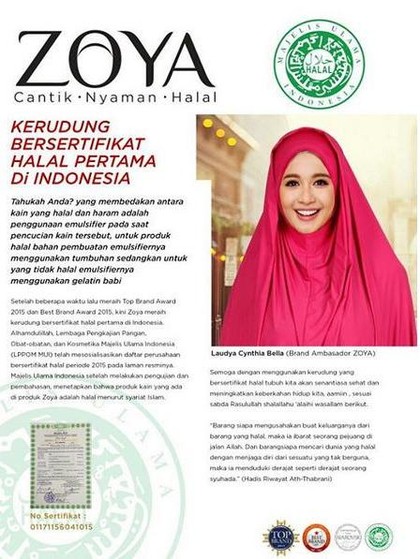
Indonesian fashion brand gets halal status, ruffles hijabs of many


Earlier this month, the appearance of Indonesia’s first halal-certified hijab, sold and promoted by Indonesian fashion company Zoya, provoked equal parts protest and support. According to the certification given by the Indonesian Ulama Council (MUI), Zoya’s hijabs are ‘halal’ because the fabrics are produced with the use of only plant-based emulsifiers, and not those made from pig gelatin. Zoya has also erected a billboard in a few major towns with the tagline “Are you sure that your hijab is halal?“


Online, some responded with incredulous sarcasm. Some said that if the fabric for hijabs had to be halal, then every article of clothing (including underwear) had to be halal as well. Others pointed out that if there were ‘halal hijabs’, then, there must necessarily be ‘haram hijabs’ existing from the beginning of time until Zoya. Some questioned if the halal certification would not be completely unnecessary after washing the hijab, especially before wearing it for the first time? And some contended that many women, after their umrah and haj, still buy abaayas made in China, which are more likely to be washed with pig gelatin-based emulsifiers.

A hijab that is clearly ‘halal’, while its competitors are not, is an example of strong product differentiation. Instagram celebrity and hijabi blogger Fifi Alvianto sees this ‘halal hijab’ as a marketing tactic. She explains, “In the religion [Islam] there hasn’t been discussions on halal fabrics, at least not as clearly as halal food.” However, Zoya’s creative director Sigit Endroyono said that their intention was only to help consumers feel confident and at peace with their hijabs. “As sellers, we are responsible for our customers’ tranquility. We try to fulfil the right of our customers by ensuring the permissibility of our clothes and headscarves.”

Despite these non-pecuniary motivations, the company’s sales manager Chandra Rahmad, admitted that the controversy surrounding their ‘halal hijab’ has resulted in an “unintentional” but “extraordinary increase” in the sales of Zoya’s products. Zoya has since retracted their advertisements on Instagram, as well as all but one billboard, and apologised in a press meeting.

It is perhaps not a surprise that Zoya chose to embark on such an aggressive marketing campaign, especially in the light of the recent introduction of a hijab and abaya collection from Dolce and Gabbana. This comes after several years of one-off and aurah-friendly Ramadan collections from DKNY, Tommy Hilfiger, and Oscar de la Renta caftans. Even more affordable brands like Uniqlo and Mango have kept up.

I appreciate the critical response from certain segments of Indonesian society. While there were certainly people who bought Zoya’s hijabs after they were certified halal, there were also others that spoke out against the absurdity of ensuring that hijabs — a non-consumable — were also halal.

Hijab designer Rani Hatta admits to being confused by the halal certification for hijab fabrics, “I thought all along that clothes that cover the aurah, are loose-fitting and don’t show the shape of the body could be worn.” Famous Indonesian designer Dian Pelangi also echoes Rani’s opinion, “Cosmetics and beauty products are absorbed into the skin, so we need to make sure that the products we use are halal.”

However, I do feel disappointed that none of the critics mentioned fair trade or ethical working practices play a role in determining whether a fabric is ‘halal’ or not. The director of MUI’s department of Food, Medicines and Cosmetics Research (LPPOM) Lukmanul Hakim clarified that the Zoya brand is not halal as a whole — just its fabric. He mentions other processes but unfortunately, his discourse remains at the superficial material level and does not go deeper to address social practices, “Zoya claims its [hijabs] to be halal […] They say that it’s because they use halal materials. But doesn’t fabric need to be sewn? Is their thread halal too? We don’t know that yet.”

MUI’s head of Halal Information Farid Mahmud said that there are now many companies that submit applications for halal certification. Companies that produce shoes, belts, paper and even social organisations have applied:
“Some laundromats provide soap and water that are guaranteed to not contain ‘najis’ [ritual impurities]. The biggest paper factory in Indonesia also submitted an application because their paper is used for printing Qur’ans […] Consumers just want to make sure that although not for eating, these materials are not contaminated with najis. Producers consider it as an obligation in accordance with Islamic law.”
In the production of cotton for example, there are several political issues related to ‘halal’ we could choose to educate ourselves on, such as Genetically Modified (GM) cotton reduces biodiversity; intensive farming uses pesticides, insecticides and fertilisers; cotton-picking in some countries like Uzbekistan is still done by hand and allegedly by children; textile processing uses high amounts of water and energy. Meanwhile, many synthetic fabrics are non-biodegradable and use harmful chemicals during processing.

Elsewhere I have written that the Qur’an encourages us to do ‘good works’ instead of committing abuse and oppression when eating or drinking — which we could reasonably extend to whatever else we consume.”[…] the source of our food and drink is important – it must not cause pollution or destruction of natural habitats, and it must not be produced by underpaid or exploited workers.”

The controversy of a ‘halal hijab’ has opened a discussion into what makes a thing halal or not. Unfortunately it seems that for Indonesia at least, Muslim discursive circles on ‘halal’ have yet to intersect with social justice discourses on fair trade, organic farming or sustainability.

All quotes have been translated from Bahasa Indonesia.

Sunday, March 6, 2016

Disabled Muslims need more than du’a to overcome mosque barriers


This article was originally posted on Aquila Style and slightly edited for Muslimah Media Watch.

A video that emphasises the determination and willpower of a disabled person overlooks the need for institutions to adopt more inclusive policies.

Arif Ali/AFP

“How is your situation with attending the mosque?” begins a video by Kuwaiti preacher Mishary Al-Kharaz, before he introduces us to his “friend in Yemen”.

The video shows Kamal, a young man with a “handicap”, as he enters a mosque, prays sitting on a chair and then goes up to the second floor after the maghrib prayer to attend a Qur’an memorisation class.

All this despite the fact that he walks with difficulty on level flooring, has to crawl up the stairs, and struggles to recite Qur’anic verses as his voice is unclear. He also has to depend on someone to walk him home from the mosque with the help of a lamp as nights get totally dark there and there are no streetlights.


Judging by the comments on the video in my social media feeds, there is an outpouring of sympathy for Kamal. People make du’a for him because he has to expend much more energy to worship, and he does even more than the average able-bodied person.

However, I think the video was made mostly to make able-bodied people feel guilty if they don’t pray five times a day in the mosque. The video misses out on the structural barriers faced by disabled people – especially in Yemen – such as the lack of affordable and suitable wheelchairs (or other kinds of supportive equipment), the lack of lifts in buildings, and the seemingly ambivalent attitude of the other Muslims around him (why is the Qur’an memorisation class still held on the second storey and not moved to the first?)

The video also does nothing to raise awareness about those similar to Kamal, as he is described simply as someone with a “handicap”. In fact, he has cerebral palsy, a neurological condition that affects movement, coordination, hearing, sight and learning to various degrees. While there is no cure, it can be improved through medication or therapy.

What about other kinds of “handicaps”? What about those who require ramps or lifts to enter the mosque, Braille Qur’ans or sign language for sermons?

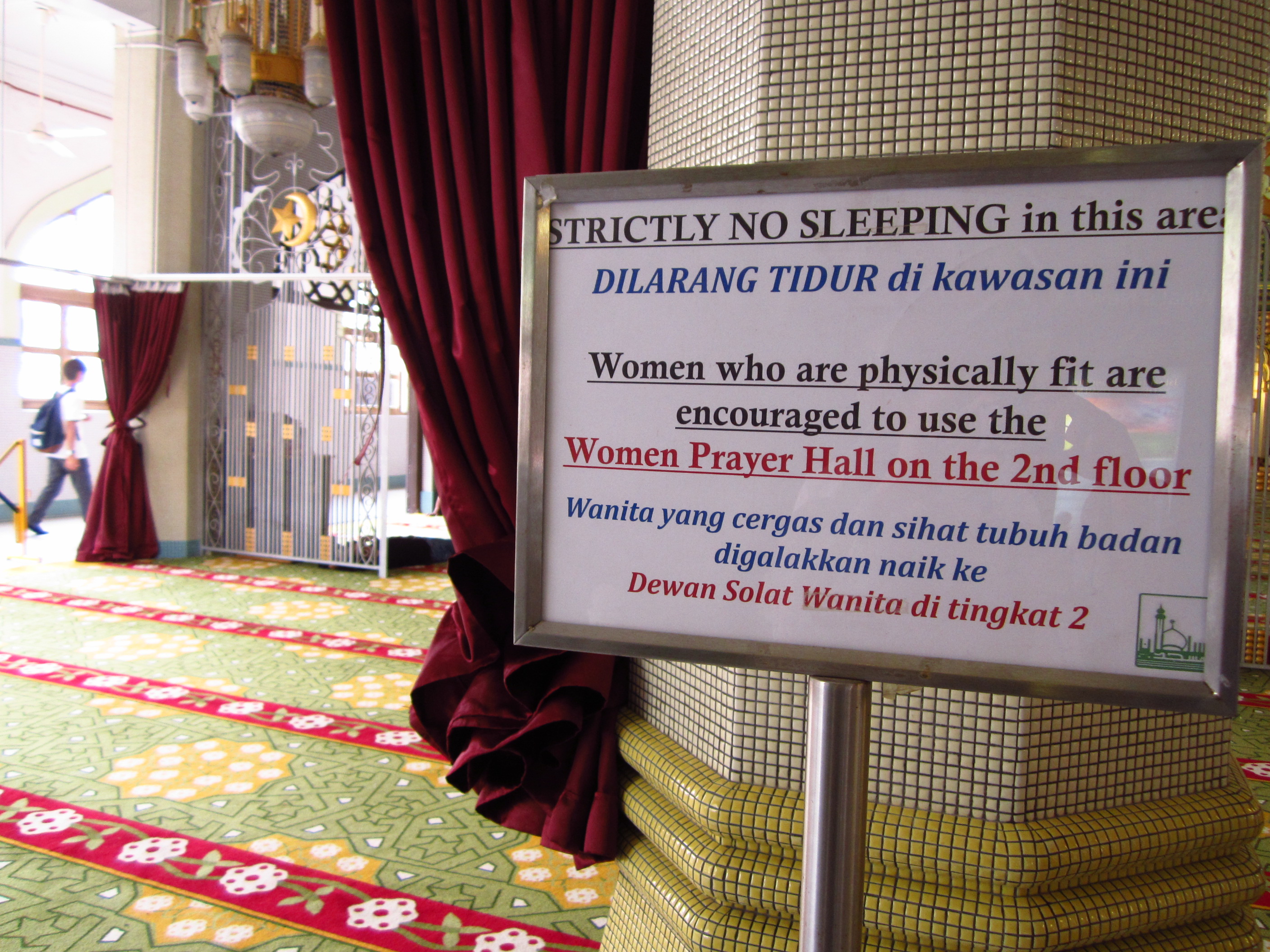
While the video commendably address the issue of accessibility in the mosques for the disabled, it does so from a male perspective. What if Kamal were Kamila: as a woman would she be able to even enter the mosque? And if she could, would she have a decent prayer space, be able to hear the sermon, and have access to Qur’an classes? In some smaller mosques in Singapore, for example, women are told to avoid the mosque during Friday prayers (although larger mosques may set aside a smaller space for them).

A sign found in Singapore’s Sultan Mosque encouraging fit and able-bodied women to use the second floor.

If Kamila were allowed access to this Yemeni mosque, where would her praying space be? In Singapore (and many other places), many of the women’s spaces are a floor or two above the main prayer hall. Without a lift, would Kamila have to crawl up the stairs every time she came to pray? In recent years, a historic mosque in Singapore has taken into account the needs of their aging congregation: a new tent-like space has been reserved on the main floor for women who are not able to climb the stairs to the second floor.

Surely we cannot continue to emphasise an individual’s determination in the face of barriers. We must take into account that disability and gender come together to produce unique sites of oppression. And mosques need to change to accommodate their congregation, too. 

Otherwise, who is the mosque for but only able-bodied men?

Friday, March 4, 2016

Film review: Desert Dancer (2015)

This article was first published on Muslimah Media Watch.

Source

Six years ago I attended a contemporary dance workshop, and while I’ve been dancing for most of my life, what struck me most was one improvisation that involved dancing as if you were the furniture in your room. When we had come up with a sequence of movements representing various wardrobes, nightstands, mirrors, beds and tables, we had to then dance it while interpreting the concept of fear.

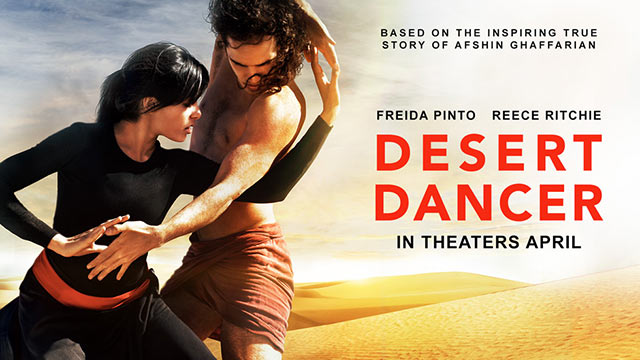
I was thinking about this workshop as I watched Desert Dancer (2015) by Richard Raymond. The film is partly based on the life story of Iranian exile Afshin Ghaffarian (played by Reece Ritchie), who is wanted by the Basijor morality police in his homeland for organising a (forbidden) dance company and an (even more forbidden) performance in the desert south of Tehran, and filming a protest by the Green Movement during the 2009 contested presidential elections.

The group is made up of a ragtag bunch of students without any experience in dance and Afshin’s plan is for them to learn from Youtube videos, “to take control of our lives” in a place “that’s ours, [with] no rules.” Eventually, Afshin assumes the identity of one of the student actors travelling to Paris to perform a play and is granted asylum by the French government.

The first thing that I remark is the choice and use of English in the film, along with a range of accents by the various non-Iranian actors. Most of the main characters are played by actors from the UK, India, Malta, with one from Morocco (Mourad Zaoui) and another from Palestine (Makram Khoury). I’m not sure if they were coached to imitate Iranian accents, but the dialogue seems stilted and unnatural. The one Iranian actress that plays Afshin’s mother (Nazanian Boniadi) only appears in a brief scene. In an interview with The Guardian, she rightly points out how financing drives casting:
“They struggled to make the film [Desert Dancer] because it was about brown people, if we’re being literal. It’s hard to get a film that’s about kids in Iran and led by Reece Ritchie and Freida Pinto financed.”
I think that casting Iranian actors in Iranian roles is important, not only to raise the profile of actors who would normally not be able to gain top billing in bigger films but to also educate viewers on certain aspects of Iranian culture that is more easily embodied by them without needing extensive research or coaching (eg. mannerisms, accent, expressions, knowledge). In this case, the film becomes another instance of non-Iranians telling stories about Iran. The use of many short takes also gives the impression of rushing through the plot, limiting potential for character development.

“When I dance, I feel free. It’s like no one can take that away, it’s limitless.”

The opening sequences of the film, where Iran is described as “the birthplace of great poetry and the first charter of human rights,” raised my hopes that the film could give a glimpse of a new aspect of the underground Iranian dance scene. The excellent choice of modern dance excerpts shown in the film – including familiar names like Sidi Larbi Cherkaoui, Sylvie Guillem and Jiri Kylian – seems to promise that if all else failed, dance enthusiasts could at least enjoy a well-choreographed dance scene or two.

However, the film doesn’t rise above the simple theme of freedom versus restriction. The young Afshin is invited to an arts centre, where Iranians can listen to Western music, practise on musical instruments, act and dance. As he watches Russian ballet dancer Rudolf Nureyev dance, Afshin’s teacher Mehdi sums up the film perfectly:
“Our country is like two parallel words. On the outside are laws, commandments and sin. Here, we are free.”
The film presents the Iranian Islamic regime as saying you can’t paint, act, play music or dance, so the only way to truly live is to eventually escape to the free West – it’s a tale as old as time. These two opposites are hammered home to the viewer constantly, much more than necessary.

In comparison to the short takes, the film devotes several minutes to Elaheh’s audition, a rehearsal between her and Afshin, their performance in the desert, and Afshin’s confession-solo in Paris. The piece most worth watching is an improvised duet (repeated later in the final desert performance) between Elaheh and Afshin, where they use the palms of their hands to push and pull, and resist and submit to each other’s energies. The desert performance however, is spoiled by the presence of Ardavan (Tim Cullen). His movements lacked finesse and he represented all too clearly a Basij who was out to break up the Elaheh-Afshin dyad representing male and female, yang and yin, modesty and exposure, inner and outer Iran.

What I find interesting about this duet is that it suggests that issues surrounding “inner” Iran should be left to its people to work through by themselves. Having a Basij-like character come and decide how the duet should dance mirrors the actions of regimes or governments who decide how Muslim women should act and dress in order to be proper citizens.

At the end of my dance workshop six years ago, I asked the choreographer why he made us come up with movements imitating furniture instead of going straight for the concept. He explained that we often have preconceived notions of fear and how it should look in our minds and in our movements. As a result, we would have all been crouching in the corner and giving terrified looks as we used our hands to push away some frightful being – movements that he considered more suited to theatre than the interpretive and allegorical potential of dance. Unfortunately, that is exactly what Afshin’s final solo in Paris entailed: an almost literal re-enactment of having his voice, rights and freedom stifled; and being caught, beaten and nearly shot by the Basij.

“Why dance if no one can see us?”

In the opening scenes, Afshin’s mother (Nazanin Boniadi) pointedly gestures towards a group of Basij standing in a corner, as a gentle warning to him to not dance in public and this teaching point could not be clearer for the viewer: “They say dancing is forbidden. If you’re going to do it, you do it somewhere safe.”

It’s perhaps ironic that the only Iranian actress (who played a “hijab-wearing agent” in the US series Homeland) in a film about Iranians is given so little screentime.

The film brings up an interesting discussion about resistance. Under a restrictive regime, Afshin and his friends resist through secret rehearsals. The process is difficult, scary and sometimes violent. When Elaheh challenges them about the purpose of their rehearsals, they decide to perform in the desert, “where there is no regime, where no one can find us.”

Is performance always the purpose of dance? Is dance worthy or legitimate if no one sees it? In the same vein, do political protests (such as the one by the Iranian students) make a difference if there is no media coverage – especially international coverage?

As a biography of one Iranian dancer against the regime, targeted to a Western audience that may not know much about Iran, Desert Dancer works. But as a story about dance, Iranian art or a critical analysis of freedom and resistance – not so much.

Thursday, March 3, 2016

Why does an Indonesian woman need to be a virgin to join the military?

This article was first published on Muslimah Media Watch.

Source

An expose by Human Rights Watch (HRW) in November 2014 on the use of virginity tests in Indonesia’s police force has revealed that just because people are silent over a long-standing practice, it doesn’t mean that it is accepted as a normal part of everyday life. Also referred to as the “two-finger test”, it involves a female physician inserting two fingers into the vagina to check for vaginal laxity and the presence of an intact hymen. Women who failed the test are not necessarily rejected, but may receive fewer points for their physical assessment and have further background checks.

The head of the national police law division, Inspector General Moechgiyarto told the media that “the chief objective of the test was to ensure that female cadets lived up to high moral standards” and implied that non-virgins (at least according to the test) are prostitutes and therefore unacceptable candidates.

The tests have been taking place since at least 1984, according to a testimony by a retired female air force officer given to HRW. This HRW report calls for an “[immediate] end the use of so-called virginity tests, which violate the prohibition of cruel, inhuman, and degrading treatment under international human rights law.” According to HRW’s research, all branches of the military – air force, army, and navy – have been requiring the test for decades for not only women planning to enter the military but also the fiancées of military officers. Women with connections to powerful or important people in the military can pay bribes to avoid the test, or obtain a favourable assessment.

In interviews with HRW, women who have undergone the test described the experience as “tense”, “embarrassing”, “humiliating”, “against the rights of every woman” and a form of “trauma”. A female doctor who had administered the test described it as “torture”, even.

Several Indonesian ministers and senior military officials are defending the practice. However, the country’s highest Islamic authority, The Indonesian Council of Ulema, says that the practice goes against Muslim jurisprudence. A district head ulema, Syarifudin Damanhuri, suggested “a religion test instead, arguing that it would give military recruiters a better profile of an individual’s character”.

The Commission for Missing Persons and Victims of Violence (Kontras) chairman Haris Azhar said in the Straits Times that the police has no good reason for requiring the test.
“The police should be ashamed. They’re not moral police. It actually makes us question the morality of the police force itself.”
As a practice instituted by the state, the test appears to serve two purposes:
  1. To teach what it means to be a proper Indonesian woman, wife and/or military recruit.
  2. To keep Indonesian female soldiers subordinate to their male superiors and the masculine state.
The work of Nira Yuval-Davis on gender in nationalist projects helps us to understand this better. While men are usually discussed in terms of their physical abilities to defend the nation, women are spoken of in terms of their capacities to produce citizens and therefore define the borders of a nation. They are the “symbolic bearers of the collectivity’s identity and honour”. With their “‘proper’ behavior” and “‘proper’ clothing”, women “embody the line which signifies the collectivity’s boundaries.” Women in the military thus carry a double burden.

"The test is discriminatory and degrading."

Indeed, the head of Indonesia’s Armed Forces General Moeldoko sees Indonesian women as being responsible for the identity of the military and the state. In The Jakarta Globe,
“[Moeldoko] conceded, though, that there was no direct link between a woman being a virgin and her abilities as a member of the armed forces, but insisted that virginity was a gauge of a woman’s morality — one of the three key traits he said a woman must have to serve in the [Indonesia Armed Forces], along with high academic aptitude and physical strength.”
There is obviously the double standard which absolves Indonesian men of the need to be ‘moral virgins’. National Commission on Violence Against Women (Komnas Perempuan) chair Yuniyanti Chuzaifah explains best why virginity tests are wrong – and in the plainest words. (Her commission has requested a meeting with the chief of the national police to discuss the issue.)
“It is wrong to judge women based on the rupture of the hymen. The virginity test violates the right of women to work – in this case to become a police officer. Moreover, their male counterparts do not take a similar test or face judgment over their virginity. The test is discriminatory and degrading.”
The fact that senior officials saw the need to defend virginity testing only after HRW’s call to stop it suggests that what it means to be the ideal Indonesian/Muslim woman is often reinforced in opposition to the imagined Western/non-Muslim woman. Indonesian women should not have sex before marriage, gaining a superior moral status from their chastity. Their morality affects not only the reputation of their (military) husbands and (military) families, but also the “dignity and the honour of the nation.”

At the same time, the test is not accepted by the women who have to undergo it. In an interview with HRW, one retired air force officer wondered how she could “defend the honour of our nation if we cannot defend our own honour” by undergoing such tests. Could this test be a way to remind women who do make it into the military that no matter how strong or intelligent they are, they will not be treated the same as men when it comes to defending their country?

Nira Yuval-Davis acknowledges this “ambivalent position” that women have within the nation.
“On the one hand (…) they often symbolise the collectivity unity, honour and the raison d’etre of specific national and ethnic projects, like going to war. On the other hand, however, they are often excluded from the collective ‘we’ of the body politic, and retain an object rather than a subject position. […] Strict cultural codes of what it is to be a ‘proper’ woman are often developed to keep women in this inferior power position.”

Tuesday, March 1, 2016

Muslimahs with disabilities need to you hold the lift door, not gawk at their mobility aids

This article was first published on Muslimah Media Watch.


A Singaporean news channel produced a series of Youtube videos featuring selected athletes with disabilities, or para-athletes. One featured athlete is Aishah Samad, a shooter who had to have all four of her limbs amputated after going into septic shock and contracting gangrene in the hospital on the way home from a trip to China.

In the short 5-minute video, at least a fifth of the entire video focuses solely on footage of Aishah’s mobility aids. The video starts with a drawn-out shot of someone putting a bionic arm on her amputated arm. There is one scene that shows only her prosthetic limbs and not even in relation to the rest of her (01:32). Yet another shot (04:41) focuses on her prosthetic legs, then bionic arms, before zooming out to her upper body sitting on a wheelchair.

This producer had also approached my sister, Nurul, a para-athlete herself, for a filming. Initially, the producer wanted to film my sister’s ‘daily routine’, consisting of showering, eating, getting dressed and most importantly, transferring from her bed to her wheelchair. Presumably, these scenes would be similar to a video done of another local athlete. The producer explained that she found this important for people to understand the challenges of persons with disabilities (PWDs).

This isn’t the first time that a film producer has found that daily activities are utterly fascinating when done by persons with disabilities. Many years ago, my sister had been approached by a another TV channel for filming that would involve scenes like showering and getting dressed. Their favourite request is inevitably to film her transferring from a bed to the wheelchair.

First of all, why the special attention to someone’s daily routine? Does it serve a purpose or is it just a chance to gawk at how someone without arms could possibly cook for herself? Would a feature of able-bodied athletes focus so much on them eating breakfast? (Maybe what they ate for breakfast, but probably not long draw, close-up shots of fingers and forks.) I call this disability porn: there is no purpose to showing these scenes except for the able-bodied to gawk and feel better about themselves.

Second, whether a PWD is willing to reveal such details or present themselves in ways that they are not usually seen (ie without mobility aids) raises questions about personal privacy. Each person – whether able-bodied or not, but especially if not – is entitled to determine their own privacy, comfort levels, and self-presentation.
“Me getting in and out of my wheelchair is like you sitting down and standing up. It’s not a struggle for me because I have figured out a routine that works for me for the past 30 years,” says Nurul.
Fortunately, after some back-and-forth and suggestions on what kinds of scenes could be shown instead in order to give a better picture of the unique challenges of para-athletes, my sister’s video turned out to be very different from that of Aishah. Instead of long shots focusing on her wheels and joystick, there are scenes of her taking notes and stretching, and shots of her various sports equipment.


The mainstream media impacts how we think about certain groups of people. Visual media has an especially strong impact because we absorb what we see without thinking. Nurul points out that the purpose of media that aims to educate or raise awareness about PWDs should aim for getting the public to act better.
“I cannot see how watching what I do in my personal life is going to encourage the public to help me hold lift doors open, tap my [public transport] card, carry my food to my table, not park across access ramps, etc.”
While it’s a step forward to feature para-sports, which receive much less attention than able-bodied sports, it’s important not to reduce para-athletes to mere tokens or shadows of able-bodied ones. Every PWD has their own history, which affects how they see themselves. Some may have born able-bodied, some may have slowly lost motor functions, and some may have had the same challenges since they were little.

Despite these differences, too much emphasis on one’s mobility aids rather than the person herself demonstrates a failure to see the person in all their human complexity and through the lenses of all their identities. For example, what about other aspects of their lives as women, as Muslim women? What are the challenges they face in the mosque? In practising dress codes? These are all equally important perspectives to address
“Public education on disability needs to go beyond ‘overcoming’ medical conditions and daily activities. No two disabled persons ‘struggle’ daily the same way anyway.”

Monday, February 29, 2016

Not Between Her and Allah: Hijab-shaming in Malaysia

This article was first published on Muslimah Media Watch.


Tunku Tun Aminah. Source
Hijab-shaming is a favourite activity for some Muslims, both on-and offline. In fact, just last month I attended a religious class where the teacher spent a good half hour doing just that (I had to stop going for my mental health).

While meeting up with a girlfriend last week, she regaled me with the details of a religious class where the female teacher showed examples of “improper hijab” from a selection of hijabi Instagram users – young women who were obviously oblivious to the use of their photos for such educational purposes.

Social media gives a degree of anonymous bravado that makes it easier than ever to degrade and shame Muslim women for not wearing the hijab – the sixth pillar of Islam. (Oh wait, it isn’t? Funny, it sometimes does seem like it is…)

Last week, Bank Negara Malaysia (the central bank, or BNM) awarded a handful of prestigious scholarships to underprivileged students from around the country. 18-year-old Nur Hajar Asyiqin Abdul Zubir was one of the four to receive the award, after several rigorous rounds of assessment.

Currently studying for her ‘A’ Levels in Negeri Sembilan state, she dreams of studying chemistry at Oxford University in the UK – a “golden opportunity” that this scholarship will be able to fund without worrying her parents, who work as meat suppliers. The youngest of five children in the family, Hajar had scored 9 A+s in her secondary school examinations last year and learned about the scholarship through a motivational programme for underprivileged students in the country.

Source
Malaysia is a multiethnic country, where the indigenous Malays form the majority alongside Chinese and Indian minorities. Instead of pride in her excellent academic results, several Malay men on Facebook chose to criticise the fact that Hajar does not wear a tudung, or hijab.

One man said it was a “pity the aurat is not covered” and that “her father bears the sins”. Another man similarly qualified his congratulatory message with a snarky proclamation that “Allah hates His servants who do not cover” and dismissed the role of Hajar’s own intellectual efforts with the remark “we succeed not because we are clever”. Yet another man even suggested that the hijab should be a requirement for a scholarship awarded for academic excellence.

While one website described this online activity as “chiding”, I disagree: shaming is more accurate. It’s easy to shame Hajar because she is a young girl from a poor family, with no social standing. But it looks like women with a higher status in society are still not exempt. Case in point: a princess from another Malaysian state.

While deriding others is an attempt of the actor to give himself moral or psychological power, it only reveals his own internal crisis of masculinity.

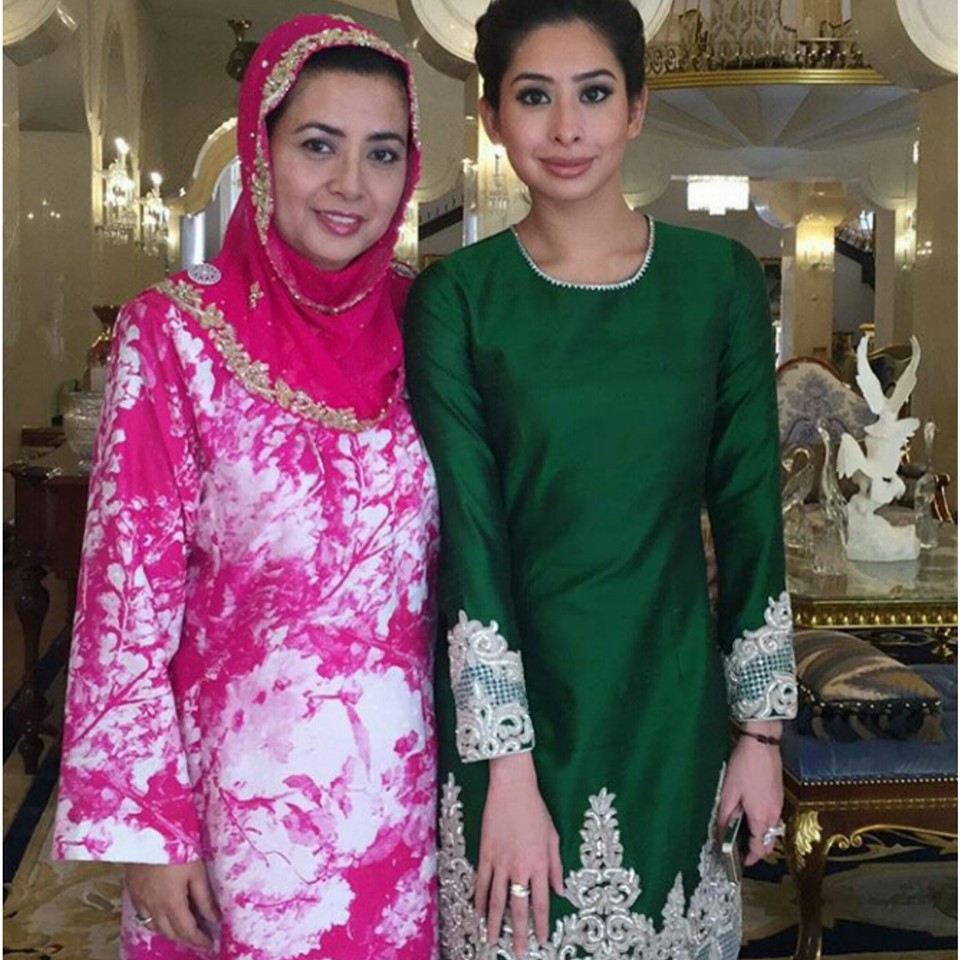
Tunku Tun Aminah Maimunah Iskandariah was recently the target of negative comments on photos posted on Instagram by herself and her brother, Tunku Idris, which shows her without a tudung – her habitual look.

The only daughter among the six children of the Johor sultan and his wife, the fashionable 28-year-old still keeps an Instagram “fashion diary” (@ttaootd), which is heavily monitored for negative comments.

While her brother claims that Tunku Aminah had shut down her Instagram account much earlier and for reasons unrelated to the comments on her lack of hijab, he admits that such comments do “tick [him] off.”

He defends his sister by posting several photos and comments on his account on not being judgemental of how others look. He even vouched for what he knows of his sister’s spirituality, like praying and covering her hair at religious events: “Is that not good enough? Isn’t it between her and Allah?”

It’s such a simple – almost rhetorical – question, yet it is one that is difficult for many of us to answer. These people are shaming Hajar and Tunku for not fitting into their narrow ideas of what it means to be an ideal (Malay) Muslim woman. While deriding others is an attempt of the actor to give himself moral or psychological power, it only reveals his own internal crisis of masculinity.

Sunday, February 28, 2016

Book review: Jewels of Allah by Nina Ansary

This article was first published on Muslimah Media Watch.


When I first heard the title of Dr. Nina Ansary’s latest book, Jewels of Allah, on the life of women in Iran, I must admit I had to restrain myself. In general I’m pretty wary about labelling women as two-dimensional objects, whether in a negative (‘lollipops’) or positive (‘pearl in its shell’) way. Ansary explains that the title is “meant to convey that women, who have been ordained as inferior [by hardline conservative factions] are in fact the jewels of the Creator”.

The book promises to tell the “untold story of women in Iran,” and it doesn’t disappoint in some ways. The first chapter begins with a determined tracing through centuries of history aiming to correct misconceptions about the popular narratives about women’s lives in Iran over the last 40 years. The popular narrative, according to Ansary, is one that creates a dichotomy between the free/modern/active/miniskirt-wearing Iranian woman during the Pahlavi monarchy and the gender-segregated/restricted/veiled Iranian woman in post-1979 Islamic Revolution Iran under Ayatollah Khomeini.

I feel optimistic when Ansary writes, “The real story is usually much more complicated, nuanced and less tidy.” These are the misconceptions she addresses in her book (one point per chapter):
  1. Before the Pahlavi monarchy, Persian women were always suppressed by the religious and political establishment.
  2. Iranian women didn’t advocate for their freedom until recently.
  3. During the Pahlavi era, all women were liberated.
  4. During the Khomeini era, women were totally oppressed.
  5. There is a lack of common ground between secular and religious women in Iran.
  6. There is not much of a women’s movement in modern-day Iran.

Chapter 2 looks at Ancient Persia and the then prevailing religion of Zoroastrianism, which she describes as egalitarian and progressive. Then, the 7th century Arab invasion and the “eventual infusion of Islamic values” into Persian society results in the loss of women’s equal status with men and their social separation, loss of educational opportunities. In the chapter, one hadith about women’s “brains [being] incapable of retaining knowledge” is quoted as if it were a widespread Islamic belief. Next, the chapter argues that women were granted a brief respite from oppression under the Iranian and Turkic dynasties from 9th to 13th centuries. However, the Safavid dynasty brought back the patriarchy, packaged in conservative Shia doctrine and persisting to this day.

Chapter 3 and 4 look at the nuances (as promised!) behind the Pahlavi and Khomeini eras. She argues that (conservative) rural women were not empowered under Pahlavi because their families kept them at home from school, while under Khomeini, a “failed gender ideology” resulted in women being empowered through education, despite legal and social efforts to oppress them. Chapter 4 contains a few rather extensive analyses of gender roles in elementary school textbooks, which read like standalone research essays.

Chapter 5, 6 and 7 look at the ups and downs of alliances between secular and religious feminists by tracing the development of various feminist publications and magazines.

The good

In the epilogue, Ansary highlights about 100 historical and contemporary Iranian women, over centuries, who espoused the feminist ideology of their times (these were previously posted on her Facebook page from March 2014 to May 2015). These women include scientists, artists, professionals and even a Paralympic athlete; this incredible collection is great for showing that Iranian women are not oppressed, have done many amazing things, and come from all walks of life – in short, they’re real people.

I also liked that she started the book with a story of her two grandmothers. Bringing in the personal helps give more context and motivation for why she wrote the book, something that authors should but rarely do.

Chapter 5 also includes a great explanation of Islamic feminism, and how religious and secular feminists in Iran work within a religious framework to advocate for women’s rights. A list of “Iran’s Islamic feminist movement” includes professor Dr. Jamileh Kadivar, journalist Parvin Ardalan, human rights activist Mehrangiz Kar, Nobel Laureate Shirin Ebadi and founder of Zanan magazine Shahla Sherkat. Other scholars mentioned include Nayereh Tohidi, Afsaneh Najmabadi, Haleh Afshar, Valentine Moghadam and Ziba Mir-Hosseini. A selection of quotes from these women indicates that they differentiate Islam as a religion from interpretation of Islamic laws and regulations – a point which is not so clear in the rest of the book.

The bad
One problem is the romanticisation of history and, in particular, of Zoroastrian culture as being a gender utopia. Further, the framing of the Arab invasion and Safavid dynasty as being severely gender unequal serves to frame the empires in between as seemingly more egalitarian. In reality, analyses of these periods deserve just as much nuance (based on other intersectionalities such as sex, race/tribe, class) given to the Pahlavi and Khomeini eras. While there were certainly female leaders and commanders in Persian cities and states in 6th century BC, what class of women could reach these ranks? Most probably educated women of noble lineage.

Walter Benjamin wrote in On the Concept of History (1940) about a painting called Angelus Novus by Klee. The painting teaches us that our view of history as a sequence of events only serves to justify a certain narrative.

“Where we see the appearance of a chain of events, he sees one single catastrophe, which unceasingly piles rubble on top of rubble and hurls it before his feet (…) The storm drives him irresistibly into the future, to which his back is turned, while the rubble-heap before him grows sky-high. That which we call progress, is this storm.”

Furthermore, there were other problematic themes that kept popping up throughout the book. One was the framing of women who ‘veil’ as being conservative and those who don’t veil as being free. One of the first notable women Ansary features in her book is Sadiqeh Dowlatabadi (1882-1961), “one of the most distinguished advocates for female education” (p.28). She reportedly said on her deathbed: “I will never forgive anyone who visits my grave veiled”. This quote is not explained or given any further context or nuance, leaving the reader to conclude that veiling can only be an unfeminist and unempowered act. (In her epilogue she also features Masih Alinejad, creator of My Stealth Freedom Facebook page for women to post photos of themselves without a headscarf.)

Compare this to a description of ‘Rejected Princess’ Naziq al-Abid, Syria’s first female general in history, and for whom going veil-less was also a big part of her life.

“She’s seen here ripping off a veil, since going veil-less was a big part of her life. Not that there’s anything wrong with choosing to wear a veil — she just didn’t have that choice for the most part, although she wanted it badly.”

The conspicuous lack of context is odd, as Ansary seems aware that there is more symbolism to the veil than the oppression-freedom dichotomy. The book shows that she is aware that there are other bigger factors that determine a women’s empowerment, such as laws and educational opportunities. This is evident in how she describes Khomeini’s ‘Islamic Government’:

“a misogynistic regimen […] embedded in a constitution reinforcing the primacy of the Sharia (Islamic law) over civil law and the absolute leadership of a Shiite jurist over popular sovereignty.” (p.200)

So it is puzzling why she does not give more nuance where it is so crucially needed.

This lack of linkage to larger political factors and global processes can result in readers making problematic conclusions. Gina B Nahai, in her review of the book, laments the lack of a “satisfying explanation” as to why “an estimated million women actively took part in the overthrow of the Shah and the return of the ayatollahs to Iran”. Nahai ends up blaming Islam as a monolithic patriarchal force, and Allah as a patriarchal god, for the problems of Iranian women. (Perhaps she didn’t read the final chapters where religious and secular Iranian women show how they are able to articulate gender equality in laws within an Islamic framework, through an ideology otherwise known as Islamic feminism.).

The final chapter also comes to an odd conclusion as to how women in Iran can achieve equality. It mainly argues for a reform of Islam based on “theological reform in Western nations”, based on the work of German priest Martin Luther and Friedrich Nietzsche. There is no mention at all of Islamic laws in other countries that do not have the same outcomes as Iran. Even a cursory look at other Muslim majority countries such as Tunisia or Indonesia could show how gender equality is not solely determined by laws or religion, but also other factors like increased employment or improvement in standards of living.

A public relations sheet that came with the book highlighted some publications and organisations that have featured her book. One organisation that stood out was The Clarion Project, which has infamously produced several Islamophobic films, the most recent being Honor Diaries. This rightwing organisation aims to “challenge extremism”, but in reality it provides a simplistic view of ‘Muslim extremism’ in order to perpetuate a cruel and oppressive image of an all-monolithic Islam. 

Despite this, in her interview with The Clarion Project, I think Ansary has bravely attempted to include some nuance about Iran’s gender inequality, highlighting that the West has its own gender inequality issues too.

Final thoughts

The language in Ansary’s book is easy to read, but it is held back by its pace. I felt like I was reading different essays cobbled together: some delving into too much detail in some topics (analysis of elementary textbooks) and some skimming over topics that needed more analysis (tracing of feminist alliances, Muslim reformers from within).

Most importantly, when I finished the book, I realised that state-sponsored terror existed under both Pahlavi/free and Khomeini/oppressed regimes. Not many readers may know that under Pahlavi, police beat up veiled women and forcibly removed their veils. Today, the basij or religious police do the same to women who are ‘improperly’ veiled. It’s an authoritarian state that imposes a regime on its people that creates oppression, not religion or a veil.

While Ansary extensively looks at the actions of the Iranian state (censorship of feminist magazines, changing of laws, the overall impression that her book gives is that patriarchy/male supremacy/culture/religion is to blame for the oppressive and misogynist laws in Iran’s history. I think she could have done a better job in differentiating Islam as a belief system from Islam as a set of legal interpretations that vary across time and space. Similarly, I think Ansary should have clearly explained that there are a multitude of meanings behind a veil or hijab; that women may wear it for many reasons that are not immediately visible from the outside.

This book may be useful to those looking for historical references and a simple discussion of Iran’s political environment; however, the book can be heavily critiqued from various feminist perspectives and is a limited contribution to the work of Islamic and Muslim feminists.

Monday, October 27, 2014

One Muslim's furry initiative gets Malaysian religious authorities hot under the collar

A few days ago, the Dutchman killed a small mouse which had been living in our kitchen for some time (possibly a year, if it's the same one). He meant to trap it and release it but in a moment of panic he killed it (while apologising to it and that's why I married this dude). After the trauma of having experienced the senseless killing of an innocent animal, I lay in bed thinking about why I had such an irrational reaction to seeing the mouse crawl up and down my sofa (and coming so close to my baby!).

The only other time I do this is when I see a gecko. (Ugh, just saying the name makes me squirm). Not just any kind, but the house lizards that are found in Southeast Asia. I have such a phobia of them that I don't even want to elaborate anymore. Suffice to say, seeing one a few metres away is enough to get me hyperventilating and getting my ass out of the room, super fast.

I don't have the same reaction anything else. Insects like cockroaches, silverfish and ants? No problemo.

Right before I dropped off to sleep, I concluded that it was probably because I had had no close interactions with mice before. I didn't grow up with pet mice, or ever handle one. (I did handle hamsters though.) Plus, seeing mice in the context of a pest (going after noodles, pasta, oatmeal and paper in my house) instead of a pet has sure changed my previously neutral opinion of it.

Source: Facebook
And then it totally made sense why Muslims in my social media feeds were freaking out over an event where - duly summarised - a bunch of Muslims petted a bunch of dogs, took selfies, and washed their hands afterwards. (Most of the photos are of hijabis, because don't you know that Muslim women are the representatives of Islam?)

This event "I Want to Touch a Dog" happened in Kuala Lumpur, Malaysia on 19 October. From what I could read online, it was meant as a friendly introduction to mankind's best friend in a friendly and safe setting with many other dog-friendly Muslims around - a rare opportunity in a community whose Islam is mostly based on the Sunni Shafi'i school of thought. 
"I have seen cases of people running away at the sight of a dog, or throw stones at it. It broke my heart… How do people feel when they see an animal ill-treated, abused or knocked over?” [Source: A Big Message]
Did you notice I said "friendly" three times? It's because I believe that is the intention of the organiser Syed Azmi Alhabshi. Dogs carry a great deal of stigma in our Shafi'i Muslim community (I include Singapore, Brunei, Indonesia and Malaysia in this category); a stigma that extends to any Muslim that handles or owns a dog (see for example, dog trainer Maznah Yusof). Syed Azmi did well: he gave a heads up to the Selangor Mufti Department, invited an ustaz, Mohd Iqbal Parjin from UTM’s Centre for Advanced Studies on Islam, Science and Civilisation (Casis) to speak about the ruling on dogs and how participants could do sertu or ritually cleanse themselves, and provided facilities for washing. All bases covered, you'd hope.

This niqabi agrees. Source: Facebook
Alas, there was so much negative reaction to the event. People went berserk on Facebook, commenting under the images of hijabis carrying different kinds of cute puppies. Add to the mix a smattering of suspicion that the event is just part of a larger conspiracy to promote "liberalism" and "pluralism" in Muslim circles.
I organised this event because of Allah, not to deviate the people's faiths, try to change the Islamic rules of law, poke fun at the ulama or encourage pluralism." [Source: The Star]
Meanwhile, the evening news in Brunei broadcasted a press statement from the ministry of religious affairs that "even though Islam has the provision of sertu to cleanse after touching najis mughallazah [major impurity], this is not an excuse to touch such things on purpose. Doing so is akin to someone who commits a sin with the excuse that one can repent for it afterwards."

The response from religious authorities in Malaysia were a little more mixed. Here's a great summary about the official response from Zurairi AR for The Malay Mail:
"...the religious authorities were at a loss to deal with the younger set of Muslims who chafe at the way they are being “managed” and not allowed to question how their creed is practised here.
The authorities reacted the only way they know how. They insisted that within the country’s borders, not only is the Sunni denomination and the Shafi’i school of jurisprudence the only right way to practise Islam, but Muslims must also accept only Jakim’s interpretation of the religion.
...younger Malaysian Muslims with access to a wider pool of information on Islam today are finding they have less in common with the country’s muftis and ulamas. As such, the Islamic religious authorities are fast losing their relevance, and with it, their iron grip on the lives of Muslims nationwide."
I'll be the first to admit that I do have an inner Shafi'i when it comes to dogs. (Yes, I know that there is a variety of opinions in the different jurisprudential schools of thought, but I'm not going there in this post.) Since I don't know if a bark is friendly or snappy, my first tendency is to jump to the other side of the sidewalk when a dog starts getting too close to me me.

I react like this despite the fact that I know the Qur'an speaks positively about dogs: an animal caught by a hunting dog is halal (5:4) and in the story of the persecuted youth hiding in a cave, a dog is stretching its forelegs at the entrance (18:18). I react like this even though I have been surprised by a farmer's dog that followed me out into a field and hung around a few metres away as if to keep guard on me as I peed. 

I am well aware that my instinctive fearful reaction to dogs and mice comes from a fear of the unknown - I'm simply not used to these animals like I am to say, cats. For that, I'm grateful and happy that there was such an event to change the attitudes, at least in this group of a few hundred Muslims in Malaysia.

Dogfies! Source: Facebook

Wednesday, January 15, 2014

Entrenching Stigma: Malaysia’s Cross-Dressing Law

This post was originally published on Muslimah Media Watch on 8 Jan 2014 

Source


2013 ended with another decision, somewhere in the world, to entrench the persecution and ostracisation of a minority group. I’m referring to a new syariah law introduced by the Pahang Islamic Religious and Malay Customs Council (MUIP) in early December 2013, which would imprison for a maximum of one year or fine up to RM1000 (USD 304) a man who dresses like a woman, or a woman who dresses like a man.

The deputy director of the Pahang Islamic Religious Department (JAIP) added that the ruling aimed to “discourage such activities from being rampant” because existing systems of detention and advice are ineffective. In local news, the main reason for prosecuting “cross-dressers” is because they create the “tendency to sway the community towards immorality“. The mufti of Pahang explained further:
“Usually these mak nyah, they are men resembling women and what is their aim of appearing like women? Because they want to tempt other men. This means that they are inviting others to immorality.” [translated from Malay]
A proposal for a similar law in the neighbouring state of Negeri Sembilan waspreviously challenged in 2012 by four transgender men, but was rejected by the federal court. The lawyer who represented these men saw this decision as a “dangerous precedent… effectively saying that state-enacted Islamic law overrides fundamental liberties.” Negeri Sembilan has been enforcing the RM1000 fines for “cross-dressing” that Pahang has just newly enacted.

In the Malay-language news, the terms translated as “cross-dressers” are mak nyah and pengkid (an umbrella term referring to women imitating men; also includes lesbians, bisexuals, and transgendered men).

Although the transgender community in Malaysia is a very small minority and hardly constitutes any kind of significant political coalition, in the local news they are spoken of as a threat to other men and women, especially by getting “braver” at openly showing their identity. This is because of the “confusion” that they create about notions of masculinity and femininity.

The transgender community is spoken of as a “social problem”, with the National Fatwa Council even squarely banning the phenomenon of pengkid, calling them haram back in 2008. In May 2013 the mufti office of Selangor in charge of matters pertaining to haj also stated that it was haram for pengkid to go for haj because neither men nor women would want to share rooms with them (which is just a terribly confusing problem).

One worry is the lack of definition surrounding cross-dressing. For a law that allows the religious police to indiscriminately arrest Muslims on the streets of Pahang based on their own perception of cross-dressing, for such an offence, held as equal to other offences such as khalwat (close proximity), consuming alcohol and not fasting during Ramadan, the focus seems to be on how effectively it can be enforced, instead of the purpose it serves or the implications it has on a minority group.

Women’s Aid Organisation executive director Ivy Josiah expressed her doubts about the enforcement and purpose of the cross-dressing law.
“Modern attire is eclectic in nature and many women these days wear trousers and sport short hair. How do we even define what cross-dressing means? [...] There is also the question as to why we are focusing on behaviour that is basically harmless. Cross-dressing is not about hurting other people or taking property from anyone. It’s a personal choice.”
Another issue is that the religious authorities seem to want to calm any backlash with the reassurance that these laws only apply to Muslims. However, we have seen in previous incidents that the conflation of the ethnic grouping Malays with Islam, in Malaysian law, has resulted in the restriction of the freedom of expression and religion for certain people in Malaysia.

In response to NGOs, activists and even syariah lawyers who call this law a violation of basic human rights, the mufti gives his own dose of logic:
“We have to understand. Mankind with God’s laws, Allah knows better. If we say that people are better than God, that’s shirk. Our Prophet said that Allah curses men that resemble women and women that resemble men, we have to agree. If we don’t, this means we don’t believe in God, don’t believe in Allah’s laws.” [translated from Malay]
In the end, what will be the outcome of such a law, with the resources needed to enforce it being better off allocated to the needy, according to a syariah lawyer. Thilaga Sulathireh of the NGO Justice for Sisters, concludes that it will only reinforce “stigma, discrimination and violence towards the transgender community and gender non-conforming individuals“, especially by placing them in opposition to Islam.
“The transgender community has suffered violence in the past due to state prosecution. Instead of prosecuting them, it is the state’s duty to protect and promote the rights of all, regardless of one’s gender identity and expression. When the stance of the government is that individuals who ‘cross dress’ are criminals, this oppression will shut down access to their other rights – for example, recognition of gender which directly affects their access to healthcare and employment.”
It is extremely disheartening to see so many state resources being put towards the prosecution of an already marginalised group, using Islam as a reason for such oppression. Despite this, I hope that people will continue to speak truth to power against such authorities who claim to speak in the name of God.