Pages

Showing posts with label review. Show all posts

Thursday, March 24, 2016

A quick guide to Islamic empires

This article originally appeared in the September 2014 Heritage issue of Aquila Style magazine. 

--

History is dreary no more when the subject is the political theatre of Islam’s Golden Age.

The interior beauty of the Alhambra (Image: Fotolia)

When I was a young Muslim kid growing up, I had to attend Islamic classes every Sunday. The history lessons were unclear, but from them I got the (correct) idea that there were four caliphs who ruled after Prophet Muhammad (peace be upon him). And since I had also vaguely heard about several Islamic empires, I got the (false) impression that each caliph had his own dynasty.

I was an intellectually awkward teenager trying to empower my Muslim self with the achievements of the Golden Age of Islam, but I had no idea where this time period fit in with the rest of history. Later I realised that what could be called an “empire” happened after the reign of the four Rightly Guided Caliphs who strove to keep the message of Muhammad (pbuh) alive: Abu Bakr, Umar, Uthman and Ali.

The Umayyad elite 
(661 – 737 CE / 40 – 120 AH)
When Muhammad (pbuh) first began his prophetic career, the Umayyads were part of Mecca’s rich elite, who also harassed his followers when he still lived in Mecca. When Muhammad (pbuh) was spreading the Word of God, condemning those who were rich but did not care for society’s downtrodden and marginalised, the Umayyads were some of the people he was referring to.

Before Islam the Umayyads were merely the city elite. But once Islam started to prove, in a way, how Muslims could also achieve success in this world, they converted to Islam and became the elite of a global empire.

The main man in this empire was Mu’awiya; he was the cousin of Umar, the second caliph. Earlier during Umar’s reign, Mu’awiya was appointed the governor of Damascus and he kept this position throughout the reigns of the next two caliphs, Uthman and Ali. Towards the end of Ali’s reign, Mu’awiya formally refused to accept Ali as caliph, and led an army against him. When Ali was assassinated by one of his own followers, Mu’awiya declared himself caliph. Towards the end of his life, his son Yazid succeeded him.

The empire of the Umayyads launched the evolution of Islam as a civilisation and political empire. During their reign the Umayyads nurtured Islam’s religious institutions, like mosques and waqf – philantrophic religious foundations. They also declared Arabic as the official language, replacing Greek in the western ends of their empire – an empire that stretched from Cordoba in the west to Persia in the east, covering parts of modern day Iran and Afghanistan.

Mecca as depicted in the Qatari TV series ‘Omar’ (2012) Photo: YouTube
The second caliph of Islam, Umar, portrayed by Samer Ismail in the TV series ‘Omar’ (2012) Photo: YouTube
A map of the city of Baghdad between 150 and 300 AH (767 and 912 CE). William Muir / Wikimedia Commons
Al-Hakim Mosque in Cairo was named after the 6th Fatimid caliph. Photo: Fotolia
A manuscript written during the Abbasid era. Wikimedia Commons

Abbasids take over, one Umayyad gets away 
(737 – 961 CE / 120 – 350 AH)
The Umayyads had created what seemed to be a stable empire, with Yazid’s descendants ruling for several generations. But the homogenisation of doctrine and bureaucracy within the empire had resulted in growing discontent among two marginalised groups: the Shi’a against the orthodox religious establishment, and the Persians against the Arab political establishment. Eventually, these two groups mapped onto each other.

This 1940s picture shows the 9th-century Malwiya Minaret with a spiral ramp at the Great Mosque of Samarra, 125 km north of Baghdad. Photo: DSK/AFP

Meanwhile in Iraq, a small anti-government band called the Hashimites dispatched to Merv (in today’s Turkmenistan) a professional revolutionary with the pseudonym Abu Muslim. His job was to protest against the growing materialism of the Umayyads and to promote the installation of Abu al-Abbas, a distant relative of the Prophet (pbuh), in order to return the Muslim world to the right track.

Abu Muslim’s army clashed with the Umayyads in Iraq, but not before incorporating bands of discontented Persians along the way. They won, and the Hashimites proclaimed Abbas as the new caliph. To cement his power, Abbas had the leading members of any surviving Umayyads killed; his brother Mansur later had Abu Muslim executed as well. The Abbasid empire had officially begun.

In embracing an orthodox approach to Islam, which had been developing under the Umayyads, Sunnism was born and was considered a clear sect, separate from Shi’ism. Perhaps the most important outcome of the Abbasid dynasty, which ruled for over 200 years, was the building of Baghdad.

Civilisation, culture, philosophy and art blossomed and reached a peak during the first two centuries or so. When Abbas died, his brother Mansur decided to build a new capital to serve as the empire’s focal point. Called the Round City because of the circular palace complex at its centre, Baghdad became the biggest and busiest city of its time. Traders, merchants and vendors settled in concentric circles around the palace, creating a maze of streets and alleys, mosques and bathhouses.

This 1940s picture shows the 9th-century Malwiya Minaret with a spiral ramp at the Great Mosque of Samarra, 125 km north of Baghdad. Photo: DSK/AFP
The thing about history is that it’s never linear; there are many simultaneous events happening all the time. If you’re sad that the Umayyads were all executed by Abbas, don’t despair: there’s a glimmer of hope. The last Umayyad nobleman, Abdul Rahman, fled to Andalusia (today’s Spain) while the Abbasid dynasty was starting up. Andalusians accepted him as their leader because as far as they knew, the Umayyads were still their leaders. And besides, Baghdad was geographically too far away to make much of an immediate impact.

Andalusia claimed to be independent from Baghdad, believing they were still the rightful caliphate. When Muslims (and non-Muslims) talk about the Golden Age, they are often referring to the Andalusian Umayyad empire. At its peak the capital of Cordoba boasted the largest libraries in Europe, hundreds of mosques, schools and bathhouses, as well as trade with North Africa and across the Mediterranean. Muslims, Jews and Christians lived under their own religious leaders and legal systems, practising their respective rituals and customs.

Co-existing caliphates: Andalusian Umayyads, Baghdadi Abbasids, and Cairene Fatimids 
(958 – 1095 CE / 347 – 487 AH)
In the 10th century yet another city rose up to challenge the Abbasid caliphate, which was by now clearly Sunni. A group of Tunisian Shi’a warriors seized Egypt from the Abbasid empire, and declared themselves the true caliph of Islam because they were descendants of Fatima, the Prophet’s (pbuh) daughter. They built a new capital and named it “Victory”: Qahira, or Cairo.

The Shi’ite Fatimid empire could be proud of building Al-Azhar, the world’s second university after Al-Karaouine in Fez. Drawing upon their natural resources of the Nile river and the Mediterranean sea, this caliphate dominated the maritime routes along the Red Sea and probably outshone both Baghdad and Cordoba.

Later on, the Fatimid empire was conquered and absorbed into the Abbasid caliphate. Meanwhile, the remaining Umayyad empire in Al-Andalus lasted until 1031, when it was conquered by Catholic Spain. The Abbasid dynasty and the Golden Age effectively ended when Baghdad was conquered by the Mongols in 1258. They regrouped in a weaker form as the Mamluk empire in Egypt, which was eventually conquered by the Ottoman empire in the 16th century.

This green glass weight from the Umayyad Dynasty is dated 743. In addition to the name al-Walid, who was the financial director of the Damascus treasury, the weight’s inscription, stamped on top in an angular script known as kufic, evokes Yazid III, a caliph of the Umayyad Dynasty. Acquired by Henry Walters, 1914. Wikimedia Commons
Map of the Umayyad Caliphate in 750 CE. From The Historical Atlas by William R Shepherd, 1926. Courtesy of the General Libraries at the University of Texas at Austin/Wikimedia Commons
An artist’s sketch of the main market in the Cordoba capital during the Andalusian Umayyad dynasty. Exhibited at Madinat al Zahra Museum. Photo: Sya Taha
The interior of Cordoba’s Mosque-Cathedral, rebuilt from a Catholic cathedral in the 8th century by Caliph Abdul Rahman. The red and white arches were inspired by the blue and white arches of the Dome of the Rock in Jerusalem. Some say that the many rows of arches were meant to resemble the palm trees of Arabia that Abdul Rahman so dearly missed. Photo: Fotolia
A dome inside the Mosque-Cathedral of Cordoba. Photo: Fotolia
The mihrab of the Mosque-Cathedral of Cordoba is richly decorated with gold and designs of flowers and plants. Unusually, it faces south instead of south-east towards Mecca. Photo: Yarehk Hernandez
The exterior of the Mosque-Cathedral of Cordoba. Photo: Sya Taha
The ruins of Madinat az-Zahra (“City of the Flower”), a palace-city built in 936–940 by Caliph Abdul Rahman that contained mosques, offices, gardens, residences and baths. Representing the power and legitimacy of the caliph to continue the Umayyad empire in Andalusian Spain, Madinat az-Zahra served as the capital of al Andalus. Photo: Fotolia
The chamber in Madinat az-Zahra. Photo: Fotolia
The Court of Lions in the Alhambra. The Alhambra was first built under Caliph Abdul Rahman in the 8th century as a fortress, before being renovated in the 11th century as a palace. Photo: Fotolia

Who rules the ummah?

Prosperous as these caliphates were, they symbolised a clear fragmentation of the Muslim world. Each of them claimed to be the true caliphate, even as it was painfully obvious that the ummah was no longer coherent and united, and that their leaders were appearing to be more and more like secular kings.

From the 9th century onwards, other Islamic empires and sultanates also began to rise (and fall) in regions such as Persia, North Africa, Central Asia, South Asia and Southeast Asia. What most of these had in common was a claim to be a descendant of the Prophet (pbuh) or some other legitimacy to rule as a Muslim ruler.

I found it enthralling to know that Islamic empires co-existed, involved different degrees of bloodshed during takeovers, and included more than just the main three. When I think back to my scattered Islamic history education, an Islamic Empires 101 course sure would have kept my attention as a kid!

For historical sources and maps, see Destiny Disrupted: A History of the World Through Islamic Eyes(2009) by Tamim Ansary

Khalifa / Caliph: Khalifa in the Qur’an (2:30,38:26) means a vicegerent on earth, referring to human beings. Historically, when the ummah (global Muslim community) could be considered one governable population (during the time of the Prophet (pbuh), for example), the leader was called a khalifa, or caliph. When Prophet Muhammad (pbuh) passed away in 632, the four rulers who succeeded him each became known by the title of Rightly Guided Caliph. The political rulers of the various Islamic empires that came afterwards also proclaimed themselves the rightful caliphs.

Sunday, March 20, 2016

Book review: Destiny Disrupted by Tamim Ansary

This article was first published on Aquila Style.

--

For a version of ancient and modern history from the eyes of Muslims, look to this easy-to-understand book as a beginner’s resource.


It’s important to know where you come from, so that you know where you are going. For many Muslims who live as minorities in their countries, learning about the history of the Muslims before them can be a powerfully empowering way to overcome many of their struggles today.

I first learned about the Golden Age of Islam as an undergraduate, in an extra-curricular course at a mosque I was active in. I never quite got the order of the caliphates right, confusing the Umayyads with the Abbasids. Perhaps it was a trend to hark back to this Golden Age in that decade, but I began to notice that more and more of the Muslim social circles I found myself in began to talk about these (male) travellers, astronomers, mathematicians, herbalists and doctors (these scholars were the epitome of multidisciplinary) in glowing terms.

I never heard a peep about the grand women of this history, like Fatima al-Fihri, the founder of the first university in the world in 859: Qarawiyyin University in Fez, Morocco. I had heard mostly of male scholars like Ibn Sina and Ibn Rushd (along with their Latinised names Avicenna and Averroes respectively, given to obscure their Muslim origins), but I had never heard some of the latter’s philosophical ideas that I could best describe as overwhelmingly feminist. It seemed that an incomplete version of Islamic history was being presented for a particular purpose.

So I was a little sceptical to read Destiny Disrupted, which I had received as a birthday gift. But I cracked open its fresh pages anyway, since it was also the most appropriate attitude to take towards gifts.

Barely five pages in, I was hooked. As an example, the author cites Ibn Khaldun’s dry codification of the process of empire creation – “conquest, consolidation, expansion, degeneration, conquest” – as a running theme of history. The author then goes on to give a lively description of the process in detail:

“The pattern went like this: settled farmers would build irrigation systems supporting prosperous villages and towns. Eventually some tough guy (…) would bring a number of these urban centers under the rule of a single power, thereby forging a larger political unit (…) Then a tribe of hardy nomads would come along, conquer the monarch of the moment, seize all his holdings, and in the process expand their empire. Eventually, the hardy nomads would become soft, luxury-loving city dwellers, exactly the sort of people they had conquered, at which point another tribe of hardy nomads would come along, conquer them, and take over their empire.”

The dominant version of world history taught in most educational systems around the world divides time into periods like the medieval Dark Ages, Renaissance, Enlightenment and the two world wars. When this version of history is taught, Muslim players are often left out. While many of us have read the classics of Shakespeare, how many of us know that in his time there were three Islamic empires that held most of the world’s power? “If you didn’t know Moors were Muslims, you wouldn’t learn it from Othello.”

Instead, this book tells the story of world history as seen “through Islamic eyes”. There are a series of simple but informative maps throughout, and an extensive list of footnotes for those who hanker for further reading. The crucial time periods for this narrative are the birth of Islam, the four caliphates, attacks by Crusaders and Mongols, and European colonisation, for example. There is also a brief tracing of the rise of “Islamism”, which can help both Muslim and non-Muslim readers understand the crisis of terrorism and violence in recent decades.

The author does a tremendous job of bringing important characters of these historical dramas to life, in each page. I would feel like I had learned so much just from reading a page or two; it is a challenge to squeeze thousands of years into 350-odd pages.

The author is remarkable in covering the scope of academic research, making these stories come to life, and then whittling it down to what he considered as essential. What I missed and would have loved to read was an inclusion of a history of the Islamic world that includes the sultanates in Southeast Asia, as well as the empires of Africa, as these had Muslim rulers too.

There was also very little mention of women in history besides the timeless examples of Aisha and Khadijah, which also reflects a problem of history in general. In the last chapter, the author makes the awkward essentialisation of Muslims as people who believe that men and women should live in separate realms. This is in comparison to people from “the West”, who believe that genders can mix. This completely erases the experiences of Muslims who are born and bred in countries where the majority are not Muslims, or who don’t have Muslim rulers.

Overall, the book is a great place to get acquainted with the alternative, Islamic narrative of world history, and the points at which they intersect with the Western one. It helps the reader to understand the motivations of the Islamic world, the violence that occurred, and where we are heading now.

“But what if we look at world history through Islamic eyes? Are we apt to regard ourselves as stunted versions of the West, developing toward the same endpoint, but less effectually? I think not.”

Friday, March 4, 2016

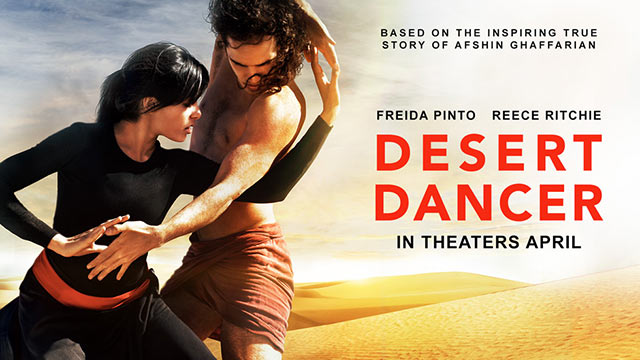
Film review: Desert Dancer (2015)

This article was first published on Muslimah Media Watch.

Source

Six years ago I attended a contemporary dance workshop, and while I’ve been dancing for most of my life, what struck me most was one improvisation that involved dancing as if you were the furniture in your room. When we had come up with a sequence of movements representing various wardrobes, nightstands, mirrors, beds and tables, we had to then dance it while interpreting the concept of fear.

I was thinking about this workshop as I watched Desert Dancer (2015) by Richard Raymond. The film is partly based on the life story of Iranian exile Afshin Ghaffarian (played by Reece Ritchie), who is wanted by the Basijor morality police in his homeland for organising a (forbidden) dance company and an (even more forbidden) performance in the desert south of Tehran, and filming a protest by the Green Movement during the 2009 contested presidential elections.

The group is made up of a ragtag bunch of students without any experience in dance and Afshin’s plan is for them to learn from Youtube videos, “to take control of our lives” in a place “that’s ours, [with] no rules.” Eventually, Afshin assumes the identity of one of the student actors travelling to Paris to perform a play and is granted asylum by the French government.

The first thing that I remark is the choice and use of English in the film, along with a range of accents by the various non-Iranian actors. Most of the main characters are played by actors from the UK, India, Malta, with one from Morocco (Mourad Zaoui) and another from Palestine (Makram Khoury). I’m not sure if they were coached to imitate Iranian accents, but the dialogue seems stilted and unnatural. The one Iranian actress that plays Afshin’s mother (Nazanian Boniadi) only appears in a brief scene. In an interview with The Guardian, she rightly points out how financing drives casting:
“They struggled to make the film [Desert Dancer] because it was about brown people, if we’re being literal. It’s hard to get a film that’s about kids in Iran and led by Reece Ritchie and Freida Pinto financed.”
I think that casting Iranian actors in Iranian roles is important, not only to raise the profile of actors who would normally not be able to gain top billing in bigger films but to also educate viewers on certain aspects of Iranian culture that is more easily embodied by them without needing extensive research or coaching (eg. mannerisms, accent, expressions, knowledge). In this case, the film becomes another instance of non-Iranians telling stories about Iran. The use of many short takes also gives the impression of rushing through the plot, limiting potential for character development.

“When I dance, I feel free. It’s like no one can take that away, it’s limitless.”

The opening sequences of the film, where Iran is described as “the birthplace of great poetry and the first charter of human rights,” raised my hopes that the film could give a glimpse of a new aspect of the underground Iranian dance scene. The excellent choice of modern dance excerpts shown in the film – including familiar names like Sidi Larbi Cherkaoui, Sylvie Guillem and Jiri Kylian – seems to promise that if all else failed, dance enthusiasts could at least enjoy a well-choreographed dance scene or two.

However, the film doesn’t rise above the simple theme of freedom versus restriction. The young Afshin is invited to an arts centre, where Iranians can listen to Western music, practise on musical instruments, act and dance. As he watches Russian ballet dancer Rudolf Nureyev dance, Afshin’s teacher Mehdi sums up the film perfectly:
“Our country is like two parallel words. On the outside are laws, commandments and sin. Here, we are free.”
The film presents the Iranian Islamic regime as saying you can’t paint, act, play music or dance, so the only way to truly live is to eventually escape to the free West – it’s a tale as old as time. These two opposites are hammered home to the viewer constantly, much more than necessary.

In comparison to the short takes, the film devotes several minutes to Elaheh’s audition, a rehearsal between her and Afshin, their performance in the desert, and Afshin’s confession-solo in Paris. The piece most worth watching is an improvised duet (repeated later in the final desert performance) between Elaheh and Afshin, where they use the palms of their hands to push and pull, and resist and submit to each other’s energies. The desert performance however, is spoiled by the presence of Ardavan (Tim Cullen). His movements lacked finesse and he represented all too clearly a Basij who was out to break up the Elaheh-Afshin dyad representing male and female, yang and yin, modesty and exposure, inner and outer Iran.

What I find interesting about this duet is that it suggests that issues surrounding “inner” Iran should be left to its people to work through by themselves. Having a Basij-like character come and decide how the duet should dance mirrors the actions of regimes or governments who decide how Muslim women should act and dress in order to be proper citizens.

At the end of my dance workshop six years ago, I asked the choreographer why he made us come up with movements imitating furniture instead of going straight for the concept. He explained that we often have preconceived notions of fear and how it should look in our minds and in our movements. As a result, we would have all been crouching in the corner and giving terrified looks as we used our hands to push away some frightful being – movements that he considered more suited to theatre than the interpretive and allegorical potential of dance. Unfortunately, that is exactly what Afshin’s final solo in Paris entailed: an almost literal re-enactment of having his voice, rights and freedom stifled; and being caught, beaten and nearly shot by the Basij.

“Why dance if no one can see us?”

In the opening scenes, Afshin’s mother (Nazanin Boniadi) pointedly gestures towards a group of Basij standing in a corner, as a gentle warning to him to not dance in public and this teaching point could not be clearer for the viewer: “They say dancing is forbidden. If you’re going to do it, you do it somewhere safe.”

It’s perhaps ironic that the only Iranian actress (who played a “hijab-wearing agent” in the US series Homeland) in a film about Iranians is given so little screentime.

The film brings up an interesting discussion about resistance. Under a restrictive regime, Afshin and his friends resist through secret rehearsals. The process is difficult, scary and sometimes violent. When Elaheh challenges them about the purpose of their rehearsals, they decide to perform in the desert, “where there is no regime, where no one can find us.”

Is performance always the purpose of dance? Is dance worthy or legitimate if no one sees it? In the same vein, do political protests (such as the one by the Iranian students) make a difference if there is no media coverage – especially international coverage?

As a biography of one Iranian dancer against the regime, targeted to a Western audience that may not know much about Iran, Desert Dancer works. But as a story about dance, Iranian art or a critical analysis of freedom and resistance – not so much.

Sunday, February 28, 2016

Book review: Jewels of Allah by Nina Ansary

This article was first published on Muslimah Media Watch.


When I first heard the title of Dr. Nina Ansary’s latest book, Jewels of Allah, on the life of women in Iran, I must admit I had to restrain myself. In general I’m pretty wary about labelling women as two-dimensional objects, whether in a negative (‘lollipops’) or positive (‘pearl in its shell’) way. Ansary explains that the title is “meant to convey that women, who have been ordained as inferior [by hardline conservative factions] are in fact the jewels of the Creator”.

The book promises to tell the “untold story of women in Iran,” and it doesn’t disappoint in some ways. The first chapter begins with a determined tracing through centuries of history aiming to correct misconceptions about the popular narratives about women’s lives in Iran over the last 40 years. The popular narrative, according to Ansary, is one that creates a dichotomy between the free/modern/active/miniskirt-wearing Iranian woman during the Pahlavi monarchy and the gender-segregated/restricted/veiled Iranian woman in post-1979 Islamic Revolution Iran under Ayatollah Khomeini.

I feel optimistic when Ansary writes, “The real story is usually much more complicated, nuanced and less tidy.” These are the misconceptions she addresses in her book (one point per chapter):
  1. Before the Pahlavi monarchy, Persian women were always suppressed by the religious and political establishment.
  2. Iranian women didn’t advocate for their freedom until recently.
  3. During the Pahlavi era, all women were liberated.
  4. During the Khomeini era, women were totally oppressed.
  5. There is a lack of common ground between secular and religious women in Iran.
  6. There is not much of a women’s movement in modern-day Iran.

Chapter 2 looks at Ancient Persia and the then prevailing religion of Zoroastrianism, which she describes as egalitarian and progressive. Then, the 7th century Arab invasion and the “eventual infusion of Islamic values” into Persian society results in the loss of women’s equal status with men and their social separation, loss of educational opportunities. In the chapter, one hadith about women’s “brains [being] incapable of retaining knowledge” is quoted as if it were a widespread Islamic belief. Next, the chapter argues that women were granted a brief respite from oppression under the Iranian and Turkic dynasties from 9th to 13th centuries. However, the Safavid dynasty brought back the patriarchy, packaged in conservative Shia doctrine and persisting to this day.

Chapter 3 and 4 look at the nuances (as promised!) behind the Pahlavi and Khomeini eras. She argues that (conservative) rural women were not empowered under Pahlavi because their families kept them at home from school, while under Khomeini, a “failed gender ideology” resulted in women being empowered through education, despite legal and social efforts to oppress them. Chapter 4 contains a few rather extensive analyses of gender roles in elementary school textbooks, which read like standalone research essays.

Chapter 5, 6 and 7 look at the ups and downs of alliances between secular and religious feminists by tracing the development of various feminist publications and magazines.

The good

In the epilogue, Ansary highlights about 100 historical and contemporary Iranian women, over centuries, who espoused the feminist ideology of their times (these were previously posted on her Facebook page from March 2014 to May 2015). These women include scientists, artists, professionals and even a Paralympic athlete; this incredible collection is great for showing that Iranian women are not oppressed, have done many amazing things, and come from all walks of life – in short, they’re real people.

I also liked that she started the book with a story of her two grandmothers. Bringing in the personal helps give more context and motivation for why she wrote the book, something that authors should but rarely do.

Chapter 5 also includes a great explanation of Islamic feminism, and how religious and secular feminists in Iran work within a religious framework to advocate for women’s rights. A list of “Iran’s Islamic feminist movement” includes professor Dr. Jamileh Kadivar, journalist Parvin Ardalan, human rights activist Mehrangiz Kar, Nobel Laureate Shirin Ebadi and founder of Zanan magazine Shahla Sherkat. Other scholars mentioned include Nayereh Tohidi, Afsaneh Najmabadi, Haleh Afshar, Valentine Moghadam and Ziba Mir-Hosseini. A selection of quotes from these women indicates that they differentiate Islam as a religion from interpretation of Islamic laws and regulations – a point which is not so clear in the rest of the book.

The bad
One problem is the romanticisation of history and, in particular, of Zoroastrian culture as being a gender utopia. Further, the framing of the Arab invasion and Safavid dynasty as being severely gender unequal serves to frame the empires in between as seemingly more egalitarian. In reality, analyses of these periods deserve just as much nuance (based on other intersectionalities such as sex, race/tribe, class) given to the Pahlavi and Khomeini eras. While there were certainly female leaders and commanders in Persian cities and states in 6th century BC, what class of women could reach these ranks? Most probably educated women of noble lineage.

Walter Benjamin wrote in On the Concept of History (1940) about a painting called Angelus Novus by Klee. The painting teaches us that our view of history as a sequence of events only serves to justify a certain narrative.

“Where we see the appearance of a chain of events, he sees one single catastrophe, which unceasingly piles rubble on top of rubble and hurls it before his feet (…) The storm drives him irresistibly into the future, to which his back is turned, while the rubble-heap before him grows sky-high. That which we call progress, is this storm.”

Furthermore, there were other problematic themes that kept popping up throughout the book. One was the framing of women who ‘veil’ as being conservative and those who don’t veil as being free. One of the first notable women Ansary features in her book is Sadiqeh Dowlatabadi (1882-1961), “one of the most distinguished advocates for female education” (p.28). She reportedly said on her deathbed: “I will never forgive anyone who visits my grave veiled”. This quote is not explained or given any further context or nuance, leaving the reader to conclude that veiling can only be an unfeminist and unempowered act. (In her epilogue she also features Masih Alinejad, creator of My Stealth Freedom Facebook page for women to post photos of themselves without a headscarf.)

Compare this to a description of ‘Rejected Princess’ Naziq al-Abid, Syria’s first female general in history, and for whom going veil-less was also a big part of her life.

“She’s seen here ripping off a veil, since going veil-less was a big part of her life. Not that there’s anything wrong with choosing to wear a veil — she just didn’t have that choice for the most part, although she wanted it badly.”

The conspicuous lack of context is odd, as Ansary seems aware that there is more symbolism to the veil than the oppression-freedom dichotomy. The book shows that she is aware that there are other bigger factors that determine a women’s empowerment, such as laws and educational opportunities. This is evident in how she describes Khomeini’s ‘Islamic Government’:

“a misogynistic regimen […] embedded in a constitution reinforcing the primacy of the Sharia (Islamic law) over civil law and the absolute leadership of a Shiite jurist over popular sovereignty.” (p.200)

So it is puzzling why she does not give more nuance where it is so crucially needed.

This lack of linkage to larger political factors and global processes can result in readers making problematic conclusions. Gina B Nahai, in her review of the book, laments the lack of a “satisfying explanation” as to why “an estimated million women actively took part in the overthrow of the Shah and the return of the ayatollahs to Iran”. Nahai ends up blaming Islam as a monolithic patriarchal force, and Allah as a patriarchal god, for the problems of Iranian women. (Perhaps she didn’t read the final chapters where religious and secular Iranian women show how they are able to articulate gender equality in laws within an Islamic framework, through an ideology otherwise known as Islamic feminism.).

The final chapter also comes to an odd conclusion as to how women in Iran can achieve equality. It mainly argues for a reform of Islam based on “theological reform in Western nations”, based on the work of German priest Martin Luther and Friedrich Nietzsche. There is no mention at all of Islamic laws in other countries that do not have the same outcomes as Iran. Even a cursory look at other Muslim majority countries such as Tunisia or Indonesia could show how gender equality is not solely determined by laws or religion, but also other factors like increased employment or improvement in standards of living.

A public relations sheet that came with the book highlighted some publications and organisations that have featured her book. One organisation that stood out was The Clarion Project, which has infamously produced several Islamophobic films, the most recent being Honor Diaries. This rightwing organisation aims to “challenge extremism”, but in reality it provides a simplistic view of ‘Muslim extremism’ in order to perpetuate a cruel and oppressive image of an all-monolithic Islam. 

Despite this, in her interview with The Clarion Project, I think Ansary has bravely attempted to include some nuance about Iran’s gender inequality, highlighting that the West has its own gender inequality issues too.

Final thoughts

The language in Ansary’s book is easy to read, but it is held back by its pace. I felt like I was reading different essays cobbled together: some delving into too much detail in some topics (analysis of elementary textbooks) and some skimming over topics that needed more analysis (tracing of feminist alliances, Muslim reformers from within).

Most importantly, when I finished the book, I realised that state-sponsored terror existed under both Pahlavi/free and Khomeini/oppressed regimes. Not many readers may know that under Pahlavi, police beat up veiled women and forcibly removed their veils. Today, the basij or religious police do the same to women who are ‘improperly’ veiled. It’s an authoritarian state that imposes a regime on its people that creates oppression, not religion or a veil.

While Ansary extensively looks at the actions of the Iranian state (censorship of feminist magazines, changing of laws, the overall impression that her book gives is that patriarchy/male supremacy/culture/religion is to blame for the oppressive and misogynist laws in Iran’s history. I think she could have done a better job in differentiating Islam as a belief system from Islam as a set of legal interpretations that vary across time and space. Similarly, I think Ansary should have clearly explained that there are a multitude of meanings behind a veil or hijab; that women may wear it for many reasons that are not immediately visible from the outside.

This book may be useful to those looking for historical references and a simple discussion of Iran’s political environment; however, the book can be heavily critiqued from various feminist perspectives and is a limited contribution to the work of Islamic and Muslim feminists.