Pages

Showing posts with label singapore. Show all posts

Wednesday, January 24, 2024

Re-thinking Disability in Islam

This article was first published on Jan 10, 2020, in Beyond The Hijab.

My sister, Syiqah, gets around on a wheelchair. As kids, we used to attend weekend madrasah classes in a mosque. Every Sunday, we gathered two or three young men to carry her wheelchair down three big steps to the classrooms, before rearranging the wall panels to let her into the classroom. This process was reversed after class. Many thanks to these young men, but sometimes I wished that we didn’t have to make such a grand entrance into class every week.

I often wonder though, how the people who worked at the mosque and madrasah viewed my sister. To start with, I will look at discourses and examples of how people with disabilities (PWDs) have been represented in Islamic theory and practice, both in history and in the contemporary period. I then turn to the Qur’an to come up with a nuanced interpretation of disability. Finally, I will build on some of Syiqah’s experiences to provide insights and suggestions on how to embrace PWDs in our communities.

Islamic discourses on disability

One of the dominant discourses in mainstream Islam is that PWDs are “special” or closer to God as they have no capacity to do wrong. This logic states that they will always remain innocent, child-like, and cannot be accountable for their actions. However, this discourse should differentiate physical from intellectual disabilities, since accountability requires mental capacity.

Another discourse is that they are “imperfect”, but this is also similar to being “special”. This logic states that there is a perfect model of a human body, created by Allah, and a disability is thus a deviation from the norm. It may also imply that when someone is deprived of a certain ability, they may have other, different abilities as compensation. For example, someone who is visually impaired may have more sensitive hearing. 

In the Malay archipelago, there are several well-known dua related to children. This supplication found in Surah Ali-Imran [1] stands out: 

At that, Zakariya called upon his Lord, saying, "My Lord, grant me from Yourself a good offspring. Indeed, You are the Hearer of supplication." (Qur’an, 3:38)

This verse describes Prophet Zakaria’s supplication God for offspring that is tayyib (good, righteous, or pure). Tayyib is used in the Qur’an to describe land (34:15), Paradise dwellings (61:12), food (2:57), properties (4:2), upright men and upright women (24:26), as well as an abstract concept that is the opposite of evil (3:179, 5:100). 

However, in Malay translations of this verse, tayyib is often translated and explained as sempurna (perfect or complete) or tidak cacat (not imperfect). Muslim parents-to-be may also be taught a dua asking God for protection from Shaitan harming one’s baby. This logic implies that foetuses or newborns with a defect or disability are the result of Shaitan’s influence. [2]

In many cultures, mental illnesses are likely to be viewed as supernatural possession by jinn. It remains a controversial topic among Muslims globally. PWDs with mental illness or intellectual disabilities may have grown up being exempted from fasting, prayer, or going to the mosque because in mainstream jurisprudence, ‘aql or a rational state of mind is required for acts of worship to be valid.

Although PWDs are not actively discouraged from taking part in communal Muslim life, physical barriers often stop them from doing so. In Singapore, mosques (as any other building) built after 1990 must be made fully accessible, while older mosques are being renovated to include lifts and ramps. Despite these improvements, some mosques in older or historic neighbourhoods remain inaccessible. Sometimes, having lifts may also reinforce segregation of prayer spaces, delegating entire levels to women and children, when it could have been more flexible before, due to the need to accommodate different circumstances.

Organisations that work on providing religious access have varying degrees of success, depending on their country’s levels of infrastructure and awareness. For example, Al Fitrah Foundation, a Malaysian non-profit organisation for visually impaired Muslims runs a Braille Quran Initiative, [3] but it relies on small-scale private donations. However, in countries with more developed infrastructure for the disabled, organisations like Kitaba (United Kingdom) and Dirasa (Norway, Denmark, Sweden) have been producing and teaching in Braille and audio, as well as even organising assisted umrah trips. [4]

Malay Islamic discourses blend different ideas from various Islamic cultures when it comes to the perception of PWDs, their characteristics and life purposes. A look at mainstream Islamic history helps us to enlarge our perspective on this topic.

Stories of disabilities in Islamic history

Julaybib was one of the Ansar, the first community of Muslims surrounding the Prophet Muhammad in Madinah. The name Julaybib means “small-grown”, suggesting that perhaps he had dwarfism. He was also described as being damim (“ugly” or “deformed”). His most serious limitation was that his parents or lineage was not known, since he could not expect any support or protection in a society that heavily stressed family and tribal connections. 

Julaybib was ridiculed and shunned to the point of being prohibited by a certain Abu Barzah of the Aslam tribe, from entering his home. However, the Prophet being aware of Julaybib’s needs and sensibilities went to one of the Ansar and suggested that his daughter marry Julaybib. While her parents protested, the Ansari girl trusted the Prophet’s decision-making process and married Julaybib. She is lauded by scholars for having ‘readily agreed to be the wife of a physically unattractive man’. [6] However, the reverse – encouraging able-bodied men to marry Muslim women with disabilities – rarely happens as reproduction heavily stressed in marriage. 

Historically, there was even a religious position which favoured those with visual impairment. In Egypt, before the advent of loudspeakers in the 1950s, such men were deliberately employed as mu’azzin to give the call to prayer from the minarets. Their disability was an advantage: they preserve the privacy of surrounding houses as they cannot look into these courtyards. Could it be possible that since no one reaches out to engage PWDs, today’s mosques may have overlooked accessibility in not just designing but organising their spaces?

As the acceptance of PWDs in practice is fluid and changes across time and space, it is always useful to go back to our basic source of divine knowledge.

Disability in the Qur’an

The Qur’an gives us a comprehensive and nuanced understanding of disability. The general reference is al-darari (4:95), translated as ‘disabled’. Coming from the root d-r-r (ض ر ر), it can connote ‘harm’ or ‘suffering’. Humans can suffer or be harmed, but this only occurs with God’s permission. [6] The actions of shaitan, hypocrites, disbelievers, or disobedient believers (e.g. use of black magic) cannot harm us (2:102). This already counters the common idea that mental illnesses and associated disabilities are the cause of jinn possession or black magic.

The form ud’turra means ‘force’ or ‘compulsion’. Doing something forbidden by force or by necessity has no sin. [7] Another form, darraa, which connotes ‘affliction’, ‘hardship’ or ‘adversity’, is also a kind of compulsion because it comes from God and it not under our direct control. 

And [mention] Ayyub, when he called to his Lord, "Indeed, adversity has touched me, and you are the Most Merciful of the merciful." (Qur’an, 21:83)

Prophet Ayyub acknowledges that his adversity, which included a painful physical disability, comes from God and that only God can remove them. [8] The Qur’an reminds us that everyone will experience hardship and ease, it’s only whether we realise it or not (7:95). Times of hardship are meant for us to remember and call on God (10:12, 16:53, 30:33, 39:8) and be patient (2:177) because it is just a trial (2:214, 39:49) aimed to humble us (6:42, 7:94). God only gives us what we can handle, and even provides supplications for us (2:286).

Taking all these nuanced meanings into account, al-darari (4:95) can be considered a person who has been has either been hurt, harmed, or born with a disability. These may be considered adversity or hardship because society generally caters to the able-bodied and the neurotypical. However, they are certainly not forbidden or necessarily exempted from striving in the way of God, as shown by the historical example of Julaybib: in a battle he managed to kill several before dying, which so moved the Prophet that he prepared Julaybib’s grave himself.

My sister

My sister has a genetic condition called spinal muscular atrophy. This is a group of inherited diseases that cause muscle damage and weakness, which worsen over time. This condition was also only recognised in medical texts in the last 20 years, so when she was younger, my family went to different people to try and find a cure. I remember a bomoh, or a traditional healer, performing rituals combined with Qur’anic recitations in my home. At the same time, she went for physiotherapy sessions.

My parents used to exempt her from fasting or praying, saying that she didn’t have to. However, as she got older, she became more interested in attending seminars, conferences and additional classes on Islam. We did start attending one class together in a mosque, but stopped going when we realised that the bus was not accessible.

My sister wears the hijab because she believes that is part of being a good Muslim. She once told me that she would like to get married and have a family someday, but she realises that her disability does stand in the way of how men perceive her.

Most importantly, she says she does not feel disabled because she was born with her disability. To her, asking if she would like to walk is like asking if we would like to fly. She has been able to excel in her studies, her work, her sport, and the various languages she learned along the way. She works and supports our family, travels independently, and has a thriving social life – pretty much what most of us want anyway.

Rethinking disability

PWDs are not a homogenous group: family support and financial ability to provide caregiving and transport matters. Physical and intellectual disabilities must be differentiated, and yet, many PWDs are eager for a sense of community, too.

The low visibility of Muslims with disabilities is probably because of the predominant ideas about them and their spiritual capabilities. Hence, there is still a dearth of critical conversations around disability. For example, would a Muslim using a guide dog be allowed in religious spaces?

Saying that all Muslims with disabilities are ‘special’ and do not need to fulfil religious obligations is counterproductive for inclusion. Even as it helps Muslims with disabilities connect, the widespread availability of Islamic knowledge, seminars, sermons, and even Friday prayers online should not prevent mosques and religious spaces from being fully accessible with ramps, lifts, railings, larger toilets and ablution areas, Braille Qur’an, or television screens to visualise the khutbah.

… "[A]dversity has touched us and our family, and we have come with goods poor in quality, but give us full measure and be charitable to us. Indeed, Allah rewards the charitable." (Qur’an, 12:88)

If a Muslim with a disability expresses their wish and interest to participate in a Muslim community, it becomes our duty to make things easier for them. A masjid should be a refuge, and not a place that causes divisions (9:107). 

Ultimately, the empathy we cultivate for Muslims with disabilities should extend to empathy towards other marginalised Muslims. Let’s make sure we are not overlooking an integral part of our community.

Notes

[1] This article uses the Sahih International translation of the Qur’an, available at www.quran.com.

[2] http://www.informasikini.com/petanda-gangguan-syaitan/

[3] http://www.alfitrah.net/braille

[4] http://www.kitaba.org/?s=umrah

[5] http://theclearsunnah.wordpress.com/2008/07/30/the-story-of-julaybib/

[6] Qur’an (5:76, 6:71, 10:18, 10:106, 13:16, 20:89, 21:66, 22:12, 25:3, 25:55, 26:73, 34:42, 48:11)

[7] Qur’an (2:173, 5:3, 6:119, 6:145, 16:115)

[8] Qur’an (10:12, 10:107, 17:56, 21:84, 36:23, 39:38)


Sunday, July 30, 2017

Taking a stand against domestic violence? Good. Pretending religious justifications don't exist? Not so good.


Firstly, great that MUIS is actually taking a stand, detailing the different forms of abuse, and stating that divorce is a logical solution to a crappy situation.

Because you know, there is no vendor of Muslim pre-marriage counselling that does. All of them dance around verse 4:34 in the Qur'an, never contesting the hegemonic interpretation and translation of 'daraba'.

They tell you that husbands have the right to discipline their wives, but then embarrassingly temper this obviously vile right with concessions that it can only be done 'lightly', with a miswak twig or a hanky, and with only the intention to 'humiliate' (as if physical abuse > psychological abuse).

And what about all the highly respected ustaz who beat their wives and say it is in the name of Islam? What about all the wives who kept silent because others told them they had to sabr as their husbands knew best? 

It is not 'most disappointing' that abusers use religion to justify abuse, it actually makes sense. Because there is plenty of 'evidence' they can use to justify it.

Emotional abuse in the form of policing of women's behaviour can be justified by appointing men as the head of households and being responsible for the sins of their wives and children. 

Abuse in the form of directly or indirectly coercing women to carry the bulk of household chores (or hiring a Third World woman to do it, while she leaves her own children behind) can be justified by the teaching that she is the 'shepherd of the home' while the man is the 'shepherd of the family'. 

Erasing marital rape can be justified by a hadith about angels cursing a woman till dawn if she doesn't have sex with her husband whenever he wants it.

What about the counsellors at our Syariah Court who indirectly but consistently shame and stigmatise people who seek a divorce? Just because their partners or themselves don't 'womanise, drink, or gamble' it is merely a case of 'differing expectations' and that they can definitely get along?

I'm pretty sure the Prophet was not 'bewildered', he was ashamed when he knew men were beating their wives.

So you can't just erase the entire cultural archive of how Islamic teachings can be used to justify domestic violence by saying 'Islam has never condoned domestic violence'. Are all these merely 'small pockets' when they are taught by our religious leaders themselves? 

Or am I actually talking about another religion?

Thursday, May 12, 2016

When transphobia blocks justice for survivors of sexual violence

Trigger Warning: This post contains discussion of underage rape and of transphobia


Four months ago, the Singaporean newspaper The Straits Times ran a few articles on a case involving Malay Muslim transgender man Zunika Ahmad, 39. He had been charged with 20 counts of sexually penetrating a girl, a minor who was between the age of 13 and 14 at the time of the offenses between April 2012 and December 2013, with a dildo.

Last week, the same newspaper ran several more articles to update on the decision of the High Court. High Court Senior Judge Kan Ting Chiu, acquitted Zunika of six charges (although Zunika was convicted of one charge of sexual exploitation and sentenced to eight months’ jail). The judge said that Section 376A of the Penal Code implies that only a person with a penis (i.e a man) can be guilty of sexual penetration: “The reference to a person who has a penis cannot be construed to include a woman without doing violence to common sense and anatomy.”

What’s interesting about this case is that while the offender is a man and should be considered as one, the sex he was assigned at birth was used to erase his sexual offenses.

Earlier coverage of the story in December 2015 spoke of Zunika as a person with “gender dysphoria” and describes a transgendered man as someone “who was born a woman but identifies as male“. The newspaper’s representation of Zunika as a trans person is mixed; it uses the wrong pronouns throughout, but in other ways it could even be considered sympathetic: Zunika felt “betrayed by her [sic] own body” when he entered puberty.

Not being able to express his gender identity is portrayed as a source of mental distress (“When her mother forbade her from going for a sex change operation, she cut her forearms […]”). Zunika was expected to be able to go for sex reassignment surgery and “rebuild” his life.

While a medical diagnosis of ‘gender dysphoria’ suggests that this condition is something innate and fixed, words and phrases used in the newspaper’s language, such as “bogus persona“, “disguised as man“, “fooled” and “her real gender” imply that transgendered people are also deceptive and manipulative. Furthermore, the pronouns ‘she’ and ‘her’ are used consistently throughout all articles – even if the term “transgender man” is used – to further emphasise that transgendered men are actually still women.

What is the purpose of law when it cannot bring about justice?

There is also a tone of incredulity at any type of marriage that is out of the heteropatriarchal norm. This is shown by the putting in apostrophes the words “married”, “husband” and “wives”. Such marriages cannot possibly be real or recognised because they do not involve the union of two people of opposite biological sexes.

The most important issue at hand, however, is the sexual exploitation of a minor. The first article describes the sex as “consensual” even though the victim was below 16 years old, the age of consent in Singapore. The purpose behind legal ages of consent is to protect minors, who are presumed to not be able to give informed consent due to unequal relations of power. Sex with a minor under 16 is an offence with or without the minor’s consent, let alone a 13- or 14-year-old having sex with someone more than 20 years older.

More disturbing perhaps is the squabbling over legal definitions (i.e. sexual offender must be a man, must have penis, etc) over the actual application of the law to derive justice (protecting a victim who was a minor at the time of the crime).

“If a court were to interpret A to include a woman, it would be rewriting the law, said [High Court Senior Judge Kan Ting Chiu]. [He] said the ‘better course’ was to leave it to the legislature to amend the provision to make it clear that A includes a woman, if that was indeed the intention.”

While the subject of this analysis is a Muslim transgender man, the insistence of the media on framing him as a woman raises several interesting points.

First, representing transgendered persons in the media only in relation to sexual offenses serves to strengthen the link between being a sexual minority and a moral deviant. In this case, Zunika not only committed the moral crime of deception, but also adultery (“cheats on wives“), paedophilia and deviant sex acts (“using sex toy“) in addition to a whole list of other charges.

“Besides the sexual offences, Zunika is also accused of four counts of using a forged Indonesian passport at Singapore checkpoints, and one count each of voluntarily causing hurt and permitting a false entry to be made at the registry of births and deaths. She will be dealt with on these charges separately.”

Second, we should be vigilant of the use of religion to provide a cover for sexual abuse. The victim, known as R, said: “My family trusted her because she has her own family and seemed very religious. She taught me and my siblings how to pray and made me wear a hijab.” Apparently Zunika also wore an “ankle-length robe and turban during religious occasions,” Arabised items of clothing that give the wearer more religious legitimacy.

Third, we need to be aware of the history of laws. The Penal Code was enacted in the late 19th century in British colonies, based on British law and understandings of society at that time. While British law today may have evolved through amendments, many former colonies remain with fossilised versions of colonial-era law that limit sexual offenses to sexual penetration with a human penis, for example.

As a mirror to Section 376A, the Penal Code also does not recognise men or boys as victims of rape, since Section 375 of the Penal Code states that a victim of rape must have a vagina. This eliminates many other types of sexual offenses that may not involve penetration, or that may involve the violent use of other objects.

Ultimately, such laws fail to protect the underage victim, whether it is a boy or girl. And what is the purpose of law when it cannot bring about justice?

Wednesday, May 11, 2016

"Do you work here?"

Institutional racism means that when you are Brown, you're taken to be a low-wage worker. Not that you might want or desire such a job, but that these are the opportunities open to you.

Institutional racism means that when you're in a clothing store, some White people will assume that you work there. You might be holding a few pieces of clothing over your arm, as you look through the shelves and racks. These are not things that you're browsing for and that you can afford to buy, but items that were already tried on or misplaced and it's your $5-per-hour job to fold and put them back.

Institutional racism means that when you are seeking something more beyond the 9-to-5 grind, some Rich people assume that you're unemployed and would be grateful for any job offered to you. You may have been privileged enough to get a degree, but educational qualifications are invisible. A rich person may look at your skin colour, and the skin colour of their loyal chauffeur and secretary, and offer you those jobs. These are not jobs you are necessarily interested in, but you are supposed to be grateful that you were offered them at all.

Institutional racism means that when you send out dozens of resumes with your Arabic-sounding Malay name, some White people will offer you a secretarial or administrative job, if it's not a cleaning job. Some White people will offer you unpaid internships. Some Rich people will, during your interview, tell you that they are glad you are not wearing hijab, because women that wear hijab "think differently". Institutional racism means that when you hyphenate your father's name to your husband's Dutch family name, you get an interview and you are assumed to be of mixed parentage.

Institutional racism means that when you find yourself too close to a person who has more privilege, other people might mistake you as the domestic worker of the person you are helping. You might be just offering a wet wipe to a Chinese woman who fell down, or helping a wheelchair-user buy something or get somewhere.

Institutional racism means that when you're doing anything resembling manual labour, some Chinese people will assume that you are the cleaner of the premises humbly doing your job. You might be moving boxes and equipment because you train with athletes in this hall everyday. It's your last day in this place and you have to pack everything to be picked up the next day. You know the Malay pakciks and Indian aunties that set up and put away sports equipment and furniture in this hall. Institutional racism means that a Chinese person may see you as just another Brown menial worker.

So the first thing he asks you is, "Do you work here?"

Monday, April 25, 2016

Calling the shots in life with wheelchair basketball

This article was first posted on AbleThrive.


Singaporean para­athlete Emilio Choo, 34, came into contact with wheelchair basketball through something completely unrelated: learning how to drive a hand­controlled car.

During a driving lesson at Handicaps Welfare Association, the person in­charge of wheelchair basketball noticed that Emilio was still “young and mobile”, and told him he was suitable for the sport. He had always been a fan of team sports, playing soccer and basketball long before a spinal injury 14 years ago left him paralysed from the waist down. “A team complements each other. You can be good at something but no one is perfect. A team can cover your shortfalls,” he said.


But he didn’t think that he would be able to continue playing sports – or achieve anything significant – after his injury. “To be independent is a big enough accomplishment. For a year I even thought, that’s the end of it and I would be bedridden for life. But to be out here and doing something [at] the ASEAN Para Games [in December 2015]… I never thought I would be able to represent the nation in any way at all.”

Being active can mean different things for different people. For some, it can be a way to meet new people. For others, it’s a way to improve their health – both physically and mentally. For people with disabilities, sports can also serve as a way to empower themselves. Emilio thinks that trying a new sport encourages people with disabilities to get out of their physical and mental comfort zones.

“I know it’s tough initially – I went through it – there’s no need to rush. But I really think sports and interaction can help you overcome all challenges. Even if you have a family that’s encouraging and providing you with help, there’s nothing better than being independent. By coming out and meeting people in similar situations, you can gain the confidence to improve your life.”

Although Emilio went through a bout of depression after his injury, he feels his mental health improved greatly with the help of his teammates. “Hanging around with them helped me a lot because they went through the same things and had good advice for me. They also made me feel that there’s nothing wrong with being in a wheelchair. We joke about it, we say things like ‘why your hands so short’ and ‘jelly legs’. We laugh at each other. Those kind of things help you accept who you are.”


Since becoming a wheelchair athlete, Emilio has had his fair share of physical and psychological challenges. For example, he has had to shift his perceptions of fitness. While as an able­-bodied athlete, he was more concerned with stamina, his priorities now are his upper body strength and balance.

“In the past, I was tall. So it was easier for me to play basketball. I didn’t even need to jump, I just had to lift slightly and I was taller than everyone else. But now I have to learn to do things differently. For me, because of my disability I don’t have much balance on the chair. I have to learn to shoot from a wheelchair and to get my balance, [I have] to strap myself down.”

His favourite part of being on a team is being able to build on the strength of others and to know that he can always count on their support. Each player has a specific role to play to the best of their abilities, which enables them to support one another on and off the court.“At the ASEAN Para Games, even though I took most of the shots, I would not have been able to do so without my teammates. They gave me good positions, and gave me the ball to shoot.”

As for the value of sports in his life, Emilio counts “a fighting spirit” as the best dividend from investing himself in wheelchair basketball. “Even when the odds are down, don’t give up. Like life, you have to try and try. You cannot get things right from the start, so you have to practise to get the perfect shot.” Vulnerability in teamwork is another valuable lesson he has learned: “You need help in team sports, you cannot do it all on your own. You don’t have to.”

Emilio is predictably wistful about the importance of his team in his life. “My teammates, I have been playing with them for 13 years. They are [not only] my teammates, but also my mentors. They taught me a lot in life.” For him, basketball isn’t just an opportunity to regain physical, but also emotional strength. It has been a way to regain his independence and self­-confidence to call his own shots in life. “Someone told me this: you might miss a shot if you’re not good. But if you don’t even try to make a shot it will never even get in.”

If you’re a newcomer or beginner to wheelchair basketball, but curious and game for an aggressive sport and working as a team, contact us and we’ll put you in touch. (Don’t worry, you won’t be pressured into joining the team!)

“Be daring, don’t be afraid. If you keep trying, we’ll support each other.”

Check out this YouTube video of Emilio explaining why he loves wheelchair basketball, and watch him take a shot!


Saturday, April 23, 2016

Does religion trump race? Yes, at least in Singapore.


One of the biggest problems that Muslim women face today is the need to deconstruct and reconstruct narratives of ourselves in the media. (That’s why Muslimah Media Watch exists, amirite?) A recent interview of Professor Jackie Ying, a Chinese Muslim scientist in Singapore, by a Singaporean Malay language news channel shows that this need can exist just as painfully among Muslims themselves.

50-year-old Professor Ying is presently the Executive Director of the Institute of Bioengineering and Nanotechnology in Singapore. Born in Taiwan, she came to Singapore at the age of seven to complete her primary and secondary school education. At the age of 15 her family moved to New York, and she attended high school and The Cooper Union to complete a bachelor’s degree in chemical engineering. Afterwards, she obtained her MA and PhD from Princeton University. In 2001, she became one of the youngest full professors at the Massachusetts Institute of Technology (MIT).

The interview was brought to my attention through a blogpost by Singaporean blogger Zaihan, in which he highlighted the problematic ‘entanglement’ of race and religion. (The blog was last accessed on 26 Feb 2016 and seems to be currently unavailable.)
“Due to her choice of converting to Islam about 15 years ago, Professor Ying is somehow now seen as a representative of the Malay/Muslim community. She was asked to comment on issues that this group faces; on how she would change or improve interest in the sciences amongst the youth of the demographic, for example. She was even prodded to share the “kemelayuan”—Malayness, in short—that she sees in herself. It’s so strange because she is Muslim, but not Malay. She was not quite able to answer so many of these queries levelled at her, because she had not lived as a Malay (…)”
In Singapore, just like in Malaysia, ethnicity and religion are deeply intertwined. To be a Malay often means to be Muslim, and Muslim converts are usually expected to adopt Malay practices. Elsewhere in MMW I wrote that “these two terms [Malay and Muslim] are often used interchangeably.” One problem with this false equivalence of terms is that it erases the experiences of Muslims of other ethnicities, like Professor Ying herself. However, this is something that is sometimes reinforced by the ehnic group itself, in this particular case, the Malay community, as highlighted by blogger Zaihan:
“The blatant manner that Berita Harian and local Malay news programmes claim her amazing achievements (she is truly prolific and well-decorated) as a Malay-Muslim point of pride—simply by virtue of her holding the same faith as their target readers—is not only very silly but also insulting to her journey.”
The other problem with equating Malays and Muslims is the discursive erasure of Malays of other religions, even though they make up a very small percentage of the population. One’s religious identity takes precedence over any other identities.

In the half-hour clip, the interviewer asks several questions that assume that Professor Ying somehow would understand what it means to be Malay, just because she converted to Islam. The interviewer poses these questions:
  1. What is the reason behind the low numbers of Malay Muslims participating in science and research?
  2. What more can the Malay Muslim community do to encourage, ensure and produce a group of science practitioners?
  3. Do you see any Malay Muslims [in your institute] who have the potential to be [a Nobel Prize winner]?
Professor Ying works with the local Malay/Muslim community through Yayasan Mendaki, a “self-help” semi-governmental organisation. She mentors young Muslims interested in science by giving them the opportunity of working on research projects in her laboratory. While she could not answer these questions from the perspective of a Malay, she did have insights from the perspective of an educator.

She highlighted the shortcomings of science education, and she said,”I think it’s the same problem for everybody. Students learn science as a fairly dry subject.” Furthermore, she spoke about the emphasis on exams and early streaming, “Doing well academically is different from being able to do research well in the lab. We have too much of a civil service mindset.”

Even though the interviewer’s questions framed her as having to speak for the Singaporean Malay community by virtue of being Muslim, I think she managed to steer the conversation away to – as much as she could – create her own representation. The struggle continues for Muslim women to create their own narratives and resisting those imposed on them.
“I think from being young, we wanted to grow up to be individuals. It was important for me that my parents did not set me in certain pigeonholes. They are very accepting of who I am (…) Of course society is a different story. We have a lot of constraints. But because my parents never set those limitations, I never felt there was something I couldn’t do. I think it’s that: we set our own challenges that makes it possible for us to try different things.”
In Singapore, the conflation of ethnicity and religion erases individual narratives, as Professor Ying highlights here. However, with this interview she has given us an example of how to resist dominant media narratives – an example both media makers and participants can learn from.

Saturday, March 26, 2016

A Chinese convert is "content wherever she finds herself"

This article was first published on Openseam. Iman Wong is a Chinese convert from Singapore. She enjoys reading, brisk walking and listening to oldies. She currently volunteers at Darul Arqam, where she counsels new converts and teaches them about Islam and prayers.

By Iman Wong

It started way back in 1978. I had decided to embraced Islam. It was indeed a very trying and difficult period for me but I survived.

I lived in a kampong area in Geylang and there was a mosque near my home. Every morning I could hear the sounds of adhan I disliked it because it was noisy and interrupted my sleep. I had many different neighbours: Malays, Indians and Chinese. We played and ran around together. All our homes were always open and we only locked our front doors after midnight. It was so safe and so sound...

Then, I was studying in a Roman Catholic school, where all of us went to church, sang hymns and also studied catechism. The British nuns would read from the Bible and tell us stories even though we were non-Catholics. Incidentally, I remembered a handsome British priest who visited our class -- all of us were mesmerised by his big blue eyes. I was not keen or interested in being a Catholic as I did not feel anything when I looked at a statue of Jesus Christ.

My parents were Taoists and they only worshipped ancestors. I was a free thinker and I simply followed what they wanted me to do, like holding joss sticks and cleaning the altar of my late grandfather. Sometimes, I followed my mother to the temple to pray to deities, but I really disliked it. The smoke from the joss sticks and the solemn looks on the deities made me feel very uneasy whenever I visited the temple. For me, worshipping deities are definitely out, because deities are all made by men.

Then, I was aware that there was a God but I did not know how to get to Him. I was like a lost ship floating on the sea.

My dearest father was hardworking but a man of very few words. He was the only breadwinner in my family and when he was stressed out, he drowned his sorrows by drinking! I did not understand him too well as there was no communication between us at all. He was like our ‘commander’ from whom we only took orders. Then, I was rather rebellious, always wanting to do something different from my siblings.

One night, I did some soul searching and wondered if life should be so monotonous – eat, sleep, work, play? I started thinking about the meaning of life and concluded that there must be some superpower that created everything. My head kept pounding.

Who is He and where is He?

Finally, one day my question was answered. A Malay Muslim neighbour gave me a English translation of the Qur’an, written by Mohammed Pickthall. When I finally found some time to take a look, I read the first verse, Al Fatiha. The phrase, "Show us the straight path" (1:5) attracted me. I felt that this was the wake-up call for which I had been searching.

I began to attend classes at Darul Arqam under the late Cikgu Zaini, at Pheng Geck Avenue. He gave me the impression of a father, a respected teacher, and a knowledgeable person. He had a good sense of humour and in other words, a jolly good fellow. And he looked so Chinese too! My first question to him was, “Are you a Chinese?” and he said "No, I look Chinese but I am born Malay."

Of course, my parents didn’t know that I was attending Islamic courses. How would they have reacted! When I decided to convert in 1978, my father was so mad at me and did not speak to me for a year, but my mother was very supportive, alhamdulillah. My eldest sister was strongly against it because she is a Catholic. I embraced Islam without their blessings and I did feel very upset.

My faith fluctuated when I lost my late husband

Fortunately, I met Brother Kamar Lim, whom I greatly respect, and also the late Sister Saibah – both of whom became my mentors. They understood the conflict with my family and gave me a lot of support and encouragement. They said, keep praying and Allah will lighten your burden. I felt so much better after talking to both of them. Brother Kamar Lim asked me to be a council member with Darul Arqam and in short, Darul Arqam became my second home.

After a year, my father started speaking to me. But, he told me that he wanted his future son–in-law to be a Chinese. I was astounded but I had no choice but to take up his challenge! As it turned out, in the same year, I attended a youth camp in Taipei organised by the World Assembly Muslim Youth (WAMY) with another Muslim sister. I was really excited to meet so many Chinese Muslims in Taiwan and, guess what, there I also met my late husband. My late father was so happy that I was marrying a Chinese Muslim and we were blessed with a son, alhamdulillah.

In 1998, my late husband met with a car accident. I realised that death is inevitable. That took me to further understand that life in this world is not forever and that one day, we have to return to God whether we are ready to or not. My faith fluctuated when I lost my late husband but it was a trial that I had to quickly get over for the sake of my only son. I renewed my faith and occupied myself with classes and activities at Darul Arqam. Just like the Chinese saying, ji lai zhi ze an shi. Be content wherever you find yourself.

Time flies. I have embraced Islam for 38 years. Thank God that He blesses me till today. I am imperfect, I still have weakness and flaws in my journey to Islam but my faith keeps me going. New converts? Put your trust in Allah and everything will fall in its place, insha’allah.

Wednesday, March 16, 2016

Leadership and Diversity: An interview with Dr. Ingrid Mattson

This article was first published in Dutch in "Vrouwelijke Leiders" (Female Leaders) Al-Nisa, Islamitisch maandblad voor vrouwen (Islamic monthly for women), 32nd year, No. 3, Mar 2013.

--

Professor Dr. Ingrid Mattson presently serves as Chair of the Islamic Studies Program at the Huron University College of The University of Western Ontario. She was previously the Director of the Macdonald Centre for Islamic Studies and Christian-Muslim Relations at Hartford Seminary in Hartford, Connecticut, where she was the founder of the Islamic Chaplaincy Program – the only accredited program to train Muslim chaplains in the United States. From 2006 to 2010 she served as the President of the Islamic Society of North America (ISNA), after serving two terms as Vice President – being the first woman elected to either position. Dr. Mattson was born in Canada and earned her PhD in Islamic Studies from the University of Chicago in 1999.

Dr. Mattson spoke to Al Nisa during our Symposium “Kent U Mij?” in Theater de Meervaart in Amsterdam on 22 September 2012, in between her keynote speech on conformity and diversity among Muslim women, and a open question-and-answer session with the audience.

Source: Author's own.


What makes a good Muslim leader?

There’s leadership in so many different sectors. The first thing is that leaders have this inability to just let problems remain; they see a need and they need to respond to it, and so they do something. A good leader has the ability to analyse a situation, understand it, assess what resources are available, and then come up with a practical solution.

A good leader is also looking to make themselves replaceable, firstly by working on strengthening the institution in which he or she works (to extent that it’s appropriate and possible) and second, mentoring other people into leadership. Making sure that you have a strong organization that could continue on without you, or that at least has the mechanisms for replacing you, and then personally mentoring or nurturing leaders.
Do you think there’s a gender difference when it comes to leadership?

There are generalisations, and they are not true in all situations. But I do think that women tend to be more consultative. They tend to try to convince people before going ahead, rather than simply making a decision and expecting everyone to go along. And that’s usually good. Although sometimes you do have to be decisive and you need to go ahead even if there isn’t buy-in.

Part of leadership is knowing when to go ahead with a decision that’s within your authority because you’re really convinced it’s the right thing, even if other people don’t understand it at that point. Between that and taking the time to really get buy-in from others, there’s a balance and. I think men tend to be more of one style and women the other, and you don’t want an imbalance between those two.

While you were in ISNA, in which situations did you find yourself having more legitimacy or authority to speak on certain issues?

I think a lot of people felt that the fact that I was in a position to speak for at least my organization ISNA, if not little more broadly for the American Muslim community. I think a lot of people found that beneficial after September 11th, because there was a great need to be able to explain Islam to Americans in terms that they understood. The fact that that’s my environment – I am Western and I’m Muslim – helped me to understand the concerns that were being raised. This helped with communication, which is natural, but it’s simply accidental that I was born in that environment.

However, there is one disturbing aspect to it, because sometimes there is an implied racism. A friend of mine who’s a rabbi and a really a good friend of the Muslim community once said, “Ingrid, it was very good that you were the leader of ISNA when you were, because you’re this small white woman so you’re not frightening in a way that maybe your predecessors were.” My predecessor and my successor were both dark-skinned Sudanese men.

Is a man scarier than a woman? Is a dark-skinned person scarier than a white-skinned person? If you ask any of my students, they will tell you I’m much scarier than either of those two people. I thought that was really terrible; just seeing my face made people comfortable. I think Muslim men of colour are the most despised people now, as their faces are associated with intimidation or violence. That is really, really sad.

How can female scholars achieve the legitimacy that male scholars do, even though they may have studied in the same places?

That’s unfortunate. I think that kind of ignorance about women scholars in our still needs to be corrected. People tend to want to make sure that what they’re getting is authentic. I think the more we learn about our tradition, the more this kind of reaction will be avoided. There’s a lot of information certainly available now about women in the isnad, like Dr. Akram Nadwi’s book Muhaddithat: The Women Scholars in Islam.
But there’s knowledge, and then there’s authority or influence. We have many women who have knowledge but if they’re not recognized by the community or given a position, then people may think that maybe they’re not really that qualified.

I once spoke with Shaykh Faraz Rabbani of Seeker’s Guidance from Canada. In his organization there are many women who have studied in Jordan and have ijazah in different fields of Islamic studies. He was frustrated because not much was being done with the knowledge that these women have. I told him the reality is that until the masjid establishes official positions (whether paid or not) recognizing her as a shaykha or as a religious teacher in the community, people won’t be going to her. Why would they recognize them as authoritative if the leadership of the community doesn’t?

I think these two things are important: knowing our history to break up our inherited assumptions about religious authority, and establishing positions for these women.

So it’s important for knowledgeable women to be affiliated to an organization. But if the current leadership is dominantly male, how does a woman negotiate that?

You have to find advocates. Allah s.w.t. says in the Qur’an that the believing men and women are awliya’ or partners of one another (9:71). Nothing can really happen in the community without partnership. Women need to call on their teachers, or those in positions of leadership who can advocate with them. It can’t always seem like only women are asking about this; this is about building the community together.

There’s always going to be some people who resist it though. Either because they sincerely believe that men should be in authority, or, like all human beings, they don't like to concede or share power with others. Or they’re just ignorant. But I’m sure there are some men who think this is wrong. You need to work in partnership with some men to change this.

Some people can be worked on and others will remain intransigent. Sometimes you can work within the system and sometimes you need to build your own thing while your community lends legitimacy and support.

Speaking of your own thing, I read that you have a dog. There are diverse opinions about it, so how do you deal with holding a minority opinion on an issue?

Well, my opinion comes from one of the fiqh (legal jurisprudence) positions. The majority of fiqh positions consider the saliva of all dogs to be impure, but the Maliki school considers only the saliva of wild dogs to be impure. The Maliki position does not consider domestic dogs to be najis (impurity). There’s strong justification for it in the Maliki school from the argument that the Qur'an allows us to use hunting dogs, and even eating animals caught in their mouths, for example.

So if you’re a Shafi’i or a Hanafi then you’re not going to be able to have a dog, and I’m not going to force anyone else to have one. But certainly, I very deliberately wrote about the Maliki position to raise the issue of the problem of making a religious issue of purity into a taboo, and then even a phobia.

We have a big problem in North America, where we have many Muslim taxi drivers and are also blind and disabled people who use service dogs. These dogs help disabled people to move around in public spaces, but we Muslim cab drivers say things like “Dogs are haraam” and they will refuse to accept them disabled people with service dogs in their cab.

This is just pure ignorance, because it’s not that dogs are haraam, there’s nothing about putting a dog in a car. You’re not required to hate dogs. Your children leave najasa all over, you’re not supposed to hate them right? I think it’s particular to Muslims in the West, although the widespread abuse of animals in Muslim countries is also haraam. We really have to break this overreaction and confusion among Muslims.

Like the issue of dogs, do you think there are other issues that Muslims tend to fixate upon and leaving more urgent issues undebated?

Yes, very clearly. A former student of mine once told me how frustrating it was for her when she was homeless with three children. She was going to the mosque and even though people knew she was homeless, they were not coming to her – she had to come and ask for support. People would say “well we don't have money for that”, yet money was being spent on all sorts of other things – fundraising for Muslims in other countries, or for certain improvements to the new building – when you have a homeless woman in the mosque.

I’m sure there will be people who will come after us and say that we were blind to certain needs. It’s not that any of us are beyond that. We’re all human and we all have limited perspectives, but this is why you need to have wide consultation and a mechanism to include as many voices as possible. The more people you include in the decision-making process, the better chance you have of avoiding at least a gross error in neglecting a true need in the community.

Are you working on any projects right now?

I’m working on a book that’s going to be called, tentatively, The Ethical Muslim. It gives tools for ethical thinking in Islam and provides case studies. I also have a new position in Canada as the new London and Windsor Community Chair in Islamic Studies at Huron University College at the University of Western Ontario in London, Canada. Like how I built that chaplaincy program at Hartford Seminary, I’m going to be looking to see what kind of religious leadership program would be suitable for Canadian Muslims in that environment, inshallah.

That sounds exciting. Finally, any advice for Muslim women who work in the public sphere but who are not visibly Muslim?

Wearing the hijab is just one part of being Muslim. More important is, are you bringing the character, behaviour, values and ethics of a Muslim to your workplace? Every Muslim should know the ethics of their field. If you are doing things correctly according to Islam and the civil law to the best that you can, you could even have an impact on your field, depending on how much authority you have. If you go to work and you’re doing things that contradict Islamic ethics or you don’t even know what the ethics of your field are – that’s problematic.

It can be a touchy subject – you don’t want to make it seem like you’re bringing religion into the workplace, but you should have an attitude of responsiveness. That if people sincerely want information, that you are available to them. It may seem burdensome – why do you have to explain your religion when others don’t – but that’s the world we live in.

Other minority groups have similar problems, so look at it as an opportunity. How many Muslims in the world have no chance to say anything? We are the elite in the Muslim world when it comes to educational opportunity and political freedom, so what kind of responsibilities do we have towards others? I don’t think you can just say you want to be a normal person. There are a lot of normal people (laughs).

That’s all, thank you for your time Dr. Mattson.

Thank you for having me, it was a pleasure.

Saturday, March 12, 2016

Power and prejudice

This article was first published on Aquila Style on 20 Mar 2014.

--
When influential Muslims deride others, they shouldn’t be immune to criticism, says Sya Taha.
Image: Photl
Recently, two incidents unfolded on social media in startlingly similar ways.

Late last month, a Muslim male professor from a prestigious university in Singapore described, on his personal Facebook page, homosexuals as “cancers” and “diseases” who should be stopped “in their tracks”.

Earlier this month, a shaykh-titled instructor from a well-known American-based Islamic institute made a series of Facebook jokes that derided women and black people.

Both these men are respected for their academic and religious authority. Yet both were speaking in a derogatory manner about groups that have been historically marginalised in different ways. Sadly, they also stand by what they said as being in the name of Islam.

One of the ways in which scholars like these continually get away with thinking, saying and promoting such beliefs is by seeking immunity behind their religious credentials. Another is by continually bringing up the importance of “making 70 excuses”[i] when someone calls them out on their offensive speech.

But to what extent should we give such figures the benefit of the doubt? Certainly not when they are promoting harm or abuse of other people. I believe that with leadership comes responsibility – being in position of power means needing to be accountable for one’s actions as well.

When we say sexist and racist things, we fail to accord dignity to people

In the aftermath of these two incidents, it became clear what strategy was usually used to silence their critics: Questioning the latter’s knowledge or adab (manners). In other words, you shouldn’t say negative things about other people if you yourself have flaws. If we were to follow this reasoning to its logical conclusion, no one would ever say anything in situations of injustice. In fact, it doesn’t even really matter how credible or knowledgeable the critic should be, because pointing to someone’s adab is just a way to erase dissent.

These two scholars insist on defending (their version of) “Islam” and how Muslims should be. As a general rule, when someone starts a sentence with “In Islam…”, I run far, far away. More often than not, that someone is talking about mainstream Sunni Islam. I was raised with Sunni teachings and believe they’re perfectly valid, as many people choose to find spiritual peace through it. I just don’t believe that there is one monolith called Islam; instead, I see it as a multiplicity of doctrines and practices.

As an example of what “Islam” should be, the professor believes that Muslims cannot be a homosexual because it is forbidden in the Qur’an. But one cannot deny that homosexual Muslims exist. The shaykh, on the other hand, believes that men and women are not equal and could probably quote a series of interpretations of Qur’anic verses to back this argument. Equally, one cannot deny that there are many egalitarian-minded Muslims who are against gender-based discrimination and violence (with their own Qur’anic interpretations).

Issues like hijab, alcohol and pork consumption, and sexual orientation often become defining markers of “Muslim-ness” more so than other issues like corruption, injustice, or pollution. It’s easy to get caught up in definitions and token discussion points of Islam and lose sight of the bigger picture.

The bigger picture is that people who identify as Muslims should be regarded as such. That every human being should be accorded respect and dignity because we don’t have the right to label one person as being higher than another. That when we say sexist and racist things, we fail to accord dignity to people. That when people in power say sexist and racist things, not only do they not model respect, but they also pave the way for others to perpetuate and justify micro-aggressions and outright violence towards certain groups.

We need to work together towards social justice because we all need each other, women and men, rich and poor, black and white. Let’s not be afraid to call out unjust speech and behaviour, especially when it comes from those who need to remain accountable, remembering that Allah (swt) is the ultimate Judge.

[i] A quote from Hamdun al-Qassar, who lived in the 9th century. Imam Bayhaqi reported that he said, “If a friend among your friends errs, make seventy excuses for him. If your hearts are unable to do this, then know that the shortcoming is in your own selves.”

Sunday, March 6, 2016

Disabled Muslims need more than du’a to overcome mosque barriers


This article was originally posted on Aquila Style and slightly edited for Muslimah Media Watch.

A video that emphasises the determination and willpower of a disabled person overlooks the need for institutions to adopt more inclusive policies.

Arif Ali/AFP

“How is your situation with attending the mosque?” begins a video by Kuwaiti preacher Mishary Al-Kharaz, before he introduces us to his “friend in Yemen”.

The video shows Kamal, a young man with a “handicap”, as he enters a mosque, prays sitting on a chair and then goes up to the second floor after the maghrib prayer to attend a Qur’an memorisation class.

All this despite the fact that he walks with difficulty on level flooring, has to crawl up the stairs, and struggles to recite Qur’anic verses as his voice is unclear. He also has to depend on someone to walk him home from the mosque with the help of a lamp as nights get totally dark there and there are no streetlights.


Judging by the comments on the video in my social media feeds, there is an outpouring of sympathy for Kamal. People make du’a for him because he has to expend much more energy to worship, and he does even more than the average able-bodied person.

However, I think the video was made mostly to make able-bodied people feel guilty if they don’t pray five times a day in the mosque. The video misses out on the structural barriers faced by disabled people – especially in Yemen – such as the lack of affordable and suitable wheelchairs (or other kinds of supportive equipment), the lack of lifts in buildings, and the seemingly ambivalent attitude of the other Muslims around him (why is the Qur’an memorisation class still held on the second storey and not moved to the first?)

The video also does nothing to raise awareness about those similar to Kamal, as he is described simply as someone with a “handicap”. In fact, he has cerebral palsy, a neurological condition that affects movement, coordination, hearing, sight and learning to various degrees. While there is no cure, it can be improved through medication or therapy.

What about other kinds of “handicaps”? What about those who require ramps or lifts to enter the mosque, Braille Qur’ans or sign language for sermons?

While the video commendably address the issue of accessibility in the mosques for the disabled, it does so from a male perspective. What if Kamal were Kamila: as a woman would she be able to even enter the mosque? And if she could, would she have a decent prayer space, be able to hear the sermon, and have access to Qur’an classes? In some smaller mosques in Singapore, for example, women are told to avoid the mosque during Friday prayers (although larger mosques may set aside a smaller space for them).

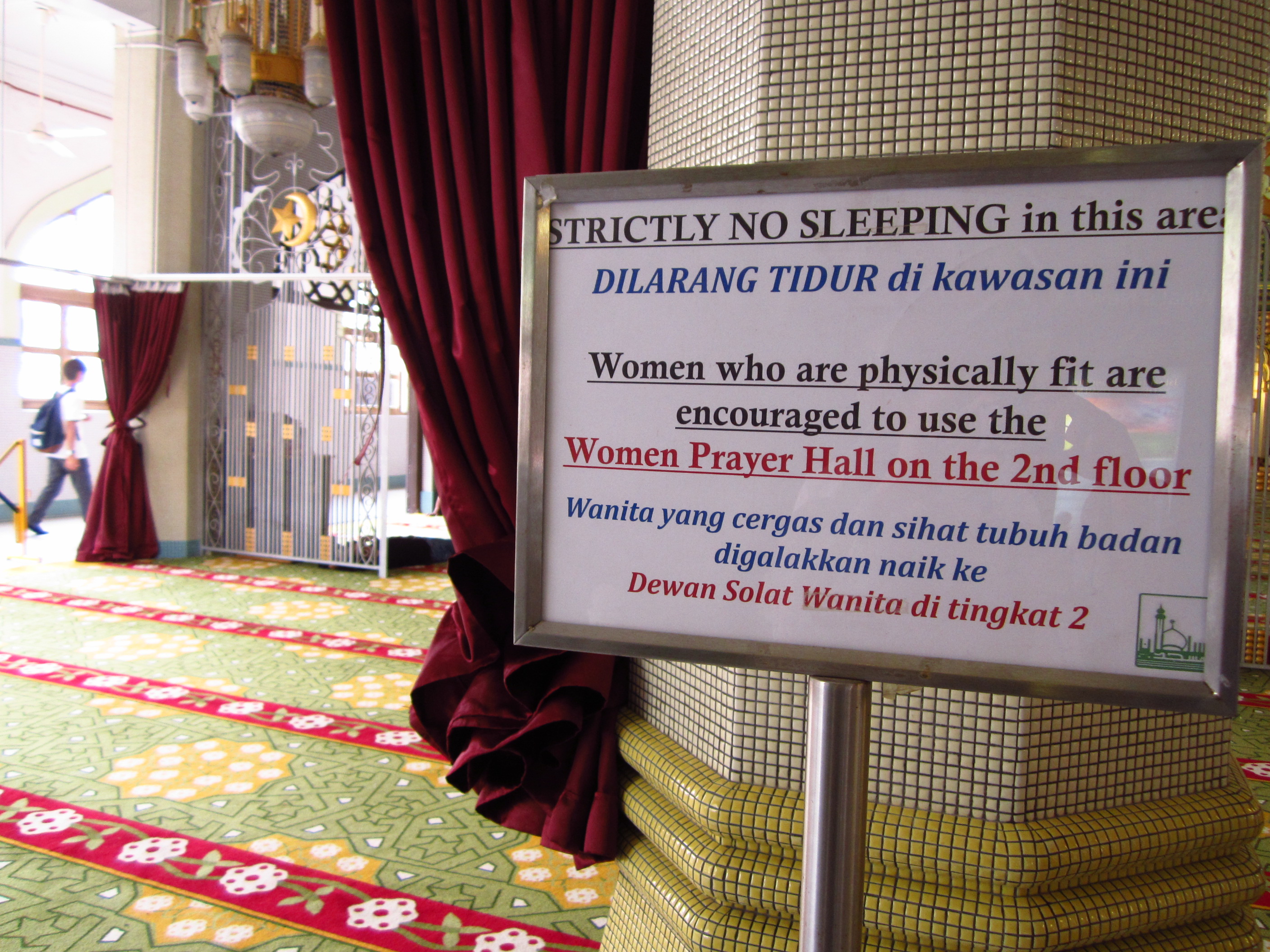
A sign found in Singapore’s Sultan Mosque encouraging fit and able-bodied women to use the second floor.

If Kamila were allowed access to this Yemeni mosque, where would her praying space be? In Singapore (and many other places), many of the women’s spaces are a floor or two above the main prayer hall. Without a lift, would Kamila have to crawl up the stairs every time she came to pray? In recent years, a historic mosque in Singapore has taken into account the needs of their aging congregation: a new tent-like space has been reserved on the main floor for women who are not able to climb the stairs to the second floor.

Surely we cannot continue to emphasise an individual’s determination in the face of barriers. We must take into account that disability and gender come together to produce unique sites of oppression. And mosques need to change to accommodate their congregation, too. 

Otherwise, who is the mosque for but only able-bodied men?

Tuesday, March 1, 2016

Muslimahs with disabilities need to you hold the lift door, not gawk at their mobility aids

This article was first published on Muslimah Media Watch.


A Singaporean news channel produced a series of Youtube videos featuring selected athletes with disabilities, or para-athletes. One featured athlete is Aishah Samad, a shooter who had to have all four of her limbs amputated after going into septic shock and contracting gangrene in the hospital on the way home from a trip to China.

In the short 5-minute video, at least a fifth of the entire video focuses solely on footage of Aishah’s mobility aids. The video starts with a drawn-out shot of someone putting a bionic arm on her amputated arm. There is one scene that shows only her prosthetic limbs and not even in relation to the rest of her (01:32). Yet another shot (04:41) focuses on her prosthetic legs, then bionic arms, before zooming out to her upper body sitting on a wheelchair.

This producer had also approached my sister, Nurul, a para-athlete herself, for a filming. Initially, the producer wanted to film my sister’s ‘daily routine’, consisting of showering, eating, getting dressed and most importantly, transferring from her bed to her wheelchair. Presumably, these scenes would be similar to a video done of another local athlete. The producer explained that she found this important for people to understand the challenges of persons with disabilities (PWDs).

This isn’t the first time that a film producer has found that daily activities are utterly fascinating when done by persons with disabilities. Many years ago, my sister had been approached by a another TV channel for filming that would involve scenes like showering and getting dressed. Their favourite request is inevitably to film her transferring from a bed to the wheelchair.

First of all, why the special attention to someone’s daily routine? Does it serve a purpose or is it just a chance to gawk at how someone without arms could possibly cook for herself? Would a feature of able-bodied athletes focus so much on them eating breakfast? (Maybe what they ate for breakfast, but probably not long draw, close-up shots of fingers and forks.) I call this disability porn: there is no purpose to showing these scenes except for the able-bodied to gawk and feel better about themselves.

Second, whether a PWD is willing to reveal such details or present themselves in ways that they are not usually seen (ie without mobility aids) raises questions about personal privacy. Each person – whether able-bodied or not, but especially if not – is entitled to determine their own privacy, comfort levels, and self-presentation.
“Me getting in and out of my wheelchair is like you sitting down and standing up. It’s not a struggle for me because I have figured out a routine that works for me for the past 30 years,” says Nurul.
Fortunately, after some back-and-forth and suggestions on what kinds of scenes could be shown instead in order to give a better picture of the unique challenges of para-athletes, my sister’s video turned out to be very different from that of Aishah. Instead of long shots focusing on her wheels and joystick, there are scenes of her taking notes and stretching, and shots of her various sports equipment.


The mainstream media impacts how we think about certain groups of people. Visual media has an especially strong impact because we absorb what we see without thinking. Nurul points out that the purpose of media that aims to educate or raise awareness about PWDs should aim for getting the public to act better.
“I cannot see how watching what I do in my personal life is going to encourage the public to help me hold lift doors open, tap my [public transport] card, carry my food to my table, not park across access ramps, etc.”
While it’s a step forward to feature para-sports, which receive much less attention than able-bodied sports, it’s important not to reduce para-athletes to mere tokens or shadows of able-bodied ones. Every PWD has their own history, which affects how they see themselves. Some may have born able-bodied, some may have slowly lost motor functions, and some may have had the same challenges since they were little.

Despite these differences, too much emphasis on one’s mobility aids rather than the person herself demonstrates a failure to see the person in all their human complexity and through the lenses of all their identities. For example, what about other aspects of their lives as women, as Muslim women? What are the challenges they face in the mosque? In practising dress codes? These are all equally important perspectives to address
“Public education on disability needs to go beyond ‘overcoming’ medical conditions and daily activities. No two disabled persons ‘struggle’ daily the same way anyway.”

Saturday, February 27, 2016

On feminist alliance and participatory media-making.


--

Writing (for Muslimah Media Watch and other platforms elsewhere) has opened up many opportunities to collaborate with other activists from around the world. In particular, some articles I wrote on female circumcision (and also male circumcision) a few years ago attracted a lot of attention from activists and filmmakers, and a fresh round of conversations about these articles prompted me to gather and reflect on these transnational interactions.

A few years ago, while I was still living in the Netherlands, a Dutch non-government organization contacted me. They were looking for a gateway into the homogenized ethnic group of “Islamic Indonesian or Malaysian background”. Even though I specifically identified myself as being a Malay (ethnic group) Singaporean (nationality), they mistook me for an Indonesian. Indonesia and Malaysia are two different countries, and Indonesia alone has over 15 ethnic groups – facts that I would have hoped an NGO would be aware of if they were targeting this demographic.

Dispersing the misconceptions about ethnicity, nationality, and diasporic communities was work enough. Then they asked me to help them find other recent immigrants who “may not be informed about the consequences if they have their daughter circumcised.” Their assumptions about immigrant Muslim women and their culture(s) were ominously foreshadowing the recent Dutch policy to teach “gay rights” in refugee centres. Both parties paint immigrants and refugees as being inherently misogynist and homophobic.

(Can we get #NotallMuslimwomencircumcisetheirdaughters trending?)

Soon after, I received a request from an filmmaker working on the issue of routine male infant circumcision (MC). She was looking for doctors or parents in either Malaysia, Indonesia, or Singapore (though anyone from “Africa or Asia” would do) who supported the less invasive forms of female circumcision (pricking, slitting) – and she wasn’t planning on portraying them in a negative light. The purpose of juxtaposing FC (which is normally considered abhorrent) in other countries to male circumcision in the US was to help point out to Americans of their “cultural blind-spots” and “double standard”.

However, it would make more sense to change just one variable instead of two. For example, how about comparing “American” forms of genital cutting such as labioplasty/vaginoplasty to male circumcision? Instead of you know, using the rest of the world as a setting to help Americans learn more about themselves.

Most recently I was asked, by an photographer-filmmaker, to find some women or girls who had been through FC. More specifically, she wanted to film the procedure and some interviews – keeping all parties anonymous. Then: “They can wear their burqas if they want to.” #NotallMuslimwomenwearburqas

In all of the above interactions, I felt conflicting emotions. On one hand, I wanted to raise awareness about FC and MC. However, on the other hand, I felt like the person’s interpretations of the topic were being forced on me. In the case of being asked to provide contacts, I felt like they were forcing their way into an extremely intimate subject – information which had required time and emotional effort on my part to obtain – making me feel like an unwilling ‘native informant’.

As a result of feeling coerced, I curiously started to become defensive. In my mind, I even wanted to defend these practices – FC in particular because of the ‘milder’ nature more prevalent in Southeast Asia – against the onslaught of eager activists. It was a wholly reactionary defense mechanism.

Multiracial alliances can fail or be productive. As in all relations of power, there are lines of privilege to consider. I feel that immortalising representations of Muslim women through the making of media (books, films, policy papers) is something to be especially careful about. What would make me want to collaborate? What would make it worthwhile?

There was one more request by an European activist, who requested me to answer a series of questions on FC. Initially suspicious (seriously you can’t blame me though), I asked her many questions about her background, work, motivations and objectives, to get a better idea about how she was planning to represent the situation in Southeast Asia. In the end, our interactions were open, pleasant and productive, so I ended up contributing my experiences.

In her book Power Lines: On the Subject of Feminist Alliances (2008), Aimee Carillo Rowe writes:

“There’s the colour of the body, and then there’s the colour of the commitment that burns like hot blue flame in our hearts… Our work is to turn ourselves inside out. To locate ourselves through our loyalty and our bravery and our willingness to fight for radical visions.”

The only project I ended up contributing to was one that I felt I had the most control over. Not only did the collaborating activist ask mostly open-ended questions, the published text is also made up mostly of quotes. This shows a willingness to let people speak for themselves (as far as it is possible in a textual form). I suppose then, what makes a collaboration worthwhile is if we can control our own representations and get our message across at the same time.

PS: I almost forgot about the random White male law student who had written a paper about FC and was looking for my feedback. When I asked him why he wanted to send it to me, he said he thought it would be ‘as much for my benefit’ as others had been ‘extremely appreciative’. I think I forgot to give him any feedback.

Saturday, January 2, 2016

How I learned that polygamy is not a big deal.

CW: polygamy, cheating

This is a collection of anecdotes of polygamy among Muslims, and the reactions surround them, told to me by various people. Arranged in no particular order.

A man in his 40s is caught walking around town with a woman who was not his wife. His brother tells him to think about how much his wife has done for him and their children, in an attempt to stop him from straying. He marries the woman anyway. Children are distraught and pretend that the co-wife is a distant relative.

A man in his 60s leaves his recently disabled wife to marry a younger woman, because he "wants to enjoy life while he can". The new woman makes him feel alive, while he says has lost the passion with his wife of 30 years.

A man in his 60s leaves his wife of 25 years and three children. He marries a woman 25 years younger than him. His peer jokingly calls him and his wife 'pengantin baru' (Malay, 'newlyweds') every time he sees them. The ex wife stays with the oldest child.

A man in his 60s has a wife and 8 children. He courts and buys a home for a woman in her 20s. His first wife leaves and stays with one of her children.

A woman is courted to be a second wife. She is plied with religious literature about how it is part of the Prophet's sunnah. Her sisters are against it, but she marries him anyway. Her husband does not fulfil the sunnah of providing financially for her. Instead, he created his own model for polygyny: each wife works to feed herself and her children.

A man with two wives reveals, 17 years later, a third wife from a neighbouring country. And a child, who is now a young adult discovering a full set of half-siblings and distant relatives.

A female convert in her 20s is courted by a man in his 40s with beautiful religious arguments and promises of leading her to Paradise. After a secret marriage, he reveals a first wife and two children. She tries to make herself accept this with Islamic-sounding justifications, but the problem isn't religion, it's deception.

A man serially cheats on his wife for decades, amongst other betrayals. He meets a non Muslim woman, gets her to convert to Islam and marries her (not sure if with or without first wife's knowledge). When she uses this reason to ask the court for a divorce, man defends himself by stating that converting someone to Islam brings a lot of 'pahala' (divine brownie points).

A smart young woman is made to believe she is fast becoming unmarriageable, too educated and too smart mouthed. She marries the first man who loves her for her mind and soul, despite feeling sick to her stomach when thinking about his wife and two children.

A woman discovers her husband's infidelity when the other woman is pregnant. She is mortified and humiliated that he then wants to marry her to save her from shame. Eventually he does not marry her, but this secret gives her a quiet power in the relationship.

--

I heard some of these anecdotes as a child, and I felt very strongly that the situation was unjust. Today if I express such sentiments, I am told that my Western education or my feminist books are to blame. Good question: Was I secretly reading Western feminist books as a child?

Why are the feelings of the women and children involved seemed insignificant or completely invalid? It may hurt the feelings of human beings I once promised to love but whatever, I'm just looking for new thrills for my penis.

Why is there no legal redress for women of a certain generation, who often did not work (whether from social expectations or economic possibilities) outside the home, and may have been mostly or completely financially dependent on their husbands?

I thought about how it is impossible to turn someone's heart away from you. Just as impossible is to turn someone's heart towards you.

Most recently someone asked me what advice she should give a friend. This friend'a husband was planning to divorce her for another woman. I thought long and hard, and eventually decided that if you're going to end up in an emotionally shitty situation, make sure you get enough money to soften the blow.

In the end, that's why legal protection is so important. Every person entering a marriage must research this and make the best possible decision for themselves. Be it pre-nups, joint bank accounts, joint tenancy, etc. No sense in adding financial hardship to an already difficult mess.