Pages

Showing posts with label dance. Show all posts

Friday, March 4, 2016

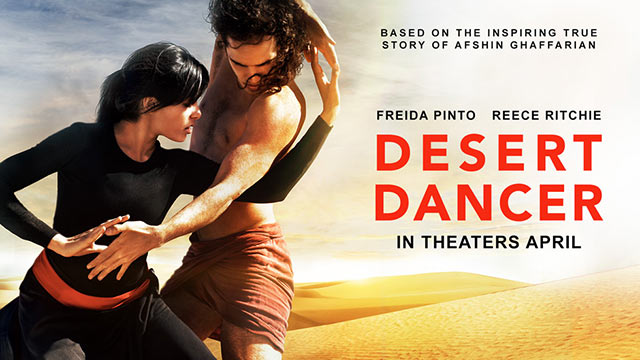
Film review: Desert Dancer (2015)

This article was first published on Muslimah Media Watch.

Source

Six years ago I attended a contemporary dance workshop, and while I’ve been dancing for most of my life, what struck me most was one improvisation that involved dancing as if you were the furniture in your room. When we had come up with a sequence of movements representing various wardrobes, nightstands, mirrors, beds and tables, we had to then dance it while interpreting the concept of fear.

I was thinking about this workshop as I watched Desert Dancer (2015) by Richard Raymond. The film is partly based on the life story of Iranian exile Afshin Ghaffarian (played by Reece Ritchie), who is wanted by the Basijor morality police in his homeland for organising a (forbidden) dance company and an (even more forbidden) performance in the desert south of Tehran, and filming a protest by the Green Movement during the 2009 contested presidential elections.

The group is made up of a ragtag bunch of students without any experience in dance and Afshin’s plan is for them to learn from Youtube videos, “to take control of our lives” in a place “that’s ours, [with] no rules.” Eventually, Afshin assumes the identity of one of the student actors travelling to Paris to perform a play and is granted asylum by the French government.

The first thing that I remark is the choice and use of English in the film, along with a range of accents by the various non-Iranian actors. Most of the main characters are played by actors from the UK, India, Malta, with one from Morocco (Mourad Zaoui) and another from Palestine (Makram Khoury). I’m not sure if they were coached to imitate Iranian accents, but the dialogue seems stilted and unnatural. The one Iranian actress that plays Afshin’s mother (Nazanian Boniadi) only appears in a brief scene. In an interview with The Guardian, she rightly points out how financing drives casting:
“They struggled to make the film [Desert Dancer] because it was about brown people, if we’re being literal. It’s hard to get a film that’s about kids in Iran and led by Reece Ritchie and Freida Pinto financed.”
I think that casting Iranian actors in Iranian roles is important, not only to raise the profile of actors who would normally not be able to gain top billing in bigger films but to also educate viewers on certain aspects of Iranian culture that is more easily embodied by them without needing extensive research or coaching (eg. mannerisms, accent, expressions, knowledge). In this case, the film becomes another instance of non-Iranians telling stories about Iran. The use of many short takes also gives the impression of rushing through the plot, limiting potential for character development.

“When I dance, I feel free. It’s like no one can take that away, it’s limitless.”

The opening sequences of the film, where Iran is described as “the birthplace of great poetry and the first charter of human rights,” raised my hopes that the film could give a glimpse of a new aspect of the underground Iranian dance scene. The excellent choice of modern dance excerpts shown in the film – including familiar names like Sidi Larbi Cherkaoui, Sylvie Guillem and Jiri Kylian – seems to promise that if all else failed, dance enthusiasts could at least enjoy a well-choreographed dance scene or two.

However, the film doesn’t rise above the simple theme of freedom versus restriction. The young Afshin is invited to an arts centre, where Iranians can listen to Western music, practise on musical instruments, act and dance. As he watches Russian ballet dancer Rudolf Nureyev dance, Afshin’s teacher Mehdi sums up the film perfectly:
“Our country is like two parallel words. On the outside are laws, commandments and sin. Here, we are free.”
The film presents the Iranian Islamic regime as saying you can’t paint, act, play music or dance, so the only way to truly live is to eventually escape to the free West – it’s a tale as old as time. These two opposites are hammered home to the viewer constantly, much more than necessary.

In comparison to the short takes, the film devotes several minutes to Elaheh’s audition, a rehearsal between her and Afshin, their performance in the desert, and Afshin’s confession-solo in Paris. The piece most worth watching is an improvised duet (repeated later in the final desert performance) between Elaheh and Afshin, where they use the palms of their hands to push and pull, and resist and submit to each other’s energies. The desert performance however, is spoiled by the presence of Ardavan (Tim Cullen). His movements lacked finesse and he represented all too clearly a Basij who was out to break up the Elaheh-Afshin dyad representing male and female, yang and yin, modesty and exposure, inner and outer Iran.

What I find interesting about this duet is that it suggests that issues surrounding “inner” Iran should be left to its people to work through by themselves. Having a Basij-like character come and decide how the duet should dance mirrors the actions of regimes or governments who decide how Muslim women should act and dress in order to be proper citizens.

At the end of my dance workshop six years ago, I asked the choreographer why he made us come up with movements imitating furniture instead of going straight for the concept. He explained that we often have preconceived notions of fear and how it should look in our minds and in our movements. As a result, we would have all been crouching in the corner and giving terrified looks as we used our hands to push away some frightful being – movements that he considered more suited to theatre than the interpretive and allegorical potential of dance. Unfortunately, that is exactly what Afshin’s final solo in Paris entailed: an almost literal re-enactment of having his voice, rights and freedom stifled; and being caught, beaten and nearly shot by the Basij.

“Why dance if no one can see us?”

In the opening scenes, Afshin’s mother (Nazanin Boniadi) pointedly gestures towards a group of Basij standing in a corner, as a gentle warning to him to not dance in public and this teaching point could not be clearer for the viewer: “They say dancing is forbidden. If you’re going to do it, you do it somewhere safe.”

It’s perhaps ironic that the only Iranian actress (who played a “hijab-wearing agent” in the US series Homeland) in a film about Iranians is given so little screentime.

The film brings up an interesting discussion about resistance. Under a restrictive regime, Afshin and his friends resist through secret rehearsals. The process is difficult, scary and sometimes violent. When Elaheh challenges them about the purpose of their rehearsals, they decide to perform in the desert, “where there is no regime, where no one can find us.”

Is performance always the purpose of dance? Is dance worthy or legitimate if no one sees it? In the same vein, do political protests (such as the one by the Iranian students) make a difference if there is no media coverage – especially international coverage?

As a biography of one Iranian dancer against the regime, targeted to a Western audience that may not know much about Iran, Desert Dancer works. But as a story about dance, Iranian art or a critical analysis of freedom and resistance – not so much.
Thursday, June 25, 2015

Why the fact that I exercise at all is a miracle.

There's a photo of a 3 year old me with my arms in the air. I'm imitating the ballerinas on a TV show.

When I was 9, I still desperately wanted to learn ballet. I was told that leotards were immodest, and ballet would destroy my feet.

When I was 13 and started secondary school, I joined the rhythmic gymnastics team. It turns out that I had great potential at being flexible (achieving over splits within a few months) and pretty decent motor skills (ie I could copy the coach's movements without too much effort). I was told, my thighs were too fat, my knees were not straight and my belly and butt poked out too much. I was told that I had to be at least five kilos underweight. I did well at competition but my scores were deliberately lowered by my coach so that they never went above those of the skinnier Chinese girls. And again, leotards were still immodest so I wore unitards instead.

When I was 15, I visited an aunt in all my full Malay conservative glory right after a long, late morning swim. I was told to not swim so much, my skin was getting darker.

When I was 17, I had a brief foray into canoeing and dragonboat racing. I trained my right arm for dragonboat. I was told i would get abnormally muscular on one side and basically be an undateable freak. I started running once in a while, and I was told to hold my hands near my boobs while running to disguise their bouncing.

When I was 19, I took a contemporary dance class for the first time, while I was studying in France. (I still firmly believe that this was immensely therapeutic. Along with learning to eat the French breakfast staple of real butter, I regained much of my emotional health.) Goofy French-Russian teacher has nothing but praise for the way I move. But while rehearsing a piece, one second of utter dread at the possibility that we might have to perform naked scared me a little. Meanwhile, a Wallah Bro engages me in a discussion about the "permissibility of dance in Islam."

When I was 20, I join a university modern dance group. 'Group A' is made up of thin and strong Chinese girls. Group B was the rest of us. I stood out only because of my unusual pixie haircut and ability to jump. When other girls complained of being fat, I'd show them my belly and tell them to not let the instructor get to their heads. (Refer to healing properties od French butter above.) And dance costumes could be immodest, but at least you could wear a nude leotard underneath.

When I was 21, I had a brief obsession with bouldering and rockclimbing. I was surrounded by Muslim girls worried that Muslim guys were looking at their butts as they climbed. (Can you climb without moving your butt? Can you climb with your butt facing the wall instead?) I was surrounded by guys who thought it was immodest for a Muslim woman to address a mixed crowd so they demonstrated the wearing of a harness on a guy instead. (Hint: A harness is less immodest on a woman's body. Bonus factor: SAFETY.)

Luckily by this point in time, I had learned to filter out these negative voices. I couldn't stop myself from dancing as much as I couldn't stop myself from breathing.

But the 3 year old me already knew that.

Monday, July 16, 2012

Why can't I do backflips too?

In Jogjakarta our wonderful host (Nadya!) had gotten us tickets to the Ramayana ballet, which only plays once a month during the full moon in the Hindu palace complex of Prambanan. (You can read a synopsis of the ballet here.)

There are many animal, superhuman, and human characters in this ballet. I really enjoyed the overall atmosphere of the ballet and the technical skill of the dancers, but I couldn't help noticing that male dancers could play so many characters in comparison to female dancers: kings good (Prabu Janaka) and bad (Rahwana), princes (Rama and Laksamana), an acrobatic monkey (Hanuman), a birddemigod (Jatayu) , and smaller monkeys and giants (Kumbakarna).

The Giant Kumbakarna

Demigod in the form of a bird, Jatayu

Hanuman helping Rama and Laksamana
A close-up of Hanuman because he's so awesome
Rahwana disguised as a beggar to trick Shinta
  
Monkey soldiers danced by young boys

The leading female character Shinta is a beautiful woman considered to be the reincarnation of a goddess, while other characters played by women or girls are: an entire bevy of court ladies, a flirtatious, delicate, and graceful deer (actually a man named Marica in disguise), and another goddess that helps Shinta.

Court ladies, some danced by girls
Shinta led away by Rama

Rama distracted by the deer

Many types of classical dance prescribe specific steps for women and for men. For example, male characters often stand astride, taking up more space, and lift up their legs to indicate presence and strength:


while female characters such as Shinta and the court ladies had a piece of cloth trailing in between their legs; flicking it to the left or right before placing one foot behind the other.


Having a sarong, or skirt wrapped rather tightly around the legs, further illustrates how female characters had no need to make strides bigger than half a metre. The only exception to this was the kijang kencana or the deer who leapt about actively, who was a man in disguise anyway! Other than the leaping, the deer still articulated seductive head, eye and hand movements.

And as a final point on how limited and limiting the characters available to female dancers were: after Hanuman rescued Shinta from the evil king Rahwana, Rama did not trust that she had not been disgraced in some way (read: lost her virginity). Shinta was asked to burn herself to prove her purity -- which she of course survived and become even more beautiful afterwards.

I however recommend you dump anyone who asks this of you

As a dancer who has trained in both classical and contemporary styles, I imagine that I would be so frustrated if only two female characters and only certain movements were available to me. It is not that the male characters had movements that were impossible for women (gymnasts can do Hanuman's backflips too!), but it is the social construction of gender that created these dance roles for women and men.

I still remember fondly my secondary school Malay dance instructor Abang Ram, who choreographed more contemporary than classical dances for us. I went to an all girls' school, so there were some dances where we could play a man's role and therefore be allowed to somersault or stand with our feet wide apart, carry spears or lift another dancer.

I also never realised how gender-neutral he made some of his pieces: there was one dance where we danced in heterosexual pairs with gender-specific movements in the first half (small and graceful for the girls, large and protective for the boys), before breaking out into expansive, active and strong movements for everyone! Both girls and boys also dressed similarly in a top and trousers with a belt and short kain samping (possibly different colours by gender, or size).

So I'm lucky and glad that I had such opportunities to explore all kinds of movements big and small through dance because it is socially acceptable to embrace what is masculine, although I realise that not all male dancers could have the chance to explore small and graceful movements typically regarded as feminine, without experiencing some kind of disdain or having his masculinity questioned for having embraced the feminine.

Sunday, February 20, 2011

Quick quick face the wall - a dance review

This piece by Club Guy and Roni, a husband-and-wife team of choreographers based in Groningen, was divided in two parts, with women interpreting the first, and men interpreting the second. The moment I stepped into the theatre, I saw a translucent screen and wondered if it was a film screening instead. It turned out to be a mixed media sort of theater, with not much movement, and by the end of the first half I wished I was watching a real film instead.

On stage right, near the audience, a quietly comical woman plays the piano and very seriously puts on a platinum-blonde wig halfway through to play a Japanese lounge singer who sings in an plaintive and non-erotic way. Meanwhile, the screen shows a long, drawn-out, and ultimately overkill video about the experience of a woman who loses her husband in a car accident. What I found completely strange was the interweaving of absurd characters (like a man dressed up as a small girl, wearing a blue dress with pigtails) into the otherwise tragic story. Comedy and tragedy unfortunately did not mesh in this story.

To assign more cooks to the broth, sounds from the film like footsteps and swerving tires were repeated and amplified by the dancers behind the screen. I found this wholly unnecessary since film as a medium is both visual and auditory; it seemed like a whole lot of work and resources to do a job already done. Sometimes simple really is best, and perhaps adding their touches to a silent film might have been more interesting.

The second part had for a setting half-stage and half-living room. In one corner is a set of drums and in the other, a tall girl watching a small television from a sofa. The male dancers enter and exit in a variety of personas: drunk macho, drag queen uncomfortable in heels, crazy kilt-wearing and drum-beating acrobat, and quiet-but-devastatingly-handsome nerd. At some moments they dance together to set movements, but it is the individual personality of each dancer that really makes the piece amusing and enjoyable.


A piece of furniture in the middle of the stage is also unexpectedly functional - in the beginning it serves as a bar, then a magician's box to make people appear and disappear, and finally as a platform for a short moment of extreme machismo, involving parading around in their underwear.

Tuesday, February 15, 2011

'Iki Shi Tai' - a dance review

On the evening of 13 Feb I watched 'Iki Shi Tai' at Korzo Theater, choreographed and interpreted by Shintaro Hirahara, Shintaro Oue, and Masahiro Yanagimoto - three charming Japanese men who have been dancing for years in the European scene.


The whole piece was inspired by breath, and it starts with Hirahara speaking in Japanese at the beginning. I didn't understand a thing, but at some points he narrated a dialogue between a man and a woman, and it's interesting how body language speaks much more, because I knew somehow that it was funny.

He is sitting on the floor on his knees and rotates his upper body; he takes a breath which helps his back to arch and move forward, and releasing it makes his back curve and move backwards. It was not until two-thirds of the way into the piece that Yanagimoto spoke about how the body moves according to the breath, while the two other dancers moved to his words.

There were some inspirations from athletic events like javelin-throwing and shotput, which were interspersed with flirtations with Japanese fans of various sizes. Every move and scene seemed to have a bubbling layer of comedy underneath the seriousness, although sometimes it was an obvious comedy.

Men acting feminine is unfortunately somehow always funny (who hasn't laughed at 'Men in Tutus'?), and Hirahara and Oue were very good at acting feminine, moving like geishas performing a tea ceremony, leaping like uncontrollable ballerinas, and making exaggerated sharp glances like gymnasts.

They speak while dancing, and sometimes it feels like I'm watching a rehearsal instead, as I can see the process of dance creation. They also laugh, and I want to laugh along with them. They have perfect timing, making just a small gesture or expression in moments of physical and auditory silence, for maximum comic effect.


All three men move with striking strength and endurance, and seem to have a remarkable memory for the intricate contact improvisation variations. The duo and trio contact improvisation is interpreted flawlessly, though they did not hesitate to show the force and fatigue of some positions through groans and grunts. It is refreshing to hear and see the effort and emotion behind the movements, normal physiological reactions that a lot of dance forms aim to eliminate.


In the final minutes, plastic bags fall from the gallery and are swept into gentle hurricane by four fan blowers in each corner. All three are swept around like plastic bags, and for a moment it suddenly feels too serious for these three delightfully-dressed men in red, yellow and blue.

Friday, February 11, 2011

'Beyond' - a dance review.


February is the month of a modern dance festival in The Hague, called Cadance. On Tuesday 8 Feb I caught a performance called 'Beyond' at Korzo Theater (bringing to life memories of late night practices at the SMU CCA room, eating speculoos amongst skinny dancers, trying to somersault backwards on tables and keeping a peripheral lookout in my identically-titled swan song in Feb 2010) with choreography by Pedro Goucha Gomes and Kalpana Raghuraman.

The first piece, 'Toxic Tears', choreographed by Goucha Gomez and interpreted by Raghuraman, revolved around the Ganges river in India and how it is a source of physical pollution but at the same time, a source of spiritual ablution. Tens of used green plastic bottles were strung like a curtain at the back of the stage and scattered around the stage, forming a sacred circle for Raghuraman to dance in.

As she was trained in Bharatanatyam by her mother, Raghuraman carries out two rituals at the beginning and at the end of her dance are reminiscent of the Hindu worship rituals done before a temple Bharatanatyam dance. Small plastic cups caress her arms, which start to move rapidly like the tails of ducks and swallows all around her torso and head. Her hands moved so fast that at a moment it appeared as if an infestation of insects surrounded her head.

She breaks through the plastic curtain noisily, and her feet move horse-like in regular rhythm to the galloping beats in the music - a noisy mixture of techno and percussion. Her Graham-like movements rise and fall like waves crashing on sand. I recognise several classical movements like Krishna shooting from his bow, and the faces of demons. Unlike many modern or contemporary dancers who show only a few emotions on their faces, at one point Raghuraman shuffles in an 8-pattern with the smallest of movements of her feet, but I can see love, seduction, horror, anger, and jealousy alternate in her face.

In the second piece, 'Kiss of Life', choreographed by Raghuraman and interpreted by Sabina Perry, the two dancers try to find a compromise between a 'traditional' Indian woman and a contemporary one. There are four shallow clay pots filled with incense marking the four corners of the stage (which sparked some coughing fits in the audience), and they were not used as anything more than markers throughout the piece.

Photo from Facebook

Perry wears a toga-like dress and the braids in her hair and the leather boots she puts on later during the piece give altogether a misplaced impression of a Greek gladiator. In a rectangular spotlight which starts the piece, Perry shakes rather controllably (I felt she could have let go more), perhaps to symbolise the rupture from the image of a pious traditional Indian woman? She moves much more gracefully in between balletic and Bharanatyam positions, and is able to impressively form and switch complex hand positions.

I suppose an attempt to depart from classical dance while trying to hold on to some of its vestiges was the reason behind the appropriation of gestures from Perry's own life, like drinking tea, shooting a gun, and disco-dancing. However, it was a shame that such a dichotomy was made between the two women - the contemporary woman brazenly splayed her legs at the audience and licked lasciviously - as it reinforced stereotypes of women as either virgins or whores. Maybe it's the heeled boots, or maybe Perry feels like a tourist in someone else's cultural landscape, as she did not look wholly comfortable dancing in some moments.

Monday, September 20, 2010

Weekend

My first weekend was smooth and also recreational! Saturday morning I went over to the new house to sign the rental contract. I thought I'd take five minutes and then I could go cycling, but W the landlord had many stories about Indonesia ('My favourite country in the world!') because he was born there, and his colleague is from Suriname, but also lived in Jakarta for a while. Landlord W got us a special rent for the remainder of this month after asking the foundation that owns this apartment building.

In the streets near my CS host's house there was a market (just like a pasar malam, except from 10h - 15h) so we had to go see that first! This was nothing typically Dutch though - no windmills or milkmaids or whatever else my blog name conjures up of Holland :) In fact, what I gather from observing the streets in the past week is that Dutch culture consists of a lot of cultural appropriation, especially when it comes to cuisines! More on that later, with pictures to boot. So when I saw a stall selling 'soeto', I had to check, and in this case it was correct.

Then we rented a bike and went cycling near Scheveningen Bos ('forest'), which is about 2 or 3km northeast of where ISS is. We went further than that, since we hit the sand dunes! Seeing hills of sand amidst temperate forest is something special. Silvery poplars are abundant too, since they grow best in sandy soil (artefact information from a course on silviculture I took in Spain 2008).

We made it back to the bike rental shop with 7 minutes to spare, and got a quick dinner at Ming Kee chinese restaurant (they must make a lot of money if they're selling rice + 2 meat + 2 veg for 5 euros!) before heading to Korzo5hoog near the Centraal Station.

The performance was ''Readymade Dance/Part of the Deal" by Andre Gingras, for the fabulous student price of 6 euros. The first piece used boxing and its related shuffling, skipping and punches to create a dance. One dancer even got a bloody nose at the end, but the blood was a bit too bright red to be real (I hope, anyways.). The second piece spent some time deconstructing steps from hiphop and breakdance, before breaking out into a frantic dance involving live singing/sounds coming from a wo/man (I really couldn't tell.).

Today is back to school and I also have to start settling into a normal life i.e. laundry, cooking, cleaning.