Pages

Showing posts with label school. Show all posts

Saturday, September 10, 2016

Openseam - "Teacher, are you Chinese or Malay?"

This article was first published on Openseam.

--
Happy Teachers' Day!

Today's post comes from Aliya Yeoh, an English teacher in Penang, Malaysia. She previously wrote about how she celebrated Chinese New Year. A Chinese Muslim, she reverted at the age of 35, after postponing her earlier plan to do so for 10 years. You can read more of her experiences and thoughts in her blog, Musings of a Mualaf.


"Teacher, do you understand Tamil?" asked Revathi.

I was with a small group of Indian students, on relief duty for an absent teacher.

"No, I don't understand Tamil," I smiled. I knew they just wanted reassurance that I would not eavesdrop on their conversation.

"Would you understand if I speak Chinese?" I asked. Revathi's turn to smile.

"Teacher, you can speak Chinese?" 

"Teacher is Chinese la," Ramanan answered for me.

"Really? I thought you're a Malay."

"I am a Chinese," my smile grew wider. She looked puzzled.

"But... you are wearing tudung?"

"I am a Chinese Muslim... born in Malaysia. I grew up as a Chinese and later..."

"You converted?" Shanti chipped in.

"That's right. I wear the tudung because I am a Muslim woman. But I am still a Chinese and I can speak and understand Chinese." I explained slowly.

"Ohhh..." Revathi nodded slowly.

I've been in this school since 2010. I taught these same students two years ago and strangely, they have not realised that I am a Chinese lady. The reason? I am wearing a hijab, or tudung.

Students, like most Malaysians, associate this garb with Islam and being Malay. In many minds, if you wear a tudung, then you must be a Malay.

And in their minds, if you happen to wear a long tudung, then you must be an especially religious Malay. They associate our clothing with religion.

It's bad enough that Muslim and non-Muslim students are always separated during religious activities. It would be havoc among other non-Muslim teachers if a non-Muslim student were to sit in the hall with other Muslim students, listening to a ceramah (sermon) by an ustaz.

So I can't blame them for their lack of understanding of Islam. They don't know much because we, the Muslims, don't do much. Sometimes we, as adults, are not allowed to.
Students learn best when they mix with their own friends. Which is why our teenagers need to be exposed to doing Islamic dakwah work, and not be scolded nor discouraged just because they 'lack knowledge'.

I wouldn't be surprised if non-Muslim students think that China is made up of only Buddhist people. I used to think that way too, when in reality there are more Chinese Muslims in China than there are Malay Muslims in Malaysia.

Once, I was told, in hushed tones, that there was a Chinese student who was interested in Islam. The ustazah didn't know what to do. Till today, I'm still waiting for her to approach me.

It's always fun watching how Chinese students react when I speak Chinese dialects or Mandarin to them. One day when I scolded a sleepy Chinese lad in Hokkien, his mother tongue, and he was so surprised that he actually sat up straight.
And the Malay students?

They might suddenly realise that it's a fact that there are other Muslims in this country who are not Malay or Mamak.* That there are other once-kafir (non-Muslim) people who have embraced Islam and are now their brothers and sisters in Islam. Because I'm living and walking proof among them.

"So teacher, are you a Malay or a Chinese now?"

"I am a Chinese... and my religion is Islam. There are more than 60,000 Chinese Muslims in Malaysia today, did you know?"

Ahhh, life is never boring as a Chinese Muslim. Xie xie, wo ai ni,** Allah.

*Mamak: local slang to refer to people of Indian ethnicity.
** Mandarin for 'Thank you, I love you'.

Monday, February 29, 2016

Not Between Her and Allah: Hijab-shaming in Malaysia

This article was first published on Muslimah Media Watch.


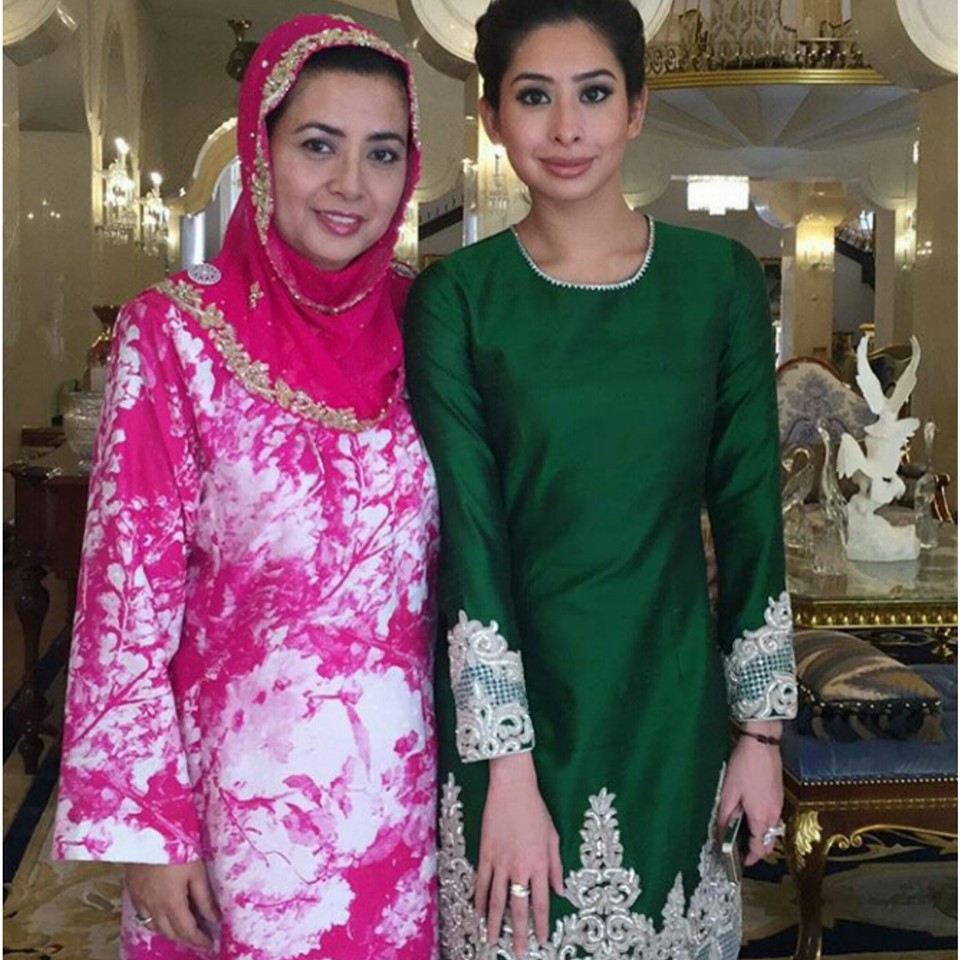
Tunku Tun Aminah. Source
Hijab-shaming is a favourite activity for some Muslims, both on-and offline. In fact, just last month I attended a religious class where the teacher spent a good half hour doing just that (I had to stop going for my mental health).

While meeting up with a girlfriend last week, she regaled me with the details of a religious class where the female teacher showed examples of “improper hijab” from a selection of hijabi Instagram users – young women who were obviously oblivious to the use of their photos for such educational purposes.

Social media gives a degree of anonymous bravado that makes it easier than ever to degrade and shame Muslim women for not wearing the hijab – the sixth pillar of Islam. (Oh wait, it isn’t? Funny, it sometimes does seem like it is…)

Last week, Bank Negara Malaysia (the central bank, or BNM) awarded a handful of prestigious scholarships to underprivileged students from around the country. 18-year-old Nur Hajar Asyiqin Abdul Zubir was one of the four to receive the award, after several rigorous rounds of assessment.

Currently studying for her ‘A’ Levels in Negeri Sembilan state, she dreams of studying chemistry at Oxford University in the UK – a “golden opportunity” that this scholarship will be able to fund without worrying her parents, who work as meat suppliers. The youngest of five children in the family, Hajar had scored 9 A+s in her secondary school examinations last year and learned about the scholarship through a motivational programme for underprivileged students in the country.

Source
Malaysia is a multiethnic country, where the indigenous Malays form the majority alongside Chinese and Indian minorities. Instead of pride in her excellent academic results, several Malay men on Facebook chose to criticise the fact that Hajar does not wear a tudung, or hijab.

One man said it was a “pity the aurat is not covered” and that “her father bears the sins”. Another man similarly qualified his congratulatory message with a snarky proclamation that “Allah hates His servants who do not cover” and dismissed the role of Hajar’s own intellectual efforts with the remark “we succeed not because we are clever”. Yet another man even suggested that the hijab should be a requirement for a scholarship awarded for academic excellence.

While one website described this online activity as “chiding”, I disagree: shaming is more accurate. It’s easy to shame Hajar because she is a young girl from a poor family, with no social standing. But it looks like women with a higher status in society are still not exempt. Case in point: a princess from another Malaysian state.

While deriding others is an attempt of the actor to give himself moral or psychological power, it only reveals his own internal crisis of masculinity.

Tunku Tun Aminah Maimunah Iskandariah was recently the target of negative comments on photos posted on Instagram by herself and her brother, Tunku Idris, which shows her without a tudung – her habitual look.

The only daughter among the six children of the Johor sultan and his wife, the fashionable 28-year-old still keeps an Instagram “fashion diary” (@ttaootd), which is heavily monitored for negative comments.

While her brother claims that Tunku Aminah had shut down her Instagram account much earlier and for reasons unrelated to the comments on her lack of hijab, he admits that such comments do “tick [him] off.”

He defends his sister by posting several photos and comments on his account on not being judgemental of how others look. He even vouched for what he knows of his sister’s spirituality, like praying and covering her hair at religious events: “Is that not good enough? Isn’t it between her and Allah?”

It’s such a simple – almost rhetorical – question, yet it is one that is difficult for many of us to answer. These people are shaming Hajar and Tunku for not fitting into their narrow ideas of what it means to be an ideal (Malay) Muslim woman. While deriding others is an attempt of the actor to give himself moral or psychological power, it only reveals his own internal crisis of masculinity.

Friday, May 31, 2013

Hard Day’s Night: A tale of two Indonesian domestic workers in Singapore

--
I remember being 4 years old and pasting stickers with the letters R-I-T-A on my pink plastic chair – that was the name of our first domestic worker. I was young and didn’t remember much of her, but over the next two decades, my household benefitted from the help of almost 10 different Indonesian domestic workers.

But there was a stark difference from what I felt in my personal relationship with these women and sentiments towards them in public discourse. Complaints by relatives about their ‘lazy’ or ‘ungrateful’ maids were a reflection of the discursive representations by the Singapore state. The reason of ‘falling into bad company’ is often invoked to justify tight social control, which is in turn based on specific ideas about their sexuality.

Through coercive policies on immigration and migrant workers, the law sees domestic workers either as potential home-wreckers or naive dependants. In the mainstream media, they are alternately either helpless victims or deviant criminals. Rarely are they portrayed as sacrificing heroines who leave their families to earn a living.

An economic necessity?
To support our post-independence capitalist development, women have been encouraged to work outside the home since our 1970s manufacturing phase. At the same time, the state insists that the best care for our ageing population is to be found within the household and family. Meanwhile, our growing urban middle class aspires to a lifestyle that previously only the rich could afford.

In short, women are valorised as workers, mothers and caregivers. But the state has never explicitly encouraged men to take up their share of housework. So who is going to do all the housework?


The solution lies in ‘cheap and disposable’[1] women from poorer neighbouring countries. Much of our post-independence development has been and is based on migrant labour from nearby Asian countries to fill in labour gaps for low-skilled, low-paid and high opportunity cost jobs that Singaporeans are unwilling to do.

Domestic work is one of these jobs. Migrant domestic workers are the answer in order to free our high-skilled but limited female labour force to work outside the home. They are the convenient response to our ageing population as smaller families mean fewer potential carers in the future.

This idea is accompanied by state policies that make it cheaper and more convenient to hire domestic workers than professional care services or nursing homes. For example, the Jamiyah Darul Takrim nursing home will only take in patients who have ‘exhausted all possible care arrangements such as hiring a domestic helper’.

Today’s pattern of migrant work was characterised by the 1978 Foreign Maid Scheme, which allowed women from mostly Indonesia and The Philippines (but also from Sri Lanka, India and other southeast Asian countries) to migrate temporarily to Singapore to work as live-in domestic workers. There are currently about 201,000 domestic workers in Singapore.

Only as of last year were all domestic workers in Singapore legally entitled to a day off. Previously, about 50 to 80 percent of all workers worked 7 days a week. While the government of The Philippines has made it a law to oblige Singaporean employers to give their Filipina workers a weekly day off, the governments of Indonesia and other Southeast Asian countries have no such laws.

Negotiating freedoms
Despite these constraints, two Indonesian women tell their stories of how they negotiated for freedoms like regular off days and time during their working day to study for a degree.

Ati, 31, first left Java for Singapore 2000 and has since been working for the same Chinese family. She did not have any off days during her first four working years because she was scared to ask for anything from her employers when she first arrived in Singapore. She even had to work in two different households, which is illegal according to the Employment of Foreign Manpower Act.
 

However, after four years and having developed a relatively good relationship with her employers, Ati managed to negotiate for a day off.
Because after the first year I went home her child had a high fever… then my boss said “Please lah please come back to work for me again”. So when I came back I asked to not be too tired because they have three children right. Slowly slowly like maybe they liked my work and so because I was close with their children so they were happy lah. After that, no off day in four years so I said “Okay, I will renew my contract with you but I want to ask for rest day, once a month.” (Ati, 31)
Meanwhile, Mita, 34, who has also been working for the same Chinese family for 14 years, had been given days off from the start of her first contract. Even then, she used to encourage and advise other women to negotiate for days off or a higher salary. To her, a good working relationship is required for a successful negotiation – both parties must be “comfortable” with each other and the employer must want the worker to renew her contract. At the same time, Mita acknowledges that only the employer makes the final decisions.
If don’t have then you can ask, if they give you then your luck lah. If not, then no choice lah. Because sometimes after you finish contract and then let’s say you want to transfer or continue your employer if you are good and comfortable with employer then go ahead. If not, OK lah you ask your off day if want to stay. Because you bargain right, okay I will work for you and you give me money. So if you increase my salary I will stay. If not, I will change employer. (Mita, 34)

Student workers
Both Ati and Mita are working towards an undergraduate degree in communications from the Open University of Indonesia, through distance learning and tutorials at the Singapore Indonesian School. Their track record – whether as well-behaved, hardworking, trustworthy or efficient domestic workers – played a significant role in determining the success of their negotiation for time in their working day and access to resources like a computer. 
Sometimes if I finish work it’s usually 10p.m., so I study 10p.m. to 12a.m. That day I told him “I need laptop for tutorial online.” [He said] “You don’t have to buy lah, don’t waste your money, just use mine.” But it’s old so it’s lagging. Then that day I said again, “Your laptop is so lagging,” and “I want to buy”. [He said] “You don’t have to buy, use my the other one.” So in the end I use the other laptop. I mean, he’s good like that, he’s not, what’s that, stingy. (Ati, 31)
Ati has to use her employers’ computers to minimise distractions from her primary role as a domestic worker. Her employers’ control over her purchases is an outcome of power relations of class, since they provide her income. Although she could use her own money to make expensive purchases like a camera or a laptop, she still requires their permission, which illustrates the boundaries of their control. 


Mita enjoys more flexible working and studying hours; she says she is allowed to study any time she likes. She earned her employers’ trust and admiration by first going for computer classes on her days off and being open about how good her employers were. Today her employers pay part of her study fees and her phone bills.

The degrees that they are working towards points to their career goals. Ati plans to return in 2014 to her hometown and start a catering business. Mita wants to work in mass communications, and laughs when she says she wants to be a deejay. Their peers, who work and study like them have ambitions to be English teachers or businesswomen.

Even though these women are a small group and do not represent all domestic workers in Singapore, they help us to see a more optimistic side to domestic work in Singapore – it’s not just all about the abuse and crime we read about in the mainstream media.

Global chains of care
Even though more Singapore women are working outside the home, the inflow of women from neighbouring countries means that women (of a different class and ethnicity) remain responsible for the home – keeping state-endorsed patriarchy intact.
But in the end my boss don’t allow me to go home yet, until 2014, then I can go home if I want. But boss hopes I don’t go home, and stay here forever. I said “You ask me to work here OK lah, pay me $5000 a month as compensation, I don’t get married!” (Ati, 31) 
While family members (mostly women) carry out some household chores and do care work by themselves, other domestic work is transferred to domestic workers, allowing female employers to enjoy the emotional value of motherhood. As domestic workers are also women, with their own families, this shifting of the burden of care should make us think about whose children and whose families are more important and deserve care: the rich or the poor?

Domestic workers are not the economic necessity that the state and employers often say it is. They are a luxury because they facilitate aspirations and affirm status for those aspiring to a middle-class lifestyle. But they are also a symptom of our state policies and rhetoric on what makes a man, what makes a woman, and what makes a family.
--
Photos: Ati
References
[1] Sassen, S. (2002) 'Global Cities and Survival Circuits', in B. Ehrenreich and A.R. Hochschild (eds) Global Woman: Nannies, Maids and Sex Workers in the New Economy, pp. 254-274. New York: Metropolitan Books.

Sunday, May 13, 2012

The benefit of a traditional religious education.

Some people think I'm against traditional religious education -- that's not true! It's a lot like learning how to dance.

I learnt this from my wonderful dance instructor in Grenoble, who gifted me my first experience of contemporary dance. He taught us that to be able to move freely, you first have to learn the classics -- only then can you depart from form. We had to learn classical ballet, not necessarily for us to all become ballerinas, but so that we would not move in preconceived ideas of dance rooted in ballet.

Traditional religious education is not to be discounted, because it is a good grounding in hegemonic discourse. It is important to know what most Muslims around the world know, because it helps to create a shared cultural history with others. It also helps to create a point of departure for other kinds of religious education.

I'll give some examples of how I experienced a shared referential consciousness with Muslim women from different parts of the world.

Meknes

A few months ago I was talking to a friend from Central Eastern Africa about how the Muslims in her country adapt their traditional dress to the requirements of hijab, and we had a great discussion about social norms and sensibilities about how much flesh non-hijabi women could show without everyone freaking out about it.

She mentioned an acquaintance in school who wears the headscarf, and commented that it was strange that she wore a 'bump' at the back of her head -- because that was haram.

I was taken aback, this was a bump from her natural hair, how else was she supposed to wear it? I rather thought that if you were going to take a hair-bump that as a sign of the inhabitants of hell, you had to pick on a more "camel-hump" looking bump.

But actually that isn't my point. My point is that we came from different regions, countries, and cultural backgrounds, but I knew why had made such a judgment on our friend's headscarf. We had both been taught a lesson on morality and how to dress, by religious teachers or elders in our communities, based on this hadith. (Although I only heard about this in the last three years or so, I seem to have heard about it in time!)

Another incident happened about six years ago. I was studying in France and was extremely pleased to have met a girl from West Africa. We were talking about dogs and she said that at home, if she touched a dog, she was taught that she should wash her hands with earth and water. When I told her that yes, that is a religious requirement (this was me six years ago!). She marveled at how we had learnt the same things, even though she didn't know whether this was a cultural or religious practice in her country.


Granada
Indeed, even now I still marvel at how we learn the same things, even though we don't know if it is a cultural or religious practice.

Thursday, January 12, 2012

Updates.

I started this blog with the initial intention of documenting everyday life, when I started my Masters in The Hague. But the wonderful thing about plans is that they always go awry. As I learnt more, I started thinking differently too, and I wrote more and more about all of it -- stereotypes, assumptions, injustices, words that I had taken for granted before.

So I have this blog and my time at ISS to thank for helping me see and think about the world in a different way. And I felt that a makeover was due since I graduated in December last year. I had initially planned to go back to Singapore or find some awesome job somewhere, but God had other plans, and so for the next year at least it seems that I will stay here, and the blog title has changed to reflect that.

Besides, I'm reclaiming the term 'minah' from its pejorative connotations to encompass more positive things -- a woman who is more concerned with what's in her head, and not what's on it.

I've also been published in NL! A few days after submitting my thesis last year, I went to interview the filmmakers of 'The Light in Her Eyes', a documentary about the work of Houda al-Habash, a female director of a girls-only Qur'an school. The interview is translated into Dutch (by none other than the Dutchman of course!), but the original English article is available here. 


I also got to watch a private screening of the film (which had juuust been completed) along with the filmmakers, another Dutch female filmmaker, and some officials. The film is fantastic. It reminded me so much about going to Sunday madrasah when I was young, except that I considered that so banal I wouldn't have thought of making a film on it! Besides, the teachers then didn't exactly emphasise the importance of secular education, like Houda does. (You can help increase publicity for the film by liking its Facebook page here.)

During the private screening, present was a rather famous female Dutch diplomat, who quite modestly described herself as an "expert on the Arab world", having lived in Syria and Jordan for oh, four years, and having quite recently predicted the Arab spring herself. She made me think quite immediately of the upper-class Greek women I met in Athens.

Anyway, I'll be writing more for this magazine, inshallah! :)

Sunday, November 27, 2011

Ability and opportunity.

Baby Mario Kart

A few weeks ago, I played Mario Kart on a Nintendo Gamecube, for the first time. Both for Mario Kart and the Gamecube (yes, don't judge me!). I played with another friend, C, who had also never played hand-held video games before. What was interesting was how the Dutchman, who witnessed our feeble attempts at racing Mario around the different tracks, remarked that I played better than C.

It would be easy to pin it down to ability, but opportunity should also be taken into account. For example, I had access to computers and all kinds of technological gizmos since I was five, while C only encountered and started regularly using a computer in her workplace, at the age of 23 or so.

The level of hand-eye coordination or whatever other psychomotor skills I have must be in part due to having been exposed to years of computers, online games, Tamagotchis, and electronic diaries, calendars, dictionaries, etc. I had the opportunity of being able to use all these things. I also had the opportunity to take computer lessons in school at the age of 10, where we experimented with typing games.

Take oil painting and sports for example. In high school I had a friend who was really good at oil painting. But that was because his parents were both artists and so he had the opportunity to experiment and gain experience in using oils, which is an expensive painting medium!

In the ISS, the students play sports every Sunday. For soccer especially, more women get the opportunity to play in an all-women's team, and so they get better. It would be fallacious to say that girls can't play soccer well when they may have never had the opportunity to play, train, and develop skills before.

Likewise, during my short stint as a sports assistant in Boccia, it was clear how good equipment was particularly crucial to the success of the training and performance of athletes in the BC3 category. Even in the Olympics, where athletes try to shave off milliseconds from their time, a special streamlined outfit that costs thousands of dollars can help.

Therefore, opportunity comes with money, and what we often mistake as ability can often be the result of life chances that are linked to one's class.

Monday, October 24, 2011

Conviviality and instrumentality.

I had a guilty moment of reflexivity before I started doing research for my thesis. I wanted to go somewhere very different from my own social position; I wanted to talk to women living in mountains in Morocco. Instead, finally I spoke to Indonesian domestic workers, because I started to know myself before trying to know others.


I often think about, although I don't often speak about the politics of difference. In other words, how does difference work? How do we deal with difference?


Instead of putting everyone together in the spirit of a harmonious humanity, I choose to differentiate between groups because all the knowledges from different people are valuable. The knowledge about the desert from Bedouins who have generations of nomad living behind him, the knowledge about the body and the spirit from waste-pickers who have sorted out recyclabe materials in Jardim Gramacho for the last 26 years, the knowledge about caring from men and women who take care of their mentally or physically-challenged spouses and children -- these are all different, and valuable.

After considering how everyone is different, I realise that not everyone has a voice. Privilege comes from many sources: language, money, education, urbanity... So it's okay to want to speak on behalf of a marginalised group. But I can't speak for them, I can only speak as myself in relation to them. And so I tried to find people that were not too different from me, so that my voice would not sound so different from them. But it's also important to ask how they see me? What kind of prejudices did they have about me?

My intention for speaking about them is to dignify them. When we consider difference as valuable and worth speaking about, we recover dignity -- the opposite of dignification is denigration. Considering difference gives dignity to everyone.


And so that's how I am learning to live with the world, instead of using it.

Conviviality, not instrumentality.

Monday, October 17, 2011

Explaining "thesis" to a 5 year-old.

Him: What are you typing?

Me: This? This is my thesis.

Him: What's a "thesis"?

Me: You know, next year you'll go to elementary school, then middle school, then high school. After that you'll go to university, then another university. Before you can leave that second university, you have to write a thesis -- it's like a little book.

Him: How thick is the book?

Me: Only about this thick (holds fingers half a centimetre apart).

Him: What's the story about?

Me: (Okay how do I explain this!) You know sometimes there's a woman who comes to clean your house?

Him: A femme de ménage?

Me: Exactly. Well in my country some of these femme de ménage also go to university. So they have to ask their boss first, before they can go. That's the story.

Him: Oh. Why do you write in English?


Friday, October 7, 2011

Touching the circle.

Earlier this week I presented my findings to some classmates and my supervisors, getting some really useful feedback afterwards. I find that it really helps me to talk about my research to others, daydream about it on the beach, and cycle through some forests to get a better visualisation of my findings.

I got a wealth of interview data from my respondents -- they told me so much about their previous and current work experiences, their relationships with their employers, and what they expect to achieve when they go home. Now is the time to pick out interesting themes, contradictions and try to summarise everything meaningfully.

I had 3 research sub-questions, 1) to analyse how my respondents gained domestic skills during the 5 to 12 years they have been in Singapore, 2) to analyse how they use these skills to bargain with their employers for 'off' days, salary increases and distance learning for their undergraduate degree, and 3) what discourses surround this process and how they react to them.


Almost all of my respondents had planned to go to university in Indonesia after completing high school, but because of the Asian Financial Crisis (1997-8), unemployment, corruption or lack of funds, they migrated to Singapore to work as domestic workers. They had planned to work for 2 years, save up, and then go back to Indonesia to study in university.

However, after those 2 years they found out that they could not save as much money as envisioned. At the same time, they were 'subjectivated' (taken from French as used by Foucault, referring to how a subject forms herself in a structure) to become domestic workers by learning domestic skills: cooking, cleaning, and child-minding among other things.

They became really good at their work; in fact, so good that their employers wanted them to stay for more than the 2-year probation period, for various reasons. They could then use their domestic skills to bargain for benefits that were due to them (e.g. working only in one household) or extra benefits (e.g. salary increase, part-time study).

Domestic workers, and especially Indonesian ones, are represented by the state, the media (arguably still the state, haha), and employers as either deviant criminals or naive, helpless victims. One of my respondents brought up something really interesting: she said she chooses to ignore and not comment on these discursive representations because her her relationship with her employer is the most important.

That really struck me, and led me to a (preliminary) conclusion that no matter how optimistic I was in the beginning in imagining their ability to act independently to resist these restrictive structures they've found themselves in, they can only act within a circle.

A bigger circle is still a circle.

This circle is set by their employers. A small circle represents restrictive employers who may not give their workers their minimum rights (e.g. adequate rest, food, salary, 'off' days). A larger circle represents 'compassionate' or 'good' employers. Domestic workers can enlarge this circle when they bargain with their domestic skills, and try to touch the circle when they seek to achieve maximum possibilities, but they are still in the circle.

One has to concede that employers have far more power than their workers. It may be quite a pessimistic conclusion, but I think that the ability to enlarge the circle, when seen in the context of the unpredictable and potentially exploitative conditions of their work, is a kind of agency that  gives hope.

Wednesday, October 5, 2011

Work.

Sorry for the lack of posts - I'm busy with my thesis and a presentation of my findings at the moment, but I'll be back with a post by Friday.

About my findings.

Cheers!

Sunday, July 17, 2011

Being invisible.

I got home a week ago and I had to push myself to start doing some research for the RP. I didn't have official permission to go to the place I planned to, because it's an educational institution and my paranoid self thinks I could be trespassing. But I don't have much time (about 5 weeks) to get data, so I just went to the school early in the morning to try my luck.

Surprise - although my father sent me there in his fancy car, the security guard thought I was just one of the domestic workers and said "Masuk, dik" (Come in, child). Not to exaggerate, but it was probably the first time I felt completely invisible - that I was exactly the same as everyone else in that vicinity - and undifferentiated on the basis of clothing, skin colour, accent, nationality or cultural background. (When in Ponorogo I looked the same as most people but my clothes and headscarf gave me away as being from Singapore, Malaysia or Brunei).

I asked around and found my initial contact person and had a chat with him, before being introduced to the head of the school program for domestic workers that I was looking for. I was most surprised by her sudden switch to Singlish, so fluent she was, having worked for a Chinese employer for several years. My contact person gave me some background info on employer-worker relations, and that he found that Malay employers are disproportionately represented in cases of abuse or low wages. Why??

Since my target are women who work for Singaporean employers, she introduced me to some of them and I learned so much about their studies and their goals for themselves. I was lucky that there were actually no lessons on that day - they were having a big carnival to celebrate Independence Day before Ramadan comes and they were busy having fun! And the fact that I could speak Singlish mixed with Malay was the best part - I could really be myself and also prevent any miscommunication.

I saw some women playing volleyball too, and what struck me the most was how fully a person they could be here. I look at my own domestic worker as just that - a worker, but I could not imagine her playing soccer or volleyball, or just having fun. It made me look deep inside as to why I had such prejudices.

Wednesday, June 8, 2011

The 'need' for domestic workers.

A promotion of DAY OFF, a public education campaign for employers to voluntarily give their domestic workers a day off, resulted in a flurry of heated comments on my Facebook wall.

The most interesting comments were about 1) the need for a FDW and if possible they would not employ one, and 2) the fear of having the FDW get into relationships with Bangladeshi male migrant workers, get pregnant, or run away.

1) FDWs are needed.

There is an interesting study on the "necessity" of FDWs by Audrey Verma, a sociologist from NUS. In her paper 'Unpacking Economic Necessity', she looks at why Singaporeans continue to employ domestic workers despite tensions between both parties. And surprise surprise, the most common reason given is that they need domestic workers.

Why are they necessary? When both husband and wife work, a FDW logically takes over the low-valued work in the domestic sphere. This is the economic rationality in Singapore; this is how our economy works.

How does Singapore construct the ideal Singaporean family? (That the Singaporean interpretation of Islam also parallels.) Men as the head of the household and the main breadwinner, women as the managers of the family and the domestic sphere.  Even though many women now work, they are still responsible for household matters.

A FDW, who is usually from a poorer neighbouring country, does not upset this patriarchy because she is seen as an extension of local women - but better, because she is invisible and unthreatening to the family unit.

Even better, there isn't a clear job scope for a domestic worker. The employer can tell her to take care of children, take care of the aged, do housework, wash the car... the list goes on. One never has to think about fairly sharing the work with other members of the family - indeed, many of us in the middle class (myself included) grow up never learning how to contribute to household chores.

http://en.domesticworkerrights.org
Having a domestic worker is not really economically necessary, but it sure is convenient. They can do all kinds of work and at any time, because they live with us and they can always be on-call. They're cheaper than hiring a specialist for each job we need e.g. babysitter, nursing home. Also, domestic workers have become so common that these specialised jobs are in short supply.

2) FDWs will find boyfriends, get pregnant or run away.

The employer doesn't want this to happen. Is this surprising? It's demanded by law - take a look at the first and seventh conditions of the Act.

"... the employer shall be responsible for the control and supervision of the worker."

Having a domestic worker gives power to the mistress of the household - the worker is subordinate to the employer. A worker does more than sustain their current lifestyle, it also makes possible a middle-class lifestyle. A big house that is always clean, while they can go about our daily lives pursuing our work and interests. 

Often we ask our workers to do things we would not do ourselves if we didn't have a worker. The domestic worker allows us to have a lifestyle that we aspire to.

"The employer shall not involve or allow the worker to be engaged in any illegal, immoral or undesirable conduct or activity."

Some say that it should be enough to treat the domestic worker as part of the family. But it is exactly this aspect that allows employers to enforce control and high expectations. Some are afraid that their workers will get into (sometimes extra-marital) relationships, have casual sex, or run away. 

But from a liberal-humanist point of view, is it really the employer's business? The employer won't lose the SGD5000 bond money if the worker gets a boyfriend, and not even if she gets pregnant. 

However, from a non-liberal point of view, the common culture and religion that many employers share with their workers prevents this freedom. I suppose many employers see it as their responsibility to ensure the morality of their workers too. It is understandable, especially if they feel like the worker is part of their family.

Let's flip it around though. Would you like to work for a boss that is interested in your love life? Or a boss that would prefer you to spend your free time with him/her? Or a boss that supervises your morality?

Monday, May 30, 2011

Meeting top-down power.

We met the Secretary-General of the Department for Gender Equality of the Greek Parliament in Athens, bright and early. The Sec-Gen was in fact the former president of the Center for Gender Studies at Panteion University, which we visited the day before but didn't get much information because the woman who welcomed us was in charge of administration. They seem to be doing lots of interesting work though, organising conferences with guest lecturers like Judith Butler (!) and film screenings of 'Frida' and 'Boys Don't Cry'.

Anyway, at the Department of Gender Equality we were welcomed by three women and and one (gay) man. I'm sorry to see the dearth of heterosexual men in this department (possibly because most Greek men are Spartans). But they somehow managed to mainstream gender throughout the government, so at least de jure women are taken into account. Although I'm not so much concerned with parity in numbers as with social attitudes.

They started a helpline for female victims of domestic violence, and they say it's doing well. But someone asked well, what about migrant women victims? They don't dare to go to the police because they are afraid they will be deported for their undocumented (illegal) status. So even when violence happens (and with undocumented migrant men too), they keep quiet or deal with it on their own.

Immigration is framed as a 'problem' to be solved, because "these people coming, they don't have jobs, and we don't know how Greece can accept them". Never mind that they come to do all the dirty informal jobs that 'native Greek' people don't want to do.

I found this pamphlet in the office for the prevention of tuberculosis (TB). The pamphlet does not say that immigrants are bringing in TB explicitly, but the head of iRED had explicitly mentioned that immigrants bring in diseases that have already been eradicated in Greece. But let's take a look at the cover:
A dark-skinned man of indeterminate ethnic origin smiling, and the words 'Tuberculosis' - we associate foreigners with the disease.

And the inside:
A dark-skinned woman of indeterminate ethnic origin with a head covering, sitting in a dark, dirty-looking  room - the idea of foreigners (and possibly, gasp, Muslims foreigners) bringing disease because of their filthy lifestyle.

Images of 'modern science', the answer to curing TB. And science, especially medical science, can be used to justify many actions.

Conclusion: TB is brought into Greece by immigrants. Stop immigration and therefore, stop TB, the disease of the developing world and outdated times.

The ironic part about finding this pamphlet was that the Sec-Gen was very insistent on the importance of the media in reproducing gender norms and had programmes and prizes to promote gender-fair advertising. But intersectionality was forgotten, so they ended up reproducing other unjust structures.

Sunday, May 29, 2011

Strong words.

Some words and phrases in Malay to me, carry such a strong image. Once a friend asked me what swear words there are in Malay, but I couldn't say them because they sounded so vulgar to me in my own head. Even though he probably would not understand them, I couldn't even say it.

One example of a phrase that I often heard in religious class and situations back in Singapore is "gaul bebas" - literally it means 'free mixing'. It refers to the interaction of girls and boys, women and men, without boundaries. As for the nature of these boundaries, feel free to set them in your mind because they have never been specified to me.

Perhaps no standing within 2m of a person from the opposite sex? Not looking down when speaking? Shaking hands? Eating or drinking at the same table? Having a conversation about the weather? Hugging?

This phrase is used to encourage gender segregation in order to avoid the perils of 'free mixing' - which seems to inevitable leads to all kinds of sins, big and small.

Another powerful word (at least in my head) is "bersubahat" - literally means 'being an accomplice of' or 'abetting'. I've heard this word in the context of positive actions (e.g. working as a supermarket cashier means you are abetting the sale of alcohol) and also negative actions (e.g. not telling someone they are doing something wrong means you are an accomplice of the wrong act).

This word connotes crime. So if you do not stop a crime, you are an accomplice. If you do not directly commit the crime, you are also an accomplice. Apa lagi if you commit the crime itself, right.

http://www.toothpastefordinner.com/042809/words-cant-describe.gif

Anyway, I'm in Discourse Analysis mode and my mind is wandering. The point of this post was just to point out how words can carry strong meanings and strong images (:

Wednesday, May 25, 2011

The old and the new in Athens.

Athena 
Does this look familiar? If you came from RGS, then it is! This is a representation of Athena, the Greek goddess of wisdom and (intelligent) warfare, found at entrance of Panteion University, where we had a meeting with the Centre for Gender Studies.


The ruins in Athens are found in the middle of the urban centres, in between shopping areas of Monastiraki and apartments. We had time in the middle of some days to visit two main ones: The Temple of Olympian Zeus and the Acropolis of Athens. The temple is much bigger than it looks here, and is according to Irma's guide book, about 5000 years old...

Temple of Olympian Zeus
Climbing up the hill towards the Acropolis
The Parthenon: built with slave labour,
renovated with China-assembled machines
It is so bizarre to see architecture familiar to me because of my secondary school - like the Parthenon above. It was built as a temple to the goddess Athena in about 400 BC, converted into a Christian church dedicated to the Virgin Mary in 5th century AD, and turned into a mosque in the 1460s under the Ottoman empire (it even had a minaret built into it!)

I wonder if the fact that "Parthenon" originates from the Greek word referring to "virgins' apartments" as well as being a temple for a female goddess has anything to do with its choice as a symbol for my school. 

Although it seems that Athena is such a powerful and empowering figure, actual women in ancient Greece were not actually venerated - an example being the practice of sacrificing virgins to ensure the safety of the city. Ugh. 

The Erechtheum temple
The side of the Parthenon

Migration and discrimination in Greece.

Study trips are part of the curriculum here at the ISS - we get a week off in May to go to any country in or nearby Europe to well, learn! Preferably about issues related to our own specialisation, but of course issues are always interdisciplinary and in our case, we ended up learning a lot about migration and specifically, migration in the Grecian context, while things happened 'live' around us.

A whole new alphabet
Greek salad on my menu... every day.
Instead of a blow-by-blow account of what we did each day (might be fascinating to some, but we really did a lot), I'll highlight some of the things that I remember the best, for various reasons, especially now that I've had almost two weeks to let all the events digest.

Greek policeman checking a random man's papers
Many shops indicating owners from
Pakistan, Bangladesh, India, Afghanistan in our neighbourhood
Greece has no official or systematic immigration policy - the most important thing I learnt from our first meeting with iRED, a research institute established in 2008, that focuses on issues of migration and discrimination against social minorities in Greece.

In the last 20 years, Greece has seen huge numbers of immigrants from Albania, Asia and the Middle East entering for employment, and they were recognised as contributors.

The day we arrived, 10 May 2011, a 44-year-old Greek citizen was "stabbed" by three "thieves" or "robbers". The attackers were described as "three dark-skinned men, possibly foreign nationals". Notice that dark-skinned = foreign = immigrants. This incident happened in the area we were staying (and even nearer to the other ISS group).

Sadly, this gave the Greek Right-wing (as represented by G. Karatzaferis of the Popular Orthodox Rally) a chance to call for the "deportation of all illegal migrants". You can read more about immigration in Greece in this paper here.

A few days later, a "clash" was planned between the Right and the Left, with the police to intervene in between, so we decided it was best to get back to the hostel before dark, and stay there.

Modernity also wants to clash...
with ancient history in Athens

Tuesday, May 17, 2011

Meeting diverse minds.

In commemoration of today, the International Day against Homophobia and Transphobia, I'll write a little bit about a meeting we had with the Homosexual and Lesbian Community of Greece (OLKE) during our study trip to Athens.
Two representatives from OLKE came to our little informal meeting on the rooftop of our hotel. Their work focuses on lobbying for legal reform in favour of homosexuals in Greece. Most of their members are Greek citizens, because when we broached our favourite topic of immigration to them, one of the representatives believed that for homosexual immigrants, their immigrant status is their primary identity, and therefore do not want to risk deportation by being publicly involved in lobbying activities. All this just convinces me of the importance of intersectionality and contexts. I must never use broad categories like homosexuals without thinking of their race, age, migrant status and religion.

Did you know that in Greece, civil partnership is only available for heterosexual couples, while it is usually for either only same-sex couples or for both same-sex and heterosexual couples in other countries? Weird, because the heterosexual couples can just, you know, marry? Ha.

Whatever your opinion or moral stand is on homosexuality, what can we learn from same-sex couples? For one thing, that the gender roles of men and women are actually related to income. Women tend to do reproductive work (childcare, housework) because they earn less - whether it's due to glass ceilings, privileging family life, tendency to work in lower-paid/part-time/informal sector.

In a lesbian couple for example, one cannot use the argument that reproductive work should be done by women because both are women (haha). Instead, this reveals a negotiation process based on other factors, like who earns less or who is better at doing what kind of tasks. Likewise, the fact that one gay partner in a household may become the main breadwinner is because of his greater income, and not because he's a man.

OLKE also aims to fight against hate crimes based on sexual orientation. The problem though is that most of the hate crimes is discovered only through hearsay, since there is no definitive way to prove that someone was attacked because of his sexual orientation.

We are not only afraid of people with sexualities and sexual practices not our own. Even within heterosexuality, some of us are afraid of those who have premarital sex. Some of us may also find it hard to believe that young men can choose abstinence until marriage. We all have a story in our heads since we were children; a narrative that we use to interpret the world and to which we go running back to when something new shakes up our worldview.

Monday, May 16, 2011

Meeting upper-class 'native' Greek women.

The last week was spent in Athens, Greece for a study trip (and of course, some sightseeing). We met several organisations related to gender equality, migration and sexuality and I learnt so many things about Greece that I wouldn't have if I had just gone there for a holiday.

One of the organisations we visited was the Hellenic Association for University Women. And I must repeat, as they did (at least five times), for “university women”. Such repetition was already instructive in warning us what awaited us in the next hour and a half.


We were welcomed by three women, including the Vice-President and Secretary of the association. After a short presentation we introduced ourselves, and two of them asked us further questions which said more about them than about us. A sampling of their questions:

  1. Was it difficult to come to the Netherlands? (Yes, I had to pay 3 smugglers to get here and now I have to work in the informal economy to pay off my debt.)
  2. Are you the only child or do you have brothers and sisters? (Is this your subtle way of finding out if my family fits your African stereotype of big families?)
  3. Do you want to go back to your country? (No, because Europe is a heaven for all from the Third World and I'll stay as one of many undocumented migrant workers who are "leaking" into Greece, making up 2 million of your total population of 11 million.)
  4. Which genocide? (You haven't heard of the genocide in Rwanda? Didn't one of you study Political Science?)

They stated their aim as increasing the educational level of young girls in Greece, but they weren't the most intersectionally aware. The problem, according to them, was that young women today, especially those from private schools, dream of having a 'good family' and as a result, give up their career ambitions in order to find a husband. Girls who don't go to private schools have similar dreams because of the popularity of Turkish soaps which show examples of more 'traditional roles' (yeah, blame the foreigners!).

After quoting statistic after statistic of the grossly lower percentage of women in the higher ranks of career hierarchies and the disproportionately higher number of women making up the unemployed (total unemployment is at around 13%, highest ever!), they implicitly blame immigrants for stealing away women's jobs, making no distinction between the types of jobs immigrants are likely to be doing (low-wage or unsafe, and usually in the informal economy).

Their solution for the lower number of women in high positions (CEOs, professors, etc.)? Give young women more accurate information on the types of careers, trainings and educational fields they can have. No acknowledgement of the fact that they want to have families too. Since they said before that women tend to give up or slow down their career to give way to their families, they seem to imply that a more aggressive pursuit of career instead of family will bring success and bring down glass ceilings all over Greece. Alternatively, one of them mentioned that it was really difficult for her to work with men in the workplace, because they would talk about football and girls to make her uncomfortable.

Getting more and more curious about who will do the housework and childcare when both parents work, I asked them what the gender division of labour was like in their own homes, and in Greek society in general. The VP replied with " My situation is exceptional, I have a very progressive husband, he encouraged me to travel and further my career" - completely personalising a needed transformation of gender relations. Of course, if women are to pursue their careers as aggressively as men who do, they need the same (emotional and physical) support that men receive (from their wives). Progressive men don't fall from heaven and marry career-driven women by luck, they are made through egalitarian socialisation.

Another lady replied that in most of Greek society, the men are "Spartans", just like her husband, who doesn't do anything at home. When I spoke to her privately after the meeting, she revealed that she hires a domestic worker - aha! The women that should get higher education is only 'native' Greek women, naturally. Such is the nature of domestic work - women from bordering Albania do the housework and childcare, making it possible for Greek women to pursue careers like Greek men, while also being responsible for raising a family. On a side note, she also insisted that "there have been no cases of abuse of domestic workers, but there have been cases of child abuse from domestic workers".

When asked if the Association does any work with men (to transform gender relations), they rather defensively said that they "don’t see ourselves as opposite to men, so when we have events, our husbands come along." I don't think attendance does much for any social transformation.

This association was the perfect illustration of the modus operandi of positivist feminists. They want women to be 50% in every sector, and focus their interventions on putting women into these positions. Problems or exceptions are often individualised (progressive husband; psychological difficulties of working with mostly men), and desires are universalised (all women should have careers - too bad if you want career and family).

There is also no intersectionality (immigrant women or women from developing countries don't need to have education or careers). This is often the mentality of women from the economically/ethnicaly dominant class, who can't see social phenomena from a nuanced perspective (e.g. migrant work, immigration) and also reinterpret history to explain the  status quo ("In fact, Greece has been a homogeneous country until the 90s").

To these upper-class 'native' Greek women, I say: show the young women of Greece some role models of women who have careers and a family, and who managed to do it with the help of their feminist partners. 

Friday, March 25, 2011

Essays

This is the most intense term yet! I had 2 short essays (1000 words) and 3 long essays (3000 words) to do and I had planned to finish them before conference on 18 March, but I only managed the short ones though. Since I had an exam 2 days ago, that left me with 2 days to do 2 long essays - 1 essay a day.

Happily it turned out strategically productive, because the first long essay I did came out as a question for the exam, and these 2 long essays I'm doing now are based on my RP topic - I'm hope I don't get sick of writing about how to write about domestic workers, haha.

Back to wingin' it.

Saturday, March 19, 2011

International Women's Day

IWD was on 8 March, but it's not too late to take a look at some pictures from the celebrations at school.


Colourful diagrams of female and male genitalia, for the uninformed among us. Notice the flowers and stars!


Because marital rape is not recognised in Singapore.


Because you can't be an ostrich forever.


Applicable to all religions?


'Corrective rape' is the rape of lesbian women to 'fix' them. Here the article describes incidents in South Africa.


Love the body that you are in!


Men from 4 continents (Asia, Africa, Europe, Latin America) cook and serve food, to break gender stereotypes, and also to allow male students who may not cook usually (and there are a lot that survive on pre-cooked meals from Albert Heijn) to learn how to in a 'non-threatening' environment (dramatic description is my own).

I was quick enough to get pictures only of the European stamppot - a savoury one with potato, andijvie (escarole), boiled eggs, soya 'sausage' and a sweet one with sweet potato, shallots and apples. Yum!