Pages

Showing posts with label mosque. Show all posts

Tuesday, March 22, 2016

A young Muslim's empathy in the mosque

This article was first published on Openseam.

--

Every day, I commute to work on my motorcycle. It allows me to avoid the traffic jams that Kuala Lumpur is notorious for. Last week though, it was raining in the morning, so I waited for the rain to stop before setting out on my journey to the office, which is about 25km away.

After about a kilometre or so from my home, a car suddenly came out from a junction on my right and caught me by surprise. I reflexively applied the emergency brakes -- which caused me to lose control of the motorcycle, which slipped on the wet road.

The next thing I knew, I was still sliding on the road while the motorcycle had stopped. After I managed to stand on my own, I tried to move my motorcycle and myself to the side of the road to avoid being hit by incoming vehicles. It was rush hour, so everyone was heading to work and traffic was heavy.

Any pain had not yet set in, so I managed to get my motorcycle to a workshop while I dragged myself to a nearby clinic to have my wounds cleaned and bandaged. I had scraped the lower part of both my palms, right knee and toes. The pant leg that covered my right knee was totally torn away, leaving holes. 

For the next few days, I had to pray in a sitting position. I was given a few days off by the doctor, but by Friday I was back to work. 

During my lunch break, I usually pray my zohor (midday) prayer in the surau (prayer room) of a nearby shop. Surau Nurul Hidayah in Taman Putra Damai is also where I perform my Friday prayers. There are about 200 people who pray there, so it has been given special dispensation by the local religious office to host and conduct Friday prayers. (Normally only mosques can host Friday prayers).

There's no special place for people with special needs to pray as it is only a small surau. So as usual, I chose an empty spot and listened to the khutbah (sermon). After the sermon, a young Malay man joined my row. He glanced at my bandaged hand. He was praying on my right. 

The prayer started and we didn't say anything to each other. Because of the injury to my knee, I could only bend it a little. Part of my leg slightly jutted out to the side. 

Despite this, I noticed that with every ruku' (bow) or sujud (prostration), this young man moved only after I had positioned myself -- presumably to see where my knee would end up, so he could avoid jostling it. I noticed that he had been doing this from the beginning of the prayer.

In my heart I was thinking, here's someone whose Islam berbuah (is bearing fruit)...

When we gave salam after the prayer, he apologised if he had accidentally jostled me during the course of the prayer. My heart warmed, thinking that people nowadays seem to put themselves first, putting aside basic societal values such as politeness and consideration. This young man had made the effort to make me comfortable, and still had enough humility to apologise in case he did hit me, despite everything he had done.

In a time when I feel that there are a lot of selfish and inconsiderate people, this young man, barely 20 years old (since he has more hair than I do!), stood out by showing values that all Muslims should have: empathy, consideration, compassion.

After we parted, my heart sent out a sincere prayer for him. 
"O Allah, there goes one of your servant whose Islam is sprouting well. Please give him more knowledge and understanding of your religion and elevate him above his peers. Amin."
--

By MHSA. MHSA is 38 year old Chinese Malaysian who converted to Islam about 24 years ago. He currently works as a senior programmer at a small software house in Klang Valley.

Sunday, March 6, 2016

Disabled Muslims need more than du’a to overcome mosque barriers


This article was originally posted on Aquila Style and slightly edited for Muslimah Media Watch.

A video that emphasises the determination and willpower of a disabled person overlooks the need for institutions to adopt more inclusive policies.

Arif Ali/AFP

“How is your situation with attending the mosque?” begins a video by Kuwaiti preacher Mishary Al-Kharaz, before he introduces us to his “friend in Yemen”.

The video shows Kamal, a young man with a “handicap”, as he enters a mosque, prays sitting on a chair and then goes up to the second floor after the maghrib prayer to attend a Qur’an memorisation class.

All this despite the fact that he walks with difficulty on level flooring, has to crawl up the stairs, and struggles to recite Qur’anic verses as his voice is unclear. He also has to depend on someone to walk him home from the mosque with the help of a lamp as nights get totally dark there and there are no streetlights.


Judging by the comments on the video in my social media feeds, there is an outpouring of sympathy for Kamal. People make du’a for him because he has to expend much more energy to worship, and he does even more than the average able-bodied person.

However, I think the video was made mostly to make able-bodied people feel guilty if they don’t pray five times a day in the mosque. The video misses out on the structural barriers faced by disabled people – especially in Yemen – such as the lack of affordable and suitable wheelchairs (or other kinds of supportive equipment), the lack of lifts in buildings, and the seemingly ambivalent attitude of the other Muslims around him (why is the Qur’an memorisation class still held on the second storey and not moved to the first?)

The video also does nothing to raise awareness about those similar to Kamal, as he is described simply as someone with a “handicap”. In fact, he has cerebral palsy, a neurological condition that affects movement, coordination, hearing, sight and learning to various degrees. While there is no cure, it can be improved through medication or therapy.

What about other kinds of “handicaps”? What about those who require ramps or lifts to enter the mosque, Braille Qur’ans or sign language for sermons?

While the video commendably address the issue of accessibility in the mosques for the disabled, it does so from a male perspective. What if Kamal were Kamila: as a woman would she be able to even enter the mosque? And if she could, would she have a decent prayer space, be able to hear the sermon, and have access to Qur’an classes? In some smaller mosques in Singapore, for example, women are told to avoid the mosque during Friday prayers (although larger mosques may set aside a smaller space for them).

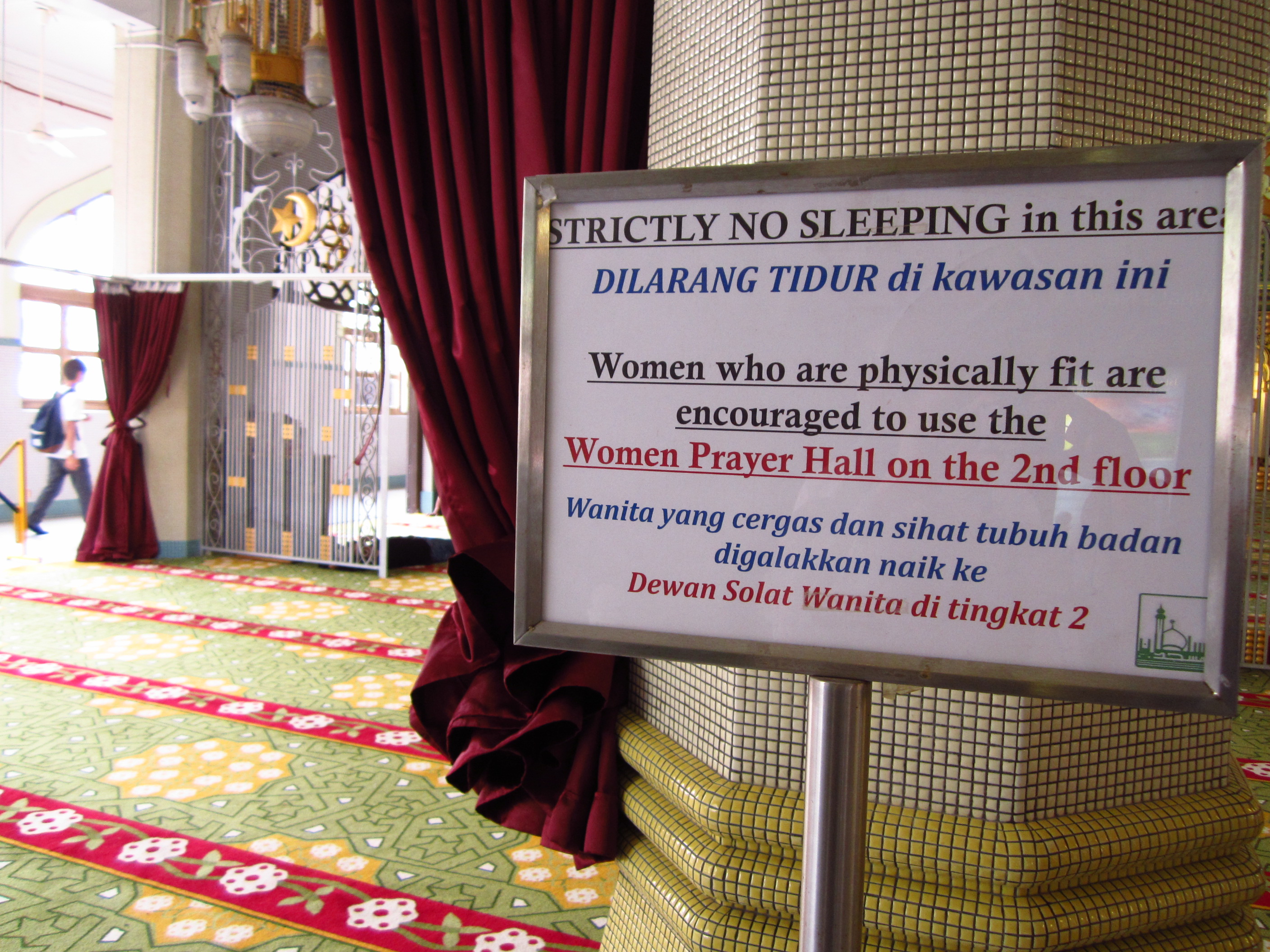
A sign found in Singapore’s Sultan Mosque encouraging fit and able-bodied women to use the second floor.

If Kamila were allowed access to this Yemeni mosque, where would her praying space be? In Singapore (and many other places), many of the women’s spaces are a floor or two above the main prayer hall. Without a lift, would Kamila have to crawl up the stairs every time she came to pray? In recent years, a historic mosque in Singapore has taken into account the needs of their aging congregation: a new tent-like space has been reserved on the main floor for women who are not able to climb the stairs to the second floor.

Surely we cannot continue to emphasise an individual’s determination in the face of barriers. We must take into account that disability and gender come together to produce unique sites of oppression. And mosques need to change to accommodate their congregation, too. 

Otherwise, who is the mosque for but only able-bodied men?

Monday, October 6, 2014

When you're being chased out of Eid ul-Adha prayer because of a baby

Hope everyone is having/had a blessed Eid ul-Adha 1435.

This was the first year that I was not alone in the women's section of the mosque, since being married. I'm largely unmosqued, mostly because I hate going to a mosque and then having to be separated from the Dutchman - with the exception of the Tokyo Camii (Mosque), where we prayed side-by-side in one of the first rows. (Being a musafir or traveller can buy you a lot of leeway, just plead ignorance.)

I know I'm not alone in having this sort of separation anxiety. Many other couples made up of one partner who is not raised Muslim, may similarly feel anxious being handed over to the 'sisters' or 'brothers' (ie total strangers) in a completely different part of the mosque. (I mean, somehow total strangers can be more helpful just because they are of the same sex?) That being said, I'm very proud of the Dutchman for being able to hold his own among these 'brothers' (after I prep him on what to expect).

This month marks the fourth year I've been in the Netherlands, and also four years of this blog! (So much for the initial title, A year in NL). It's also the fourth year that I've been going to the Indonesian mosque in my town. It's three storeys high, and the main prayer space is on the second floor (there's a complimentary balcony for women). The first floor houses some classrooms and a kitchen.

Spot the complimentary balcony
As with many other mosques that make space for women, during big congregations like the two Eids, this mosque repurposes the first floor classrooms into special rooms for women and children. All men go into the main area space, while the female congregation is split into four different spaces: the (complimentary) balcony, two or three saff or rows in the main hall, and two rooms on the first floor: one for women with children, and one for women without children.

I've always been a big supporter for equal and equally decent prayer spaces, and ever since I saw the room labelled 'women with children' four years ago I've told myself, hell no. By putting all the children into one room, it becomes extremely chaotic because the children don't see the imam and learn how to carry themselves during a congregation. Nothing against the need for children to play and run around - in which case why confine them to a room with women trying to get the best of both worlds? Just set aside a room dedicated to fun and games, get a few adults to watch them and ta-da, everyone's a winner. (By the way, this arrangement is exactly what several mosques in Singapore organised during tarawih sessions in Ramadan earlier this year.)

I rave about this mosque because of the low wooden barrier (lower than waist-height) that seems to nominally demarcate the male and female praying spaces in the main hall. But this year, with little Nootje I had to face the attitudinal barriers head on.

When we arrive at the mosque a good 30 minutes before the Eid ul-Adha prayer is due to start, I wave off the Dutchman into the main entrance and I go round to the side entrance. I saunter up the stairs to the main area space, carrying Nootje in my arms. I find a spot near the door ( to make a quick exit if he starts bawling) in the front row, look around for the Dutchman in case I decide to pass Nootje over to him, and settle down.

The takbir is being chanted over a booming microphone, which freaks out Nootje a bit. He unusually lets me carry and rock him in my arms, hardly moving (very rare since he doesn't like being held unless we're walking or bouncing him) since he's an hour overdue for a morning nap - I have high hopes that he will zone out through the noise or maybe even fall asleep (a mum can dream can't she!).

There's a mother on my left, with a 1.5 or 2 year old girl in a pink dress, who is sitting quietly. Not five minutes pass when one of the women who is working today as an usher for all the congregants tell me that babies are not allowed in the main hall. I decide not to point out the toddlers in the men's area, who are shrieking. The mother beside me quietly sneaks away to the second row and her little girl almost melts into the pipes along the wall - she's just as stealth as her mum!

I have so much to tell this woman who's trying to chase me down to the vrouw met kinderen room. 

Did she know that God loves the laughter of children? That the Prophet would shorten the prayer if he heard children crying in the congregation? That the Prophet's original mosque was relaxed and inviting? That if families were so highly regarded in our religion, they should be able to sit and worship together in the mosque, which is meant to symbolise society? That asking me to leave the area because I was holding a baby made me feel like a baby is unclean, unholy and unworthy?

Instead of all that, I fumble out an answer in half Indonesian and half English and respond to her order as if it was posed to me as an option: it's okay, I'm staying here. She looks confused and tries her command again, this time in Dutch, stressing that "it's the rules". Another woman chips in with English, because I'm beginning to look like a right tourist who doesn't understand anything anyone is saying.

By this time, another mother has taken the empty space to my left, and she has two children: one looks about 6 or 7 and the other is older. She helpfully tries to encourage me into leaving ("This is the first time I'm here [in the main hall]. All these years I've been downstairs.") but this only makes me determined to not banish myself.

I simply shrug and smile to both women and assure them that I'm not taking extra space and that Nootje will be quiet. Mosque lady is not satisfied, but happily she moves away to usher more women downstairs as the main hall is filling up. Woman to my right is ambivalent, and no one comes to my support. Clock is ticking... ten more minutes to prayer. I continue rocking Nootje and whisper the takbir in his ear.

Finally! The prayer starts, and it's an exercise in balancing a 8kg weight while bowing and prostrating without putting any hands on the floor. Takbir seven times with one hand, and hope that the communal and extra loud "Ameen" doesn't startle Nootje. He doesn't mind the shift in orientation during the ruku', and I make an almost-there prostration with him right under me. 

After the prayer ends, he is looking super tired (nap is two hours overdue by now) so I pop out a boob under my hijab to feed him. He contentedly nurses to sleep and I get to listen to 15 minutes of the sermon. And no one seems to mind the two toddlers running around in the men's section during the prayer. (The section which, by the way, had two extra rows free, which could have been filled up with women.)

The imam tells us the story of how when God created Adam, God told all the malaikat (angels) to prostrate to the first human being. They all did so, except Iblis. Iblis believed that being created from fire was better than being created from clay. Because Iblis disbelieved, he was sent out of Paradise for his arrogance (7:11-18).

(Side note: I'm often quoted this story from the Qur'an by those who think that whatever I write or post is controversial, or that I'm being arrogant and stepping over my God-given womanly boundaries, whatever those may be. Essentially, likening me to Iblis... stay classy, guys.)

But I love how the imam interprets this story. To him, the moral of the this parable is that even though God creates beings from clay, fire and light, all the creations lived in Paradise together. While we humans, all made out of earth and are all flesh and blood, can't even live together on Earth. 

Post-sermon selfie

Thursday, April 25, 2013

Why women shouldn't lead prayer: Prologue

Sometimes, people write my posts for me. An acquaintance, whom I knew in high school, and whom I never spoke too much with (even until today), appears to have discovered a new level of spirituality -- something I noticed was so common among my friends who hit the mid-twenties and start searching for meaning.

In young women, this often manifests itself as the decision to wear hijab. In both young men and women, this is manifested by the switching of Facebook profile pictures, notes, and photos with more Islam-oriented ones. Statuses are used as a channel for public supplications, photos of nature and/or some sort of peaceful scenery replace photos of their actual faces, and quotes from religious texts proliferate.

I had seen, a few weeks ago, this young man in question post a message aimed to dispel the notion that Islam oppresses women (le sigh, Islam doesn't, Muslims do). His contribution to this tired debate was a hadith telling people to treat their women kindly.
"The believer with the most complete faith is the one with the best character, and the best of them are those whom treat their women the best." (Tirmidhi)
But why don't people see that just because the Prophet said do something, it doesn't mean that we human beings actually act that way?

Articles with titles containing 'women', 'Islam', and 'status'/'role'/'rights' are inevitably going to be apologist, quoting religious texts on the rights of women (which can be used either way, mind you), dismissing oppression as unrepresentative of this mysterious monolith called 'Islam', and then usually concluding with praising the elevated status of mothers (and you wonder why you have to tell Muslim women who are stressed about getting married that that shouldn't be their main focus in life). (PS: not every woman can or want to have children, okay?)

I know people have the best intentions, but some people who know I have an interest in gender and Islam think that I am interested in the abovementioned genre of articles. So for the record: NOT INTERESTED. Make an effort to understand the diversity of women's movements within Islam first.

Source


Now on to the good stuff! Recently this article 'Dr. Amina Wadud and the Progressive Muslims: Some Reflections on Woman-Led Prayer' was sent to me as a sincere (read: patronising) aim at correcting my 'twisted' views on women in Islam, as represented by my gushing over this beautiful article by Asma Barlas on the need to claim for all of us to read and understand the Quran, and to remove the monopoly of interpretation from the authority of the (male) ulama. (Since the source links in that one suck, here's another.) The article by Asma Barlas touched briefly on why people need to chill TF out over Amina Wadud's imamate:
"...At least the people who prayed behind her have democratically selected her. The authority of an imam or leader of prayer is not the same as a priest or a pope. Nobody is going to be forced to obey her. An imam can be anybody leading the prayer. If people want to pray behind her, why not? If she is the most knowledgeable Muslim in that room and she can lead the prayer: why not?"
Health warning: Feelings may range from empathy to outrage, or flit back and forth while reading this article. This may or may not be good for your own emotional well-being and self-esteem.

In general, the author seemed to be torn between two camps: the mainstream, and her own gut feelings of being treated like crap in the mosque and in social interactions just for being a woman. She seems to go back and forth between demonising this strangely-homogenous-sounding group called the 'Progressive Muslims' and highlighting legitimate concerns of feminist Muslim scholars.

As an appetiser, I picked out a whole load of assumptions from the article...
  1. Progressives are one homogenous group of people as represented by PMUNA.
  2. Quran = Sacred law = Sharia law = Sharia of Allah.
  3. Feminist scholars have biases, but male scholars are unbiased.
  4. Progressive movements have no credibility because they promote sex outside of marriage.
  5. Non-Muslims have values different from 'traditional Islamic values'.
  6. Hadith should be accepted at face value, especially those with certain names in its transmission.
  7. Mainstream scholars agree that a woman cannot be imam. Two scholars said it was possible on certain conditions. These two are the minority and so the majority opinion wins.
  8. Female imamate divides society, so we shouldn't discuss it.
  9. Women's biological conditions (i.e. menstruation, pregnancy, post-partum bleeding) prevent 'complete' prayer.
    • Menstruation should not be advertised.
    • Prayer requires bowing and prostrating. 
  10. Women praying next to men does not produce an environment of mutual respect and piety.
    • Mixed congregation = touching each other's bodies.
    • Men will harass women once they are close to them.
    • Women are responsible for NOT being harassed.
  11. Prayer is either valid or invalid, according to jurisprudence.
  12. Shari' conceptions of gender identity exist. These are the true forms of gender identity. 
  13. Western scientists, Western gender theorists, Western feminists exist. They are inferior to Muslim scholars.
  14. Harsh male imams prevent women from going to the mosque. Not humiliating women will make them feel welcome in the mosque.
...which would make for an crazy long post if I were to address them all, so I've decided to split it up over 3 separate blog posts. Bon appetit!

  1. Quran = Sacred law = Sharia law = Sharia of Allah.
  2. Hadith should be accepted at face value, especially those with certain names in its transmission.
  3. Feminist scholars have biases, but male scholars are unbiased.
  4. Most Sunni and Shia scholars agree that a woman cannot be imam. Two scholars said it was possible on certain conditions. These two are the minority and so the majority opinion wins.
  5. Western scientists, Western gender theorists, Western feminists exist. They are inferior to Muslim scholars.
  6. Shari' conceptions of gender identity exist. These are the true forms of gender identity. 
  1. Prayer is either valid or invalid, according to jurisprudence.
  2. Women's biological conditions (i.e. menstruation, pregnancy, post-partum bleeding) prevent 'complete' prayer.
  3. Women praying next to men does not produce an environment of mutual respect and piety.
Why women shouldn't lead prayer Part III: On society
  1. Progressives are one homogenous group of people as represented by PMUNA.
  2. Progressive movements have no credibility because they promote sex outside of marriage.
  3. Non-Muslims have values different from 'traditional Islamic values'.
  4. Female imamate divides society, so we shouldn't discuss it.
  5. Harsh male imams prevent women from going to the mosque. Not humiliating women will make them feel welcome in the mosque.