Pages

Showing posts with label indonesia. Show all posts

Tuesday, January 2, 2024

Blackface and brownface in Indonesia and Singapore

This article was first published in ERIF Sinterklaas Brand & Product Study 2020: 5 Years of Monitoring Blackface in the Market, 2020. 

On a clear day a decade ago [2009] in East Java, where my grandparents were from, I found myself watching a carnivalesque procession of floats and performers of all ages, dressed up in marvellously colourful and shiny costumes. Behind a truck carrying a dozen heavily made up secondary school students were a group of men, painted shoe-polish black, with fabric leaves around their waists. I asked a relative beside me to explain this: “This group represents the transfer of mysteries from Irian Jaya,” he said, and I remained mystified.

A reog procession in Ponorogo, East Java in 2009.
Photo by author.

Only a year later, I would arrive to study and live in the Netherlands, discover the ‘tradition’ of Zwarte Piet. I did not make the connection until one day, at the annual concert of my academic institution, a group of students from Indonesia performed a variety of ethnic dances from their archipelago. Decked in costumes borrowed from the embassy, they demonstrated dances representing Sumatra, Java and Bali.

From video 'Yamko Rambe Yamko'

For their final piece, four male students appeared in pitch black full body leotards and paint marks on their faces, accessorised with raffia skirts. Halfway through, I realised that the grunting dance was meant to represent Papuans. An Indonesian friend who witnessed this performance too later told me that every 5th of December, people in her hometown in Ambon – who speak a creole inflected with Dutch words – dress up as Sinterklas, Suarte Pit (also known as Om Pit (Uncle Pete) or Pit Hitam (Black Pete), fairies and clowns (see Goppel, 2016 for a video).

From video 'Sie Gins Kom de Stoomboot - Sinterklaas Op De Molukken: Ambon'

In 2008, I was attending a conference on critical Islam when the conversation veered to the colonisation by Muslims of other peoples. I asked an Indonesian man in our group about colonisation of Papua and incidents of forced conversion happening there. His defence: “But they are a little primitive, backward, you know?”

Blackface and brownface in Asia

In American cultural history, blackface is used to portray racist stereotypes of African Americans through performances. As a representation of a ‘subservient black body’ lacking in intellect, coordination and other virtues, blackface is an ‘imposed conceptualising representation’ that has travelled across the globe (Reyes, 2014).

Ad for Dunkin Donuts in Thailand

In Asia, some recent incidents of blackface in print and television advertisements in Thailand (Dunkin Donuts in 2013), Japan (Astigu pantyhose in 2014) and Malaysia (Watsons in 2017) caused major backlash online. In Japan, African-American writer Baye McNeil led a campaign to remove blackface performances in 2015. In each incident, the initial defence was that the ‘local’ use of blackface does not having racist intentions, but a look into the country’s history reveals economic and political connections with colonial powers.

The Euro-American discourse on Black people has shaped the discourse in Asia more than actual encounters with Black people (Fukushima, 2011). This is seen in the influence of European and Hollywood films and minstrel shows in different countries. As cuisines from the colonies transferred to the metropole (Kuipers, 2017), cultural influences like Zwarte Piet and minstrel shows travelled to the colonies. In 1887, the year of the 50th anniversary of the accession of Queen Victoria, one of the celebrations in the British crown colony of Singapore was a costume race that included racial caricatures of ‘native’ communities of Chinese, Malay and Tamils as well as blackface.

A 1935 photo of Singaporeans in blackface republished in a 1980 Straits Times column.
National Library archives.

 Minstrel parties and groups were common in the 1930s. Each neighbourhood had their own minstrel group that performed at events, parties and weddings. Until the late 1980s, American and British minstrel performances were popular, available ‘live’ in theaters and on television, and described as “good family entertainment” (Kaur, 2019).

Closely related to the practice of blackface is brownface: the portrayal of racist stereotypes of Indians and other ethnic minorities by artificially darkening the skin, using visible ethnic or religious markers such as the turban, and adopting an “Indian accent” which involves head-shaking and rolled ‘R’s. The diversity of Indian ethnic groups like Punjabis, Bengalis, and Tamils are all collapsed into a homogenising, offensive stereotype.

Some Singaporeans had taken great offense at the use of brownface in the film Gunga Din (1939) and comedy Short Circuit (1986). However, in the last decade, there have been incidents of brownface that included corporate Bollywood parties, YouTube channels, and state media (Veerasamy, 2019). These have mostly gone unchallenged, and brownface was declared by government bodies to be “insensitive” but not illegal (Kaur, 2019). Tradition is not innocent either: in Malay folklore exists a blackface bogey man called Orang Minyak (‘oily man’), who commits voyeurism and abduction of young women under the cover of night.

Performing racial supremacy and inferiority

Showing minority populations with a history of racial oppression as varying combinations of primitive, backward, stupid, ignorant serves the discursive strategy of keeping them subordinated. The same processes occur globally, whether as a result of information flow and exchange with former or current colonising countries, or as a proven technique for keeping minority populations subordinated and establishing racial superiority both “on and off-stage” (Reyes, 2014).

The racial dynamics of non-White societies such as those in Latin America, the Caribbean (see Bonilla-Silva, 2004). and most of Asia, has gone largely unstudied and unanalysed. Within a discourse of white supremacy, the “reality and politics of a middle-racial category” can show us new ways of identifying and analysing racial interests.

Because the discourse of a ‘Black-White’ racial order is so pervasive, one of the common defences of societies without any majority White populations is that racism simply does not exist. However, the examples above have shown that while White racial supremacy exists globally, a similar, parallel process manifests in different forms as linked to local racial interests. Hence, the dominant group in a society will often enjoy economic, political, social and cultural privileges – all while also being linked to how near to Whiteness they can attain i.e. honorary White (Bonilla-Silva, 2004).

Just as the historical legacies of Black peoples are marked by “slavery, gender-specific servitude, conquest, legal segregation, colonisation, and socioeconomic peonage” (Reyes, 2014), so are the bodies of Brown and other racialised groups today in different ways and to different extents according to their contexts.

The colonised colonises: case of Indonesia

The Indonesian case illustrates all the above processes. Under Dutch colonisation, the practice of blackface was documented in the 1890s when a Malay-language commercial theatre group Komedie Stamboel performed stories from A Thousand and One Nights, which included a ‘black-amoor’ character meant to represent an African slave. As this actor announced the next night’s play (as per theatrical tradition), he used “broken Dutch mimicking an African” mixed with malapropisms, Malay and low Javanese words (Tjerimai, 15 November 1893; in Cohen, 2004).

In 1945, the new Indonesian republic declared independence from the Netherlands and claimed the entire territory of the former Dutch East Indies. What was Western New Guinea remained under the Dutch until the mid-1960s, when a controversial referendum resulted in the Indonesian annexation of the region. Thus in 1962 with the New York Agreement it became the province of Irian Jaya and was later renamed to Papua and West Papua in 1999 (the eastern half of the island being independent Papua New Guinea). Organisasi Papua Merdeka (Free Papua Movement, or OPM) was established by West Papuan nationalists, who rejected the compromised referendum.

Blackface and racist stereotypes of Papuans justify economic exploitation through extraction of natural resources. Papua houses Grasberg, the world's largest gold mine and third largest copper mine. It is operated by Freeport Indonesia since 1973, a subsidiary of US-owned Freeport McMoran Copper and Gold. The mine dumps waste in the deltas and rivers, destroying food sources and degrading the environment. Military and police oppression, kidnapping, torture, and surveillance of religious and local leaders are all attempts to contain any protests or demands for self-rule. The profits of mining are not channelled back into the province, where Papuans live in poverty in addition to dealing with Indonesian settlers from other islands.

In the national discourse, the province is seen as valuable to the country because of natural resources and biodiversity. However, Papuans who study and work in cities on the major island of Java face racial discrimination from both the general public and the police. In August this year, Papuan students in several cities protesting the 1962 agreement were accused of vandalising the Indonesian flag and were arrested, sparking protests in West Papua demanding justice for the students with banners saying ‘kami bukan monyet’ (we are not monkeys) and social media hashtags #papuabukanmonyet.

Demasking blackface

[…] all people are defined according to a set of terms that are constructed as mattering by those in positions of power or by those with investments in maintaining social hierarchies. To “see” “racial difference” is thus not to actually see differing bodies, but to see bodies as fundamentally marked by a particular way of viewing, with a particular emphasis on certain aspects of embodiment. (Riggs, 2008)

What does it take to demask the harms of blackface and brownface, when they are often hidden under the guise of humour? The first step is to make the connections between what seems like ageless cultural traditions and transnational flows of conceptualised representations. What seems to have always been there needs to be situated in a historical context. Excavating the past may also reveal more a history of progressive action and refusal of blackface and brownface.

Next is to understand that the performative use of blackface and brownface creates and reinforces racial hierarchies in a society. While in some contexts, brownface is used with reference to local dynamics while blackface to global dynamics, both build on each other and have a shared goal of dehumanisation, subordination and oppression in the service of larger economic ends. Finally, as culture is dynamic, it is always possible to create or bring back alternative performances that humanise historically marginalised peoples.

References

Bonilla-Silva, Eduardo. 2004. “From Bi-Racial to Tri-Racial: Towards a New System of Racial Stratification in the USA.” Ethnic and Racial Studies 27 (6): 931–50.

Cohen, Matthew Isaac. 2004. “Thousand and One Nights at the Komedie Stamboel: Popular Theatre and Travelling Stories in Colonial Southeast Asia .” Middle Eastern Literatures 7 (2): 235–46.

Fukushima, Yoshiko. 2011. “Ambivalent Mimicry in Enomoto Kenichi’s Wartime Comedy: His Revue and Blackface.” Comedy Studies 2 (1): 21–37.

Goppel, Daan. 2016. “Sie Gins Kom de Stoomboot - Sinterklaas Op De Molukken: Ambon.” YouTube. 2016.

Ho, Michelle H.S. 2017. “Consuming Women in Blackface: Racialized Affect and Transnational Femininity in Japanese Advertising.” Japanese Studies 37 (1): 49–69.

Kaur, Sharan. 2019. “Everything Old Is New Again: Singapore’s Long History with Blackface.” Coconuts Singapore. 2019. https://coconuts.co/singapore/features/everything-old-is-new-again-singapores-long-history-with-blackface/.

Kuipers, Matthijs. 2017. “‘Makanlah Nasi! (Eat Rice!)’: Colonial Cuisine and Popular Imperialism in The Netherlands During the Twentieth Century.” Global Food History 3 (1): 4–23. https://doi.org/10.1080/20549547.2017.1279515.

Reyes, Angelita D. 2019. “Performativity and Representation in Transnational Blackface: Mammy (USA), Zwarte Piet (Netherlands), and Haji Firuz (Iran).” Atlantic Studies : Global Currents 16 (4): 521–50.

Riggs, Damien. 2008. “How Do Bodies Matter? Understanding Embodied Racialised Subjectivities.” Darkmatter. 2008. http://www.darkmatter101.org/site/2008/02/23/how-do-bodies-matter-understanding-embodied-racialised-subjectivities/.

Veerasamy, Visakan. 2019. “It’s Time for a History of Singaporean Chinese People in Brownface.” Twitter. 2019. https://twitter.com/visakanv/status/1156127173721251841.

Thursday, May 19, 2016

Mouthpainter shares story of love at first sight (Part 2)

This article was first published on AbleThrive. Read Part 1 here!

--

One evening when they were working late in the office of their organisation, the Bandung Independent Living Centre, Indonesian mouthpainter Faisal Rusdi finally confessed his feelings to his childhood crush, Cucu Saidah. He had been keeping his feelings for his colleague and soon-to-be-wife to himself for 24 years.

When asked to describe what he loves most about his wife, he said candidly, “I liked her thick eyebrows. She is beautiful, very intelligent and she loves me.”

A year after dating, they decided to marry. But first, they had to break the news to their parents. “My mother and my family were surprised, overwhelmed and happy,” said Faisal, who is based in Bandung, Indonesia.

However, Cucu’s parents did not like the idea of them being together. “They tried to keep us apart, to the point of keeping her at home,” said Faisal. “I think they considered me severely disabled and unable to take care of myself.”

Through one of her brothers, Faisal tried to communicate to her parents. “My uncle and my family approached her family to ask for her hand many times but we were refused.”

Increasingly stressed and frustrated, Cucu grew distant from Faisal, who struggled to accept the reality of his situation. “But her love for me became stronger, and for me as well. We kept trying, and praying and consulting with many people,” he said.

Eventually, they decided to solemnise the marriage through a legal procedure that overrides the bride’s need for a wali, or guardian – the closest male relative – since her father was against the marriage. Finally, the religious court granted them a wali hakim, or a judicial guardian.

“We still invited her parents and family to the wedding, but not one of them attended. Only my extended family and our friends,” said Faisal.

Faisal and Cucu in traditional wedding outfits from Padang, West Sumatra, enter the accessible reception hall on their power wheelchairs during their wedding in Bandung.

After the wedding, the couple continued to reach out to Cucu’s family and their efforts eventually paid off. “Eight months later on Idul Fitri [a celebration after the fasting month of Ramadan], her parents started to accept us slowly,” he said.

Faisal and Cucu were married on 30th November, 2008 in Bandung. As his parents were originally from Padang, the couple chose to follow West Sumatran customs and traditions for their wedding. Naturally, since both Faisal and Cucu are electric wheelchair users, the event hall and wedding dais were designed to be as accessible as possible.

The wedding was just the start of a relationship with unique challenges, which widens the common but narrow conception that the daily work of marriage only involves two parties. For example, Faisal hires a regular caregiver. “The role of assistants/caregivers who help me in my activities is extremely important, and I do not deny it,” he said.

“An assistant [knows] the technical and ethical aspects of accompanying a person with disabilities. He is a good friend who understands me well, and is part of my life. The presence of an assistant completes my independence.”

While the couple strongly promote a definition of independence from their perspective – that includes the presence of an assistant and not solely the ability “to manage oneself” – they still have to deal with society’s misconceptions of their relationship.

“[People think] that we are not able to manage a household, be physically and financially independent, or not able to have or raise children,” said Faisal.

As for their marriage goals, Faisal and Cucu look towards helping their broader community as well. “Both of us want to own or start an art restaurant or cafe where people can come to not just eat but communicate, educate and advocate about an inclusive community.”

Wednesday, May 18, 2016

Mouthpainter shares story of love at first sight (Part 1)

This article was first published on AbleThrive

--

For professional mouth painter Faisal Rusdi, 41, who was born with cerebral palsy, love at first sight isn’t simply a cliché.

Faisal first saw his wife, Cucu Saidah, on his first day at a special education school in Bandung, Indonesia. It was 1983, and back then there was a flag-raising ceremony every Monday. Cucu was standing just a few metres in front of him – she was leading the ceremony.

“In that moment, I knew I liked her immediately,” said Faisal. “Perhaps we could say it was love at first sight, at nine years old.” However, Faisal’s nine-year-old self was “shy, reserved and quiet.” Throughout the four years of elementary school, he never even greeted or spoke to her. Later, Cucu continued her secondary education at a mainstream school, while he remained at the same special school. They occasionally met each other at school reunions, where they had brief conversations. “I still felt the same as I did. I liked her, but I kept it to myself,” said Faisal.

To take his mind off her, Faisal threw himself into drawing and painting. In 2002 he was part of the Association of Mouth and Foot Painting Artists (AMFPA). The next year, Cucu returned from 10 months in Japan, where she had been following a leadership training on independent living. She began to apply this philosophical knowledge through events and workshops. Faisal found himself at one of these events, at the insistence of a friend and fellow painter.

‘Why, Faisal jealous ya?’

“I met Cucu after such a long time. I greeted her with a smile and at long last, we became friends,” said Faisal. Together with her friends, Cucu invited him to work in her organisation, the Bandung Independent Living Centre (BILiC). Faisal soon replaced Cucu as the head of the organisation as she had accepted a job in the US, although she soon returned in 2004 to BILiC as a consultant. As they continued working together, Cucu had no idea that Faisal’s feelings for her were growing stronger by the day.

One day in 2007, they were working late in the office – long after their colleagues had left. “As we worked, Cucu chatted with me and I don’t know why, but I told her that I had once dreamed of her walking with some guys that I knew. She replied jokingly, ‘Why, Faisal jealous ya?’”

“I was a bit scared. Slowly, I turned off my computer and told her everything,” said Faisal. Cucu was surprised, because he had been keeping his feelings from her for the past 24 years. “I made her promise to not get angry, to not make fun of me, or to tell our friends because I felt embarrassed.”

Confessing his feelings to Cucu was the easy part of their courtship. Faisal soon had to overcome many other obstacles before he could marry the woman for whom he had fallen at first sight – at nine years old.


Read more about what Faisal had to overcome to marry the love of his life in Part 2 next week!

Saturday, May 14, 2016

Leaping over language barriers

This article was first published on Aquila Style.

Adventures in picking up a new language doesn’t have much to do with meeting new people.
Image: Pixabay
At this moment, I live unwillingly in the Netherlands. I didn’t move here because I loved the language or the culture. After three and a half years, I can understand most of what people are saying, but since I haven’t had (read: couldn’t afford) any formal lessons and I’m not particularly fond of the language, the Dutch language requires the activation of a whole other part of my brain.

I’ve nothing against learning new languages. Or European languages for that matter. I stuck through French lessons in middle school before I finally realised how I actually loved speaking it when I participated in an immersion programme in a sleepy French town (and later, studied there for a year). I still speak decent French and try to not lose my skills by watching French films. And because I already speak English by virtue of being born and bred in a former British colony, I think two imperialist languages are enough for me, thank you.

The thing about speaking Dutch in the Netherlands is that… you don’t have to. Most people in the big cities speak decent English, which is enough to get by if all you want is to buy groceries at the supermarket, or find your way with public transport.

But there’s a double standard when it comes to speaking the local lingo. If you’re a Caucasian or European, you’re not expected to speak Dutch. Laws that allow free movement in the European Union also mean that for Europeans, learning Dutch is merely voluntary. However, for me as a non-European permanent resident, I have to take a language exam in the next two years or risk a severe fine.

Here, there are two types of people who are usually assumed to be unequivocally Dutch: White or Brown (thanks to colonial history). Because my appearance is typically Javanese or Indonesian, I’m often mistaken as being Dutch. Many Dutch people also have grandmothers or great-grandmothers who came over from the former colonies. These women often attempted to integrate totally by adopting the local language and ways of life.

At one point in time, I figured I’d similarly integrate by forcing myself to speak and listen to Dutch. I decided to start in a prenatal yoga group that I had just joined. I figured that I would do okay since I could understand most words relating to movement and parts of the body. Plus, it was a good opportunity to learn the relevant vocabulary for labour and delivery.

It turned out to be a very lonely 10 weeks. Even though I tried my best to speak a little bit of Dutch each lesson to the yoga instructor and to the other participants, I never got around to actually striking up a semblance of a friendship with the other mothers. Perhaps it was our age difference: Almost all the other women were well into their 30s, and some in their 40s. Perhaps we lived in different places: They live in the suburbs and I live in the city. Or perhaps I was just the only non-White person in the whole group.

I had a very different experience in a postnatal Pilates class I’m currently attending. It’s a small and cosy studio not too far from where I live, run by an English woman and attended by many English-speaking people (even though most of the instructors are Dutch). I take two different classes, and both instructors willingly carry out their lessons in a mix of Dutch and English to make sure I can understand.

I’ve also met some kindred souls in this class – a total change from awkward attempts at conversation in my previous yoga class. Whether it’s because women are more sympathetic when they can bond over how bad their hospital experience was, or whether it’s just a friendlier group of women, I haven’t needed to speak Dutch at all. (Besides, my go-to excuse is that my brain is too sleep-deprived caring for a baby to string together a sentence.)

I realised then that it’s not about the language we speak, but about our willingness to know the other. Now when someone speaks to me in Dutch, I don’t feel obligated to reply in the same language to prove I’m a “good” migrant. I’m perfectly happy to speak what is most comfortable to me because what is more important is our effort to communicate, not the language we communicate in.

Thursday, March 10, 2016

Indonesian fashion brand gets halal status, ruffles hijabs of many


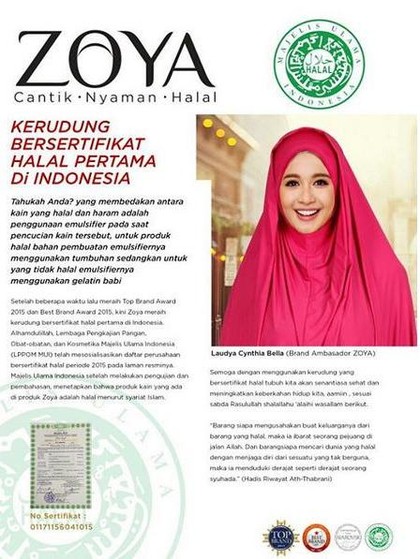
Earlier this month, the appearance of Indonesia’s first halal-certified hijab, sold and promoted by Indonesian fashion company Zoya, provoked equal parts protest and support. According to the certification given by the Indonesian Ulama Council (MUI), Zoya’s hijabs are ‘halal’ because the fabrics are produced with the use of only plant-based emulsifiers, and not those made from pig gelatin. Zoya has also erected a billboard in a few major towns with the tagline “Are you sure that your hijab is halal?“


Online, some responded with incredulous sarcasm. Some said that if the fabric for hijabs had to be halal, then every article of clothing (including underwear) had to be halal as well. Others pointed out that if there were ‘halal hijabs’, then, there must necessarily be ‘haram hijabs’ existing from the beginning of time until Zoya. Some questioned if the halal certification would not be completely unnecessary after washing the hijab, especially before wearing it for the first time? And some contended that many women, after their umrah and haj, still buy abaayas made in China, which are more likely to be washed with pig gelatin-based emulsifiers.

A hijab that is clearly ‘halal’, while its competitors are not, is an example of strong product differentiation. Instagram celebrity and hijabi blogger Fifi Alvianto sees this ‘halal hijab’ as a marketing tactic. She explains, “In the religion [Islam] there hasn’t been discussions on halal fabrics, at least not as clearly as halal food.” However, Zoya’s creative director Sigit Endroyono said that their intention was only to help consumers feel confident and at peace with their hijabs. “As sellers, we are responsible for our customers’ tranquility. We try to fulfil the right of our customers by ensuring the permissibility of our clothes and headscarves.”

Despite these non-pecuniary motivations, the company’s sales manager Chandra Rahmad, admitted that the controversy surrounding their ‘halal hijab’ has resulted in an “unintentional” but “extraordinary increase” in the sales of Zoya’s products. Zoya has since retracted their advertisements on Instagram, as well as all but one billboard, and apologised in a press meeting.

It is perhaps not a surprise that Zoya chose to embark on such an aggressive marketing campaign, especially in the light of the recent introduction of a hijab and abaya collection from Dolce and Gabbana. This comes after several years of one-off and aurah-friendly Ramadan collections from DKNY, Tommy Hilfiger, and Oscar de la Renta caftans. Even more affordable brands like Uniqlo and Mango have kept up.

I appreciate the critical response from certain segments of Indonesian society. While there were certainly people who bought Zoya’s hijabs after they were certified halal, there were also others that spoke out against the absurdity of ensuring that hijabs — a non-consumable — were also halal.

Hijab designer Rani Hatta admits to being confused by the halal certification for hijab fabrics, “I thought all along that clothes that cover the aurah, are loose-fitting and don’t show the shape of the body could be worn.” Famous Indonesian designer Dian Pelangi also echoes Rani’s opinion, “Cosmetics and beauty products are absorbed into the skin, so we need to make sure that the products we use are halal.”

However, I do feel disappointed that none of the critics mentioned fair trade or ethical working practices play a role in determining whether a fabric is ‘halal’ or not. The director of MUI’s department of Food, Medicines and Cosmetics Research (LPPOM) Lukmanul Hakim clarified that the Zoya brand is not halal as a whole — just its fabric. He mentions other processes but unfortunately, his discourse remains at the superficial material level and does not go deeper to address social practices, “Zoya claims its [hijabs] to be halal […] They say that it’s because they use halal materials. But doesn’t fabric need to be sewn? Is their thread halal too? We don’t know that yet.”

MUI’s head of Halal Information Farid Mahmud said that there are now many companies that submit applications for halal certification. Companies that produce shoes, belts, paper and even social organisations have applied:
“Some laundromats provide soap and water that are guaranteed to not contain ‘najis’ [ritual impurities]. The biggest paper factory in Indonesia also submitted an application because their paper is used for printing Qur’ans […] Consumers just want to make sure that although not for eating, these materials are not contaminated with najis. Producers consider it as an obligation in accordance with Islamic law.”
In the production of cotton for example, there are several political issues related to ‘halal’ we could choose to educate ourselves on, such as Genetically Modified (GM) cotton reduces biodiversity; intensive farming uses pesticides, insecticides and fertilisers; cotton-picking in some countries like Uzbekistan is still done by hand and allegedly by children; textile processing uses high amounts of water and energy. Meanwhile, many synthetic fabrics are non-biodegradable and use harmful chemicals during processing.

Elsewhere I have written that the Qur’an encourages us to do ‘good works’ instead of committing abuse and oppression when eating or drinking — which we could reasonably extend to whatever else we consume.”[…] the source of our food and drink is important – it must not cause pollution or destruction of natural habitats, and it must not be produced by underpaid or exploited workers.”

The controversy of a ‘halal hijab’ has opened a discussion into what makes a thing halal or not. Unfortunately it seems that for Indonesia at least, Muslim discursive circles on ‘halal’ have yet to intersect with social justice discourses on fair trade, organic farming or sustainability.

All quotes have been translated from Bahasa Indonesia.

Thursday, March 3, 2016

Why does an Indonesian woman need to be a virgin to join the military?

This article was first published on Muslimah Media Watch.

Source

An expose by Human Rights Watch (HRW) in November 2014 on the use of virginity tests in Indonesia’s police force has revealed that just because people are silent over a long-standing practice, it doesn’t mean that it is accepted as a normal part of everyday life. Also referred to as the “two-finger test”, it involves a female physician inserting two fingers into the vagina to check for vaginal laxity and the presence of an intact hymen. Women who failed the test are not necessarily rejected, but may receive fewer points for their physical assessment and have further background checks.

The head of the national police law division, Inspector General Moechgiyarto told the media that “the chief objective of the test was to ensure that female cadets lived up to high moral standards” and implied that non-virgins (at least according to the test) are prostitutes and therefore unacceptable candidates.

The tests have been taking place since at least 1984, according to a testimony by a retired female air force officer given to HRW. This HRW report calls for an “[immediate] end the use of so-called virginity tests, which violate the prohibition of cruel, inhuman, and degrading treatment under international human rights law.” According to HRW’s research, all branches of the military – air force, army, and navy – have been requiring the test for decades for not only women planning to enter the military but also the fiancées of military officers. Women with connections to powerful or important people in the military can pay bribes to avoid the test, or obtain a favourable assessment.

In interviews with HRW, women who have undergone the test described the experience as “tense”, “embarrassing”, “humiliating”, “against the rights of every woman” and a form of “trauma”. A female doctor who had administered the test described it as “torture”, even.

Several Indonesian ministers and senior military officials are defending the practice. However, the country’s highest Islamic authority, The Indonesian Council of Ulema, says that the practice goes against Muslim jurisprudence. A district head ulema, Syarifudin Damanhuri, suggested “a religion test instead, arguing that it would give military recruiters a better profile of an individual’s character”.

The Commission for Missing Persons and Victims of Violence (Kontras) chairman Haris Azhar said in the Straits Times that the police has no good reason for requiring the test.
“The police should be ashamed. They’re not moral police. It actually makes us question the morality of the police force itself.”
As a practice instituted by the state, the test appears to serve two purposes:
  1. To teach what it means to be a proper Indonesian woman, wife and/or military recruit.
  2. To keep Indonesian female soldiers subordinate to their male superiors and the masculine state.
The work of Nira Yuval-Davis on gender in nationalist projects helps us to understand this better. While men are usually discussed in terms of their physical abilities to defend the nation, women are spoken of in terms of their capacities to produce citizens and therefore define the borders of a nation. They are the “symbolic bearers of the collectivity’s identity and honour”. With their “‘proper’ behavior” and “‘proper’ clothing”, women “embody the line which signifies the collectivity’s boundaries.” Women in the military thus carry a double burden.

"The test is discriminatory and degrading."

Indeed, the head of Indonesia’s Armed Forces General Moeldoko sees Indonesian women as being responsible for the identity of the military and the state. In The Jakarta Globe,
“[Moeldoko] conceded, though, that there was no direct link between a woman being a virgin and her abilities as a member of the armed forces, but insisted that virginity was a gauge of a woman’s morality — one of the three key traits he said a woman must have to serve in the [Indonesia Armed Forces], along with high academic aptitude and physical strength.”
There is obviously the double standard which absolves Indonesian men of the need to be ‘moral virgins’. National Commission on Violence Against Women (Komnas Perempuan) chair Yuniyanti Chuzaifah explains best why virginity tests are wrong – and in the plainest words. (Her commission has requested a meeting with the chief of the national police to discuss the issue.)
“It is wrong to judge women based on the rupture of the hymen. The virginity test violates the right of women to work – in this case to become a police officer. Moreover, their male counterparts do not take a similar test or face judgment over their virginity. The test is discriminatory and degrading.”
The fact that senior officials saw the need to defend virginity testing only after HRW’s call to stop it suggests that what it means to be the ideal Indonesian/Muslim woman is often reinforced in opposition to the imagined Western/non-Muslim woman. Indonesian women should not have sex before marriage, gaining a superior moral status from their chastity. Their morality affects not only the reputation of their (military) husbands and (military) families, but also the “dignity and the honour of the nation.”

At the same time, the test is not accepted by the women who have to undergo it. In an interview with HRW, one retired air force officer wondered how she could “defend the honour of our nation if we cannot defend our own honour” by undergoing such tests. Could this test be a way to remind women who do make it into the military that no matter how strong or intelligent they are, they will not be treated the same as men when it comes to defending their country?

Nira Yuval-Davis acknowledges this “ambivalent position” that women have within the nation.
“On the one hand (…) they often symbolise the collectivity unity, honour and the raison d’etre of specific national and ethnic projects, like going to war. On the other hand, however, they are often excluded from the collective ‘we’ of the body politic, and retain an object rather than a subject position. […] Strict cultural codes of what it is to be a ‘proper’ woman are often developed to keep women in this inferior power position.”

Saturday, February 27, 2016

On feminist alliance and participatory media-making.


--

Writing (for Muslimah Media Watch and other platforms elsewhere) has opened up many opportunities to collaborate with other activists from around the world. In particular, some articles I wrote on female circumcision (and also male circumcision) a few years ago attracted a lot of attention from activists and filmmakers, and a fresh round of conversations about these articles prompted me to gather and reflect on these transnational interactions.

A few years ago, while I was still living in the Netherlands, a Dutch non-government organization contacted me. They were looking for a gateway into the homogenized ethnic group of “Islamic Indonesian or Malaysian background”. Even though I specifically identified myself as being a Malay (ethnic group) Singaporean (nationality), they mistook me for an Indonesian. Indonesia and Malaysia are two different countries, and Indonesia alone has over 15 ethnic groups – facts that I would have hoped an NGO would be aware of if they were targeting this demographic.

Dispersing the misconceptions about ethnicity, nationality, and diasporic communities was work enough. Then they asked me to help them find other recent immigrants who “may not be informed about the consequences if they have their daughter circumcised.” Their assumptions about immigrant Muslim women and their culture(s) were ominously foreshadowing the recent Dutch policy to teach “gay rights” in refugee centres. Both parties paint immigrants and refugees as being inherently misogynist and homophobic.

(Can we get #NotallMuslimwomencircumcisetheirdaughters trending?)

Soon after, I received a request from an filmmaker working on the issue of routine male infant circumcision (MC). She was looking for doctors or parents in either Malaysia, Indonesia, or Singapore (though anyone from “Africa or Asia” would do) who supported the less invasive forms of female circumcision (pricking, slitting) – and she wasn’t planning on portraying them in a negative light. The purpose of juxtaposing FC (which is normally considered abhorrent) in other countries to male circumcision in the US was to help point out to Americans of their “cultural blind-spots” and “double standard”.

However, it would make more sense to change just one variable instead of two. For example, how about comparing “American” forms of genital cutting such as labioplasty/vaginoplasty to male circumcision? Instead of you know, using the rest of the world as a setting to help Americans learn more about themselves.

Most recently I was asked, by an photographer-filmmaker, to find some women or girls who had been through FC. More specifically, she wanted to film the procedure and some interviews – keeping all parties anonymous. Then: “They can wear their burqas if they want to.” #NotallMuslimwomenwearburqas

In all of the above interactions, I felt conflicting emotions. On one hand, I wanted to raise awareness about FC and MC. However, on the other hand, I felt like the person’s interpretations of the topic were being forced on me. In the case of being asked to provide contacts, I felt like they were forcing their way into an extremely intimate subject – information which had required time and emotional effort on my part to obtain – making me feel like an unwilling ‘native informant’.

As a result of feeling coerced, I curiously started to become defensive. In my mind, I even wanted to defend these practices – FC in particular because of the ‘milder’ nature more prevalent in Southeast Asia – against the onslaught of eager activists. It was a wholly reactionary defense mechanism.

Multiracial alliances can fail or be productive. As in all relations of power, there are lines of privilege to consider. I feel that immortalising representations of Muslim women through the making of media (books, films, policy papers) is something to be especially careful about. What would make me want to collaborate? What would make it worthwhile?

There was one more request by an European activist, who requested me to answer a series of questions on FC. Initially suspicious (seriously you can’t blame me though), I asked her many questions about her background, work, motivations and objectives, to get a better idea about how she was planning to represent the situation in Southeast Asia. In the end, our interactions were open, pleasant and productive, so I ended up contributing my experiences.

In her book Power Lines: On the Subject of Feminist Alliances (2008), Aimee Carillo Rowe writes:

“There’s the colour of the body, and then there’s the colour of the commitment that burns like hot blue flame in our hearts… Our work is to turn ourselves inside out. To locate ourselves through our loyalty and our bravery and our willingness to fight for radical visions.”

The only project I ended up contributing to was one that I felt I had the most control over. Not only did the collaborating activist ask mostly open-ended questions, the published text is also made up mostly of quotes. This shows a willingness to let people speak for themselves (as far as it is possible in a textual form). I suppose then, what makes a collaboration worthwhile is if we can control our own representations and get our message across at the same time.

PS: I almost forgot about the random White male law student who had written a paper about FC and was looking for my feedback. When I asked him why he wanted to send it to me, he said he thought it would be ‘as much for my benefit’ as others had been ‘extremely appreciative’. I think I forgot to give him any feedback.

Thursday, January 15, 2015

7 ways to ace the Dutch integration exam

Last month I spent eight hours in a centre proving how worthy I am of staying in this country. In other words, the Dutch integration exam or inburgeringexamen.

As I walk into the ordinary looking building that houses several other offices, about 30 faces greet me: mostly brown, some are white. Some are married to people holding Dutch passports and must do the exam or risk a fine, some are refugees who have lived here for almost a decade and need a Dutch passport, some are from rich countries looking to gain another citizenship in order to become "a world citizen", some have come in the 70s as guest workers and have to show that they haven't been creating their own ethnic ghettoes, others are economic refugees or students looking to escape their countries.

I fall under the first category. But I'm about to find out that this exam is not created to take all these candidates into consideration; it's just one long day of alternate feelings of embarrassment, amusement, outrage and pity.

It doesn't take long to be micro-aggressed. First I have to register, standing face to face with an overly chirpy Dutch woman who makes it a point to note on my paper that although my name is too long to fit on my residence permit, it is indeed my name and I am not posing as someone else. Smiling too much and enunciating each word slowly, she even tells me that since my hairstyle is different from my photo, I need to tuck my hair behind my ears because it's hard to tell brown people apart or something. 

I chose to do all 5 exams in one day: Dutch language listening, speaking, writing and reading skills, and knowledge of Dutch society (kennis nederlandse samenleving). Each test presents a few "cases" or situations, with 2 or 3 related questions. They're all done on a computer except for the writing test. One participant who is on her third attempt tells me that the speaking test used to be done with an examiner, which predictably makes things more stressful. With the new format, you watch a video of someone making small talk and asking a question. You record your reply in the software and you can repeat until your time is up.

I laugh out loud at certain questions, because they were so ridiculous. But I know I just have to put aside any critical thinking skills (saving it for this blog post) and just give the right answer. So here you go, here are 7 ways to ace integration, the Dutch way.

1. Work a labour-intensive job and don't study too much

One of the writing tasks is to compose an email to a colleague (you work together in a cleaning company) asking her to please vacuum the next day because you forgot to do so, and explain what you'll do for her in return. My vocabulary on household chores is pretty poor (because hey, I don't go around talking about it), so I come up with the only thing I knew the words for: that I'll clean the windows.

In one of the questions for the speaking test (which consists of only a handful of actual speaking into the microphone and then a series of multiple-choice questions on what your best response would be), you have to pretend to be a (Black) baker, busy packing something when your (White) boss asks you to get him coffee. The computer suggests that you can give a plain "no", you can tell your boss to get his own coffee or that you can tell him that you're busy. It's clear you need to say no without pissing off your boss. (No points for guessing the right answer.)

Other situations involve characters that work in a nursing home and supermarket. While their ethnicity or cultural background is not overtly stated, there are obvious clues that they are Moroccan, Turkish, or Black Antillean. There are some situations with characters pursuing some sort of education, but these are limited to vocational courses like cooking.

2. Submit to authority 

Meet Zam (not his real name). He has a headache and he goes to the doctor, who prescribes him a medication. He doesn't feel too good after taking the meds for a while, so he stops taking it. He shouldn't have done this even though he may know the best for his body (this is actually one of the answer options, but it's accompanied with a very Photoshopped photo of Zam looking like an arrogant know-it-all so WINK WINK). Instead, he should apologise to the doctor for not having consulted him first. (Though from my experience with medical professionals here and how some pretend they cannot speak English unless you're White, they should be the ones apologising to you.)

3. Learn the value of (White) opinions

In life, you will hear about the trials and tribulations of others. If you hear about a jewellery store robbery, you need to learn to accept that robbers are perhaps poor people who needed to eat (I'm pretty surprised at the compassion taught in this example but anyway). It's unacceptable to say that this is a ridiculous idea or that one is forbidden to have such ideas.

If you tell someone else that you plan to divorce your wife and said friend is not married, you must not assume that said friend doesn't know anything. White people can have an opinion on any and every topic (including how C-sections are not all that bad hey, true story) and you must listen to this opinion because, free speech. To be properly integrated, you should ask him why he holds such an opinion even though you're starting to feel mighty irritated.

4. Love gay people

This is very important. Probably the most important thing that determines your worth as an immigrant. It's not important to think of people as being on a continuum of sexual orientation, but rather that "homosexuals" are a simple alternative to "heterosexuals". Trans? Queer? What's all that complexity?

Just remember that gay people are allowed to hold hands anywhere in this country. Especially if they're white. Never you mind about the hostility faced by queers of colour (or God forbid, couples of colour!). Just love them for being lucky enough to be living in this country of freedom.

5. Love the police

Never mind that if you look Moroccan or Turkish, or if you have dark skin, you're more like to be stopped by the police on the street. Never mind also that you can be shot for merely putting your hands in your pockets because it looked like you were reaching for a gun.

Repeat after me: the police is your friend. If you are just taking an innocent walk around the block with your wife and you see a young man in a hoodie throwing a brick through a shop window, what should you do? (hint: call the police.) If you encounter a group of protesters who are suddenly attacked by a mysterious group of young men (with the same hoodies), what should you do? Just. call. the. police.

6. Accept whitewashing of history

Meet Dinh, a new immigrant from Vietnam. He wants to learn more about Dutch history so he goes to the museum. There he sees an exhibit about the VOC (Dutch East India Company). Now as a migrant from a former colony of France, Dinh probably knows a thing or two about colonial powers, so he knows that the VOC didn't just go what is Indonesia today to simply trade in spices so they could establish Conimex.

But just pretend that that is all they went there for. Colonisation, oppression, violence -- that's all much too messy for the integrated mind.

7. Know that this is not real life

It is striking how the test tries to consciously work against stereotypes. Although many practice questions for the test focus on how this country is the land of gender equality (where men and women split housework 50-50, where contraception is seen as female emancipation, and where men are not allowed to hit women), during the test you'll meet a white man who hits his wife and kids, while his Moroccan neighbours are left with the awkward dilemma of trying to get him to stop drinking, get a job and stop abusing his family (no idea why you can't call the police in this case, because it seems like a pretty good option).

This Moroccan couple has the darndest life. Not only does their daughter's bicycle get stolen, but one day they encounter a group of white protesters on strike, demanding higher wages. For some reason, they are attacked by a few young brown boys in hoodies (I get it, hoodies are scary).

The most important thing to know about the exam is that these situations do not reflect real life in the Netherlands. The test is a representation of what a few people in power thought Dutch life should be. If you can put this aside and put on your integrated-immigrant hat, you'll pass with flying colours.

At least I did. :)

Monday, October 6, 2014

When you're being chased out of Eid ul-Adha prayer because of a baby

Hope everyone is having/had a blessed Eid ul-Adha 1435.

This was the first year that I was not alone in the women's section of the mosque, since being married. I'm largely unmosqued, mostly because I hate going to a mosque and then having to be separated from the Dutchman - with the exception of the Tokyo Camii (Mosque), where we prayed side-by-side in one of the first rows. (Being a musafir or traveller can buy you a lot of leeway, just plead ignorance.)

I know I'm not alone in having this sort of separation anxiety. Many other couples made up of one partner who is not raised Muslim, may similarly feel anxious being handed over to the 'sisters' or 'brothers' (ie total strangers) in a completely different part of the mosque. (I mean, somehow total strangers can be more helpful just because they are of the same sex?) That being said, I'm very proud of the Dutchman for being able to hold his own among these 'brothers' (after I prep him on what to expect).

This month marks the fourth year I've been in the Netherlands, and also four years of this blog! (So much for the initial title, A year in NL). It's also the fourth year that I've been going to the Indonesian mosque in my town. It's three storeys high, and the main prayer space is on the second floor (there's a complimentary balcony for women). The first floor houses some classrooms and a kitchen.

Spot the complimentary balcony
As with many other mosques that make space for women, during big congregations like the two Eids, this mosque repurposes the first floor classrooms into special rooms for women and children. All men go into the main area space, while the female congregation is split into four different spaces: the (complimentary) balcony, two or three saff or rows in the main hall, and two rooms on the first floor: one for women with children, and one for women without children.

I've always been a big supporter for equal and equally decent prayer spaces, and ever since I saw the room labelled 'women with children' four years ago I've told myself, hell no. By putting all the children into one room, it becomes extremely chaotic because the children don't see the imam and learn how to carry themselves during a congregation. Nothing against the need for children to play and run around - in which case why confine them to a room with women trying to get the best of both worlds? Just set aside a room dedicated to fun and games, get a few adults to watch them and ta-da, everyone's a winner. (By the way, this arrangement is exactly what several mosques in Singapore organised during tarawih sessions in Ramadan earlier this year.)

I rave about this mosque because of the low wooden barrier (lower than waist-height) that seems to nominally demarcate the male and female praying spaces in the main hall. But this year, with little Nootje I had to face the attitudinal barriers head on.

When we arrive at the mosque a good 30 minutes before the Eid ul-Adha prayer is due to start, I wave off the Dutchman into the main entrance and I go round to the side entrance. I saunter up the stairs to the main area space, carrying Nootje in my arms. I find a spot near the door ( to make a quick exit if he starts bawling) in the front row, look around for the Dutchman in case I decide to pass Nootje over to him, and settle down.

The takbir is being chanted over a booming microphone, which freaks out Nootje a bit. He unusually lets me carry and rock him in my arms, hardly moving (very rare since he doesn't like being held unless we're walking or bouncing him) since he's an hour overdue for a morning nap - I have high hopes that he will zone out through the noise or maybe even fall asleep (a mum can dream can't she!).

There's a mother on my left, with a 1.5 or 2 year old girl in a pink dress, who is sitting quietly. Not five minutes pass when one of the women who is working today as an usher for all the congregants tell me that babies are not allowed in the main hall. I decide not to point out the toddlers in the men's area, who are shrieking. The mother beside me quietly sneaks away to the second row and her little girl almost melts into the pipes along the wall - she's just as stealth as her mum!

I have so much to tell this woman who's trying to chase me down to the vrouw met kinderen room. 

Did she know that God loves the laughter of children? That the Prophet would shorten the prayer if he heard children crying in the congregation? That the Prophet's original mosque was relaxed and inviting? That if families were so highly regarded in our religion, they should be able to sit and worship together in the mosque, which is meant to symbolise society? That asking me to leave the area because I was holding a baby made me feel like a baby is unclean, unholy and unworthy?

Instead of all that, I fumble out an answer in half Indonesian and half English and respond to her order as if it was posed to me as an option: it's okay, I'm staying here. She looks confused and tries her command again, this time in Dutch, stressing that "it's the rules". Another woman chips in with English, because I'm beginning to look like a right tourist who doesn't understand anything anyone is saying.

By this time, another mother has taken the empty space to my left, and she has two children: one looks about 6 or 7 and the other is older. She helpfully tries to encourage me into leaving ("This is the first time I'm here [in the main hall]. All these years I've been downstairs.") but this only makes me determined to not banish myself.

I simply shrug and smile to both women and assure them that I'm not taking extra space and that Nootje will be quiet. Mosque lady is not satisfied, but happily she moves away to usher more women downstairs as the main hall is filling up. Woman to my right is ambivalent, and no one comes to my support. Clock is ticking... ten more minutes to prayer. I continue rocking Nootje and whisper the takbir in his ear.

Finally! The prayer starts, and it's an exercise in balancing a 8kg weight while bowing and prostrating without putting any hands on the floor. Takbir seven times with one hand, and hope that the communal and extra loud "Ameen" doesn't startle Nootje. He doesn't mind the shift in orientation during the ruku', and I make an almost-there prostration with him right under me. 

After the prayer ends, he is looking super tired (nap is two hours overdue by now) so I pop out a boob under my hijab to feed him. He contentedly nurses to sleep and I get to listen to 15 minutes of the sermon. And no one seems to mind the two toddlers running around in the men's section during the prayer. (The section which, by the way, had two extra rows free, which could have been filled up with women.)

The imam tells us the story of how when God created Adam, God told all the malaikat (angels) to prostrate to the first human being. They all did so, except Iblis. Iblis believed that being created from fire was better than being created from clay. Because Iblis disbelieved, he was sent out of Paradise for his arrogance (7:11-18).

(Side note: I'm often quoted this story from the Qur'an by those who think that whatever I write or post is controversial, or that I'm being arrogant and stepping over my God-given womanly boundaries, whatever those may be. Essentially, likening me to Iblis... stay classy, guys.)

But I love how the imam interprets this story. To him, the moral of the this parable is that even though God creates beings from clay, fire and light, all the creations lived in Paradise together. While we humans, all made out of earth and are all flesh and blood, can't even live together on Earth. 

Post-sermon selfie

Monday, November 4, 2013

Little Hijabis: To Wear Or Not To Wear?

This article was first published in Muslimah Media Watch on 4 Oct 2013.

Recently, a series of online shopping sites were brought to my attention: at first glance, they seemed to be the garden-variety online hijab shops. Some even had blanked-out faces – again, nothing that I hadn’t seen before. However upon a closer inspection, I noticed that the hijabi models on the website were smaller than usual – they were little girls.
My immediate reaction was that of uneasiness. Even though in Singapore where I grew up, it is common for parents to dress their pre-pubescent daughters in hijab (as young as just one year old), I only recently found out that it’s not the norm in other countries with Muslim communities. I myself wore it to kindergarten at the age of five, and I remember wearing it during Eid at the age of seven onwards. My mother thought it was harmless and she never forced it on me because she thought it would be better for me to get used to it in the most pleasant way possible.
It was only when I travelled to Morocco about five years ago, where I met young girls who were allowed to wear anything they wanted, and it was only after reaching puberty that they would usually wear a hijab when leaving the house. This made sense to me, because even the most oft-cited hadith that provides the guidelines for hijab mentions menstruation, or puberty, as the starting point.
However, I could also understand why parents would want their young daughters to start wearing hijab or cover up at an early age, even though this was not a religious requirement. The reason usually given is that it is easier to make them get used to wearing it. I even heard one of my aunts suggest that parents should dress their girl infants with headbands so that they would get used to having something on their head, which would make wearing hijab easier later on.
This forced socialization has its drawbacks, for example, when girls are old enough to question why they have to wear the hijab. In fact, this was exactly the question posed to me by a nine-year-old girl, who had come to the mosque where I volunteered by giving tours, as part of her weekend religious class activities.
Because women (she was not a woman) have to cover up their beauty (‘beauty’ as a euphemism for sexual appeal) in the presence of men they are not related to (is mahramrelevant for a child?) and can only show it to men she is related to, like her husband (she was decades away from having one): all my stock answers simply fell short of satisfying her innocent curiosity.
This little girl’s question eventually led me to a long journey of researching about hijab, especially for myself.
Another concern I have with making little girls wear hijab is that it is prematurely socializing them into worrying about their looks, especially in the context of the male gaze. Take a look at the models on some of these online shops:
Source: Little Zee
Source: KidsMii
Some of these outfits are too complicated (not to mention impractical in hot weather) for these girls to be doing everything they would want to go, like playing freely outside.
Another common reason given for dressing little girls modestly is that it counters the sexualized girl outfits that come from “the West”. I agree that these shops provide some very lovely and simple alternatives, with no glittery slogans like “Cutie Pie” emblazoned across the chest.
But hijab sexualizes its wearer in its own way, because in a social setting it indicates that the wearer has the ability to give off sexual appeal in the first place. (Sometimes at a glance, it can even make the wearer look older than she really is.) One of the shops even showcases a fashion runway of young girls in various styles of hijab and clothes that cover all their limbs – what’s the difference, exactly?
I truly believe in wearing the hijab for spiritual reasons. I also acknowledge that hijab has social reasons, for which some women wear it as well. The bottom line is, the informed decisions that grown women make, with their own research and knowledge, is something to laud. But let’s allow our children to choose for themselves when they are old enough.

Thursday, September 19, 2013

Do beauty pageants empower or objectify?

Some Muslims in Indonesia are unhappy about the finals of Miss World 2013 to be held in Bali this week. The event has sparked protests from conservative groups across Indonesia. As a response to classic beauty pageants, Rofi Eka Shanty founded the World Muslimah pageant in 2011. This annual event selects 20 finalists from over 500 candidates using an online selection process based on their proficiency in reciting the Qur’an, and sharing anecdotes of how they wear the hijab.

Shanty explains her reason for creating Indonesia’s alternative to Miss World: ‘We don’t just want to shout “no” to Miss World. We’d rather show our children they have choices. Do you want to be like the women in Miss World? Or like those in Muslimah World?’

This hints of a divisive us-or-them attitude towards the women who participate in Miss World as being immodest or having loose morals – a view supported by Indonesian protestors holding placards reading ‘Miss World Is Whore Contest’ and ‘Miss World Go To Hell’. Women in World Muslimah, in contrast, are pious and modest.

Often confused with other classic pageants such as Miss Universe (promoting intelligence and good manners) and Miss International (promoting world peace and goodwill), Miss World is the world’s oldest beauty pageant. It began in 1951 as a bikini contest, but added intelligence, personality and talent segments in the 80s as a response to protests by women’s liberation activists in the 70s. A more recent campaign to promote the concept of ‘beauty for a cause’ is the Philippines-based Miss Earth pageant (promoting environmental activism), which started in 2001 – an idea echoed by the World Muslimah pageant with its goal to show how ‘beauty can be a driving inspiration’.

Although not judging women’s (uncovered) bodies seems to be the main idea of the World Muslimah pageant, the event still includes a ‘parade of Islamic fashions’ to show that young Muslim women do not have to show their ‘immodest’ hair and bare shoulders in order to be considered beautiful. Indeed, wearing the hijab is one of the main (and most visible) requirements of the World Muslimah event, with photos of previous events showing a sea of elaborately-decorated hijabs. Demonstrating a hijab style is also one of the event’s segments.

Furthermore, before entering the grand final of World Muslimah 2013 on September 18, the 20 finalists have to participate in workshops covering spiritual subjects such as Qur’an memorisation, developing ‘humanitarian intelligence’, Islam’s challenges, how to be the best wife and mother in Islam; as well as practical subjects such as fashion photography, public speaking, presentation skills, beauty, style, fashion modelling and stage performance. This is in addition to reciting the Qur’an and performing both compulsory and optional evening prayers on the day of the finals.

I can appreciate the alternative criteria for the World Muslimah pageant, which includes academic and social achievements and certain markers of religiosity, as a means to promote positive role models for young Muslim women. It is also a way to make Islam more relatable to young people, as shown by a male version of an Islamic pageant in Malaysia called Imam Muda (Young Imam), although this television series did not include any physical markers of religiosity (eg keeping a beard) and judged young men based on their religious knowledge and skills.

However, the claim that World Muslimah is ‘Islam’s answer to Miss World’ begs the question: What was Miss World looking for? Miss World accepted Muslim women, even though the swimsuit segment of their competition often meant that they were excluded.

World Muslimah is mostly an Indonesian women’s pageant (14 out of 20 finalists are Indonesian). At its core, it is still about judging young, slim, educated women and what they wear and do. The crucial difference is that piety, the only thing that remains invisible and that only God can assess (53:32), is now reduced to markers like Qur’an recitation (not necessarily understanding it) and wearing hijab in fashionable ways. What about Muslim women who do a lot of social and humanitarian good, without necessarily being hijabis?

Women who participate in beauty pageants should not be accused of being immodest whores. There is no need to react to whatever we find degrading from the ‘West’ by making Islamic versions for hijabis. Let’s instead think twice about supporting the institution of pageantry that promotes the objectification and judging of women’s bodies and minds.

This post was originally published at Aquila Style

Wednesday, September 18, 2013

Budding Bedfellows: Islamists and Feminists against Beauty Pageants

This post was originally published on Muslimah Media Watch on 11 Sep 2013

This last week has seen protests in Jakarta, Medan, Surabaya and Jogjakarta over the Miss World 2013 beauty pageant to be held in the next few weeks. Recently, I wrote a post about a similar debate in Malaysia where their Muslim participants were eventually dropped. The Miss World 2013 protests numbered in the thousands and were made up of members of small Islamist organizations such as the Front Pembela Islam (Islamic Defenders Front or FPI) on the island of Java, and Muslimah Hizbut Tahrir Indonesia (MHTI) in Sumatra. The protesters were described as ‘conservatives’ and ‘Muslim hardliners’ (here and here).
‘Miss World is not of our culture’ and ‘Miss World destroys women’s character’
Source: Demotix
The main reasons given for rejecting the beauty pageant, as expressed by the Majlis Ulema Indonesia (Indonesian Ulama Council or MUI) was that it was not in line with ‘Eastern’ culture:
“Muslims should protest strongly against this event, especially as it is linked with the self-worth of the Muslim community and our Eastern culture.”
Similarly, the spokesperson of MHTI, Honriani Nasution, used the protest as an opportunity to push for Islamic law:
Miss World = A Cultural Liberalization Campaign’
Source: The State
“At the North Sumatra governor’s office, we sent a delegation to convey our opposition to the organization of the 2013 Miss World and other similar contests and urged the government to immediately implement Islamic law because only under Islamic values are women honored deeply.”
I did not find it surprising that the pageant was constructed as a ‘liberal Western’ import and that opposition to it should come in the form of supporting ‘conservative Eastern’ culture. However, I was interested in the fact that most of the pictures featured women. I was also interested that some placards appeared to indicate other reasons for being against the pageant, such as anti-corporation or anti-capitalism, and the objectification and exploitation of women’s bodies.

Poster suggesting that participants are being ridiculed, with the hashtag #RejectMissWorld
Source: The Wall Street Journal
These other reasons for opposing pageants seemed to make more sense, especially since it had already been confirmed by the chairwoman of the Miss World Organization, Julia Morley, that there would be no bikinis in the swimsuit segment; instead, participants would wear a one-piece suit and a showcase of sarongs.

While browsing the hashtag #RejectMissWorld on Twitter, I came across several tweets that highlighted a 2011 protest in London by the London Feminist Network at the 60thanniversary of Miss World. The founder of the feminist organization UK Feminista, Kat Banyard, made an argument against Miss World that similarly pitted the ‘backwards’ culture of female objectification with ‘modern Britain’:

Source: Twitter @hidcom
”We’re here because Miss World has absolutely no place in a world that treats women and men equally. It perpetuates the beauty myth [and] indoctrinates people across the world with its toxic ideals, We know that [those ideals] have a very harmful effect.”
This is essentially the same argument as the ‘Muslim hardliners’ in Indonesia. While the conservative Muslims point towards the superiority of Islamic values and Islamic law in deeply honouring women (but not necessarily considering them as being on equal footing to men in all aspects), secular feminists point to the notion of the modern, egalitarian nation-state that rejects female objectification (but not necessarily acknowledging or appreciating any material or spiritual differences between sexes).

It is indeed fascinating to see two groups who would hardly consider each other allies, or work together in solidarity, somehow agree that Miss World (and perhaps beauty pageants that show women’s bodies in general) is an event worth protesting against.

Women that identify themselves as Muslim feminists, such as Asma Lamrabet and Ziba Mir Hosseini (and perhaps some of the writers on this site) often find themselves at the intersection of this debate: do they oppose or promote an issue because they are Muslims, or because they are (secular) feminists? The recent troubles with Femen’s anti-Islam actions seem to further divide these two groups. Nevertheless, the protests against Miss World suggest that female objectification is certainly one issue that both groups could agree on.