Pages

Showing posts with label quran. Show all posts

Wednesday, January 24, 2024

Re-thinking Disability in Islam

This article was first published on Jan 10, 2020, in Beyond The Hijab.

My sister, Syiqah, gets around on a wheelchair. As kids, we used to attend weekend madrasah classes in a mosque. Every Sunday, we gathered two or three young men to carry her wheelchair down three big steps to the classrooms, before rearranging the wall panels to let her into the classroom. This process was reversed after class. Many thanks to these young men, but sometimes I wished that we didn’t have to make such a grand entrance into class every week.

I often wonder though, how the people who worked at the mosque and madrasah viewed my sister. To start with, I will look at discourses and examples of how people with disabilities (PWDs) have been represented in Islamic theory and practice, both in history and in the contemporary period. I then turn to the Qur’an to come up with a nuanced interpretation of disability. Finally, I will build on some of Syiqah’s experiences to provide insights and suggestions on how to embrace PWDs in our communities.

Islamic discourses on disability

One of the dominant discourses in mainstream Islam is that PWDs are “special” or closer to God as they have no capacity to do wrong. This logic states that they will always remain innocent, child-like, and cannot be accountable for their actions. However, this discourse should differentiate physical from intellectual disabilities, since accountability requires mental capacity.

Another discourse is that they are “imperfect”, but this is also similar to being “special”. This logic states that there is a perfect model of a human body, created by Allah, and a disability is thus a deviation from the norm. It may also imply that when someone is deprived of a certain ability, they may have other, different abilities as compensation. For example, someone who is visually impaired may have more sensitive hearing. 

In the Malay archipelago, there are several well-known dua related to children. This supplication found in Surah Ali-Imran [1] stands out: 

At that, Zakariya called upon his Lord, saying, "My Lord, grant me from Yourself a good offspring. Indeed, You are the Hearer of supplication." (Qur’an, 3:38)

This verse describes Prophet Zakaria’s supplication God for offspring that is tayyib (good, righteous, or pure). Tayyib is used in the Qur’an to describe land (34:15), Paradise dwellings (61:12), food (2:57), properties (4:2), upright men and upright women (24:26), as well as an abstract concept that is the opposite of evil (3:179, 5:100). 

However, in Malay translations of this verse, tayyib is often translated and explained as sempurna (perfect or complete) or tidak cacat (not imperfect). Muslim parents-to-be may also be taught a dua asking God for protection from Shaitan harming one’s baby. This logic implies that foetuses or newborns with a defect or disability are the result of Shaitan’s influence. [2]

In many cultures, mental illnesses are likely to be viewed as supernatural possession by jinn. It remains a controversial topic among Muslims globally. PWDs with mental illness or intellectual disabilities may have grown up being exempted from fasting, prayer, or going to the mosque because in mainstream jurisprudence, ‘aql or a rational state of mind is required for acts of worship to be valid.

Although PWDs are not actively discouraged from taking part in communal Muslim life, physical barriers often stop them from doing so. In Singapore, mosques (as any other building) built after 1990 must be made fully accessible, while older mosques are being renovated to include lifts and ramps. Despite these improvements, some mosques in older or historic neighbourhoods remain inaccessible. Sometimes, having lifts may also reinforce segregation of prayer spaces, delegating entire levels to women and children, when it could have been more flexible before, due to the need to accommodate different circumstances.

Organisations that work on providing religious access have varying degrees of success, depending on their country’s levels of infrastructure and awareness. For example, Al Fitrah Foundation, a Malaysian non-profit organisation for visually impaired Muslims runs a Braille Quran Initiative, [3] but it relies on small-scale private donations. However, in countries with more developed infrastructure for the disabled, organisations like Kitaba (United Kingdom) and Dirasa (Norway, Denmark, Sweden) have been producing and teaching in Braille and audio, as well as even organising assisted umrah trips. [4]

Malay Islamic discourses blend different ideas from various Islamic cultures when it comes to the perception of PWDs, their characteristics and life purposes. A look at mainstream Islamic history helps us to enlarge our perspective on this topic.

Stories of disabilities in Islamic history

Julaybib was one of the Ansar, the first community of Muslims surrounding the Prophet Muhammad in Madinah. The name Julaybib means “small-grown”, suggesting that perhaps he had dwarfism. He was also described as being damim (“ugly” or “deformed”). His most serious limitation was that his parents or lineage was not known, since he could not expect any support or protection in a society that heavily stressed family and tribal connections. 

Julaybib was ridiculed and shunned to the point of being prohibited by a certain Abu Barzah of the Aslam tribe, from entering his home. However, the Prophet being aware of Julaybib’s needs and sensibilities went to one of the Ansar and suggested that his daughter marry Julaybib. While her parents protested, the Ansari girl trusted the Prophet’s decision-making process and married Julaybib. She is lauded by scholars for having ‘readily agreed to be the wife of a physically unattractive man’. [6] However, the reverse – encouraging able-bodied men to marry Muslim women with disabilities – rarely happens as reproduction heavily stressed in marriage. 

Historically, there was even a religious position which favoured those with visual impairment. In Egypt, before the advent of loudspeakers in the 1950s, such men were deliberately employed as mu’azzin to give the call to prayer from the minarets. Their disability was an advantage: they preserve the privacy of surrounding houses as they cannot look into these courtyards. Could it be possible that since no one reaches out to engage PWDs, today’s mosques may have overlooked accessibility in not just designing but organising their spaces?

As the acceptance of PWDs in practice is fluid and changes across time and space, it is always useful to go back to our basic source of divine knowledge.

Disability in the Qur’an

The Qur’an gives us a comprehensive and nuanced understanding of disability. The general reference is al-darari (4:95), translated as ‘disabled’. Coming from the root d-r-r (ض ر ر), it can connote ‘harm’ or ‘suffering’. Humans can suffer or be harmed, but this only occurs with God’s permission. [6] The actions of shaitan, hypocrites, disbelievers, or disobedient believers (e.g. use of black magic) cannot harm us (2:102). This already counters the common idea that mental illnesses and associated disabilities are the cause of jinn possession or black magic.

The form ud’turra means ‘force’ or ‘compulsion’. Doing something forbidden by force or by necessity has no sin. [7] Another form, darraa, which connotes ‘affliction’, ‘hardship’ or ‘adversity’, is also a kind of compulsion because it comes from God and it not under our direct control. 

And [mention] Ayyub, when he called to his Lord, "Indeed, adversity has touched me, and you are the Most Merciful of the merciful." (Qur’an, 21:83)

Prophet Ayyub acknowledges that his adversity, which included a painful physical disability, comes from God and that only God can remove them. [8] The Qur’an reminds us that everyone will experience hardship and ease, it’s only whether we realise it or not (7:95). Times of hardship are meant for us to remember and call on God (10:12, 16:53, 30:33, 39:8) and be patient (2:177) because it is just a trial (2:214, 39:49) aimed to humble us (6:42, 7:94). God only gives us what we can handle, and even provides supplications for us (2:286).

Taking all these nuanced meanings into account, al-darari (4:95) can be considered a person who has been has either been hurt, harmed, or born with a disability. These may be considered adversity or hardship because society generally caters to the able-bodied and the neurotypical. However, they are certainly not forbidden or necessarily exempted from striving in the way of God, as shown by the historical example of Julaybib: in a battle he managed to kill several before dying, which so moved the Prophet that he prepared Julaybib’s grave himself.

My sister

My sister has a genetic condition called spinal muscular atrophy. This is a group of inherited diseases that cause muscle damage and weakness, which worsen over time. This condition was also only recognised in medical texts in the last 20 years, so when she was younger, my family went to different people to try and find a cure. I remember a bomoh, or a traditional healer, performing rituals combined with Qur’anic recitations in my home. At the same time, she went for physiotherapy sessions.

My parents used to exempt her from fasting or praying, saying that she didn’t have to. However, as she got older, she became more interested in attending seminars, conferences and additional classes on Islam. We did start attending one class together in a mosque, but stopped going when we realised that the bus was not accessible.

My sister wears the hijab because she believes that is part of being a good Muslim. She once told me that she would like to get married and have a family someday, but she realises that her disability does stand in the way of how men perceive her.

Most importantly, she says she does not feel disabled because she was born with her disability. To her, asking if she would like to walk is like asking if we would like to fly. She has been able to excel in her studies, her work, her sport, and the various languages she learned along the way. She works and supports our family, travels independently, and has a thriving social life – pretty much what most of us want anyway.

Rethinking disability

PWDs are not a homogenous group: family support and financial ability to provide caregiving and transport matters. Physical and intellectual disabilities must be differentiated, and yet, many PWDs are eager for a sense of community, too.

The low visibility of Muslims with disabilities is probably because of the predominant ideas about them and their spiritual capabilities. Hence, there is still a dearth of critical conversations around disability. For example, would a Muslim using a guide dog be allowed in religious spaces?

Saying that all Muslims with disabilities are ‘special’ and do not need to fulfil religious obligations is counterproductive for inclusion. Even as it helps Muslims with disabilities connect, the widespread availability of Islamic knowledge, seminars, sermons, and even Friday prayers online should not prevent mosques and religious spaces from being fully accessible with ramps, lifts, railings, larger toilets and ablution areas, Braille Qur’an, or television screens to visualise the khutbah.

… "[A]dversity has touched us and our family, and we have come with goods poor in quality, but give us full measure and be charitable to us. Indeed, Allah rewards the charitable." (Qur’an, 12:88)

If a Muslim with a disability expresses their wish and interest to participate in a Muslim community, it becomes our duty to make things easier for them. A masjid should be a refuge, and not a place that causes divisions (9:107). 

Ultimately, the empathy we cultivate for Muslims with disabilities should extend to empathy towards other marginalised Muslims. Let’s make sure we are not overlooking an integral part of our community.

Notes

[1] This article uses the Sahih International translation of the Qur’an, available at www.quran.com.

[2] http://www.informasikini.com/petanda-gangguan-syaitan/

[3] http://www.alfitrah.net/braille

[4] http://www.kitaba.org/?s=umrah

[5] http://theclearsunnah.wordpress.com/2008/07/30/the-story-of-julaybib/

[6] Qur’an (5:76, 6:71, 10:18, 10:106, 13:16, 20:89, 21:66, 22:12, 25:3, 25:55, 26:73, 34:42, 48:11)

[7] Qur’an (2:173, 5:3, 6:119, 6:145, 16:115)

[8] Qur’an (10:12, 10:107, 17:56, 21:84, 36:23, 39:38)


Sunday, March 13, 2016

"Go and pray again!"

This article was first published on Openseam.

--

I was raised as a Muslim. For a long time, my understanding of Islam was more of accepting what people said, and not to ask too many questions about religious issues. I grew up in an environment where my mom brought me to different mosques to attend Islamic lectures by ustaz or ustazah (religious teachers). We would also attend maulud, the celebration of the Prophet Muhammad’s birthday, every year.

I was educated in a full-time madrasah (Islamic school) where the first language was either Arabic or English, depending on the subjects. For a decade, I was taught that Islam was a religion that is full of haram (forbidden) and halal (permissible), and we were highly discouraged from asking ‘too many’ questions -- whether about jurisprudence or theological matters.

As Muslims, we were told to believe in the Oneness of God, there is no doubt about it. We were taught not to discuss about God's zat (characteristics) in details as it is beyond human understanding.

Agreed.

But, deep in my heart, I did ask questions. It is my religion. If I simply follow it blindly, then what is the difference between me and others who embrace the faith of their forefathers without even understanding it? (2:170, 5:104)

In Singapore, the majority of Muslims are Sunnis who only follow the Shafie madzhab (school of thought). I face the huge problem of being viewed differently because I practise my religion differently from a conventional Sunni, Shafie follower.

One example is prayer. According to the Shafi’e school of thought, Muslim women are supposed to cover their whole body except the face and the palm during prayer. If you are found to be performing your prayer without your feet covered by socks, there will be ‘concerned’ individuals approaching you to say:

Ni salah ye adik, kita mazhab Shafi’e. Kena ikut betul-betul. Pergi solat balik!
(This is wrong, child. We are from the Shafie school of thought. We have to follow it properly. Go and pray again!)

Believe me, I’ve heard it too many times in my own country.

Doing my university education in an international Islamic university in Malaysia was such an eye-opener to me. It was a place where I strongly felt the world coming to me – Muslims from all over the world studied there, and I had the opportunity to observe the way they practiced their obligations as Muslims.

There, I never received any remarks from ‘deeply concerned’ Muslims about the way I or other Muslims from other parts of the world prayed. Perhaps because the environment was filled with people from all corners of the world, following different madzhab. They performed their acts of worship according to how their scholars have taught them for centuries. The differences in their details shows that Islam is flexible and is open to different circumstances.
Another common example is the touching of dogs. In Singapore, if you touch a dog, according to Shafie opinion, you have to wash your hands six times with water and once with earth. On the other hand, according to Maliki opinion, all you need to do is simply wash your hands.

After living and studying in such an international setting in Malaysia for about three and a half years, in an environment that celebrated the diversity of cultures and mazhab followers, I returned to Singapore embracing diversity. Instead, I find it harder to be Muslim in the way I am comfortable with – to say it simply, it seems that the broader Muslim society in Singapore is not accepting of non-Shafi’e followers.

I would not say that I am labelling myself as a Shafie, Maliki, Hanafi or Hanbali follower. I am a Muslim, and I have deep respect for all the learned scholars who took pains to help Muslims practice Islam in a flexible way. However, I feel that it is up to me to decide which school of jurisprudence to follow, as long it does not threaten my level of faith. In fact, God said in the Qur'an, giving the example of fasting, that God intends for us ease, not hardship (2:185).

The last couple of years, I have been working in Singapore to promote interfaith engagement among Muslims and non-Muslims, and to celebrate diversity across cultures and religions. This work made me more curious to out more about what Islam was exactly all about, and to shatter the myth of Islam consisting of only Sunni and Shafie.

At this job, I started to pick up invaluable knowledge, which my madrasah educational background did not teach me. I am slowly learning that Islam is in fact, a highly flexible religion because it allows Muslims to perform their obligations keeping in mind practicality, not rigidity.

It is wonderful that I am able to slowly understand why God makes it easy for us to fast or pray, in order to be grateful (2:185). Living as Muslims in Singapore, we may have neighbours who keep dogs as pets. Adhering strictly to one madzhab may result in difficulties when cleansing one’s self from the ritual impurity of touching a dog -- whether deliberately or purposefully.

In the course of my work, I also learnt that Shias are not a group that ‘deviated’ from sharia (as I had been previously taught to think). I grew to understand that the Shias alone are divided into a further 12 sects and that they too, have intra-faith issues amongst themselves, in ways in which only a Shia follower would understand.

In short, my undergraduate studies was an opening door to a better understanding of my own religion. My recent job working at the interfaith centre increased my knowledge, bit by bit, and drove me to realise that Islam is indeed a religion that emphasises practicality -- after the theological framework.

This certainly helps me to practice Islam the way the profound scholars of the past have laid it out for us – according to the ones that I am comfortable with, and regardless of time and space. At the end of the day, Islam is about acquiring knowledge and increasing one’s faith to the Creator.

With this aim, I am free to learn, ask questions and understand why Islam is known as a way of life.

By Ilham Fansuri

Saturday, March 12, 2016

Power and prejudice

This article was first published on Aquila Style on 20 Mar 2014.

--
When influential Muslims deride others, they shouldn’t be immune to criticism, says Sya Taha.
Image: Photl
Recently, two incidents unfolded on social media in startlingly similar ways.

Late last month, a Muslim male professor from a prestigious university in Singapore described, on his personal Facebook page, homosexuals as “cancers” and “diseases” who should be stopped “in their tracks”.

Earlier this month, a shaykh-titled instructor from a well-known American-based Islamic institute made a series of Facebook jokes that derided women and black people.

Both these men are respected for their academic and religious authority. Yet both were speaking in a derogatory manner about groups that have been historically marginalised in different ways. Sadly, they also stand by what they said as being in the name of Islam.

One of the ways in which scholars like these continually get away with thinking, saying and promoting such beliefs is by seeking immunity behind their religious credentials. Another is by continually bringing up the importance of “making 70 excuses”[i] when someone calls them out on their offensive speech.

But to what extent should we give such figures the benefit of the doubt? Certainly not when they are promoting harm or abuse of other people. I believe that with leadership comes responsibility – being in position of power means needing to be accountable for one’s actions as well.

When we say sexist and racist things, we fail to accord dignity to people

In the aftermath of these two incidents, it became clear what strategy was usually used to silence their critics: Questioning the latter’s knowledge or adab (manners). In other words, you shouldn’t say negative things about other people if you yourself have flaws. If we were to follow this reasoning to its logical conclusion, no one would ever say anything in situations of injustice. In fact, it doesn’t even really matter how credible or knowledgeable the critic should be, because pointing to someone’s adab is just a way to erase dissent.

These two scholars insist on defending (their version of) “Islam” and how Muslims should be. As a general rule, when someone starts a sentence with “In Islam…”, I run far, far away. More often than not, that someone is talking about mainstream Sunni Islam. I was raised with Sunni teachings and believe they’re perfectly valid, as many people choose to find spiritual peace through it. I just don’t believe that there is one monolith called Islam; instead, I see it as a multiplicity of doctrines and practices.

As an example of what “Islam” should be, the professor believes that Muslims cannot be a homosexual because it is forbidden in the Qur’an. But one cannot deny that homosexual Muslims exist. The shaykh, on the other hand, believes that men and women are not equal and could probably quote a series of interpretations of Qur’anic verses to back this argument. Equally, one cannot deny that there are many egalitarian-minded Muslims who are against gender-based discrimination and violence (with their own Qur’anic interpretations).

Issues like hijab, alcohol and pork consumption, and sexual orientation often become defining markers of “Muslim-ness” more so than other issues like corruption, injustice, or pollution. It’s easy to get caught up in definitions and token discussion points of Islam and lose sight of the bigger picture.

The bigger picture is that people who identify as Muslims should be regarded as such. That every human being should be accorded respect and dignity because we don’t have the right to label one person as being higher than another. That when we say sexist and racist things, we fail to accord dignity to people. That when people in power say sexist and racist things, not only do they not model respect, but they also pave the way for others to perpetuate and justify micro-aggressions and outright violence towards certain groups.

We need to work together towards social justice because we all need each other, women and men, rich and poor, black and white. Let’s not be afraid to call out unjust speech and behaviour, especially when it comes from those who need to remain accountable, remembering that Allah (swt) is the ultimate Judge.

[i] A quote from Hamdun al-Qassar, who lived in the 9th century. Imam Bayhaqi reported that he said, “If a friend among your friends errs, make seventy excuses for him. If your hearts are unable to do this, then know that the shortcoming is in your own selves.”

Sunday, March 6, 2016

Disabled Muslims need more than du’a to overcome mosque barriers


This article was originally posted on Aquila Style and slightly edited for Muslimah Media Watch.

A video that emphasises the determination and willpower of a disabled person overlooks the need for institutions to adopt more inclusive policies.

Arif Ali/AFP

“How is your situation with attending the mosque?” begins a video by Kuwaiti preacher Mishary Al-Kharaz, before he introduces us to his “friend in Yemen”.

The video shows Kamal, a young man with a “handicap”, as he enters a mosque, prays sitting on a chair and then goes up to the second floor after the maghrib prayer to attend a Qur’an memorisation class.

All this despite the fact that he walks with difficulty on level flooring, has to crawl up the stairs, and struggles to recite Qur’anic verses as his voice is unclear. He also has to depend on someone to walk him home from the mosque with the help of a lamp as nights get totally dark there and there are no streetlights.


Judging by the comments on the video in my social media feeds, there is an outpouring of sympathy for Kamal. People make du’a for him because he has to expend much more energy to worship, and he does even more than the average able-bodied person.

However, I think the video was made mostly to make able-bodied people feel guilty if they don’t pray five times a day in the mosque. The video misses out on the structural barriers faced by disabled people – especially in Yemen – such as the lack of affordable and suitable wheelchairs (or other kinds of supportive equipment), the lack of lifts in buildings, and the seemingly ambivalent attitude of the other Muslims around him (why is the Qur’an memorisation class still held on the second storey and not moved to the first?)

The video also does nothing to raise awareness about those similar to Kamal, as he is described simply as someone with a “handicap”. In fact, he has cerebral palsy, a neurological condition that affects movement, coordination, hearing, sight and learning to various degrees. While there is no cure, it can be improved through medication or therapy.

What about other kinds of “handicaps”? What about those who require ramps or lifts to enter the mosque, Braille Qur’ans or sign language for sermons?

While the video commendably address the issue of accessibility in the mosques for the disabled, it does so from a male perspective. What if Kamal were Kamila: as a woman would she be able to even enter the mosque? And if she could, would she have a decent prayer space, be able to hear the sermon, and have access to Qur’an classes? In some smaller mosques in Singapore, for example, women are told to avoid the mosque during Friday prayers (although larger mosques may set aside a smaller space for them).

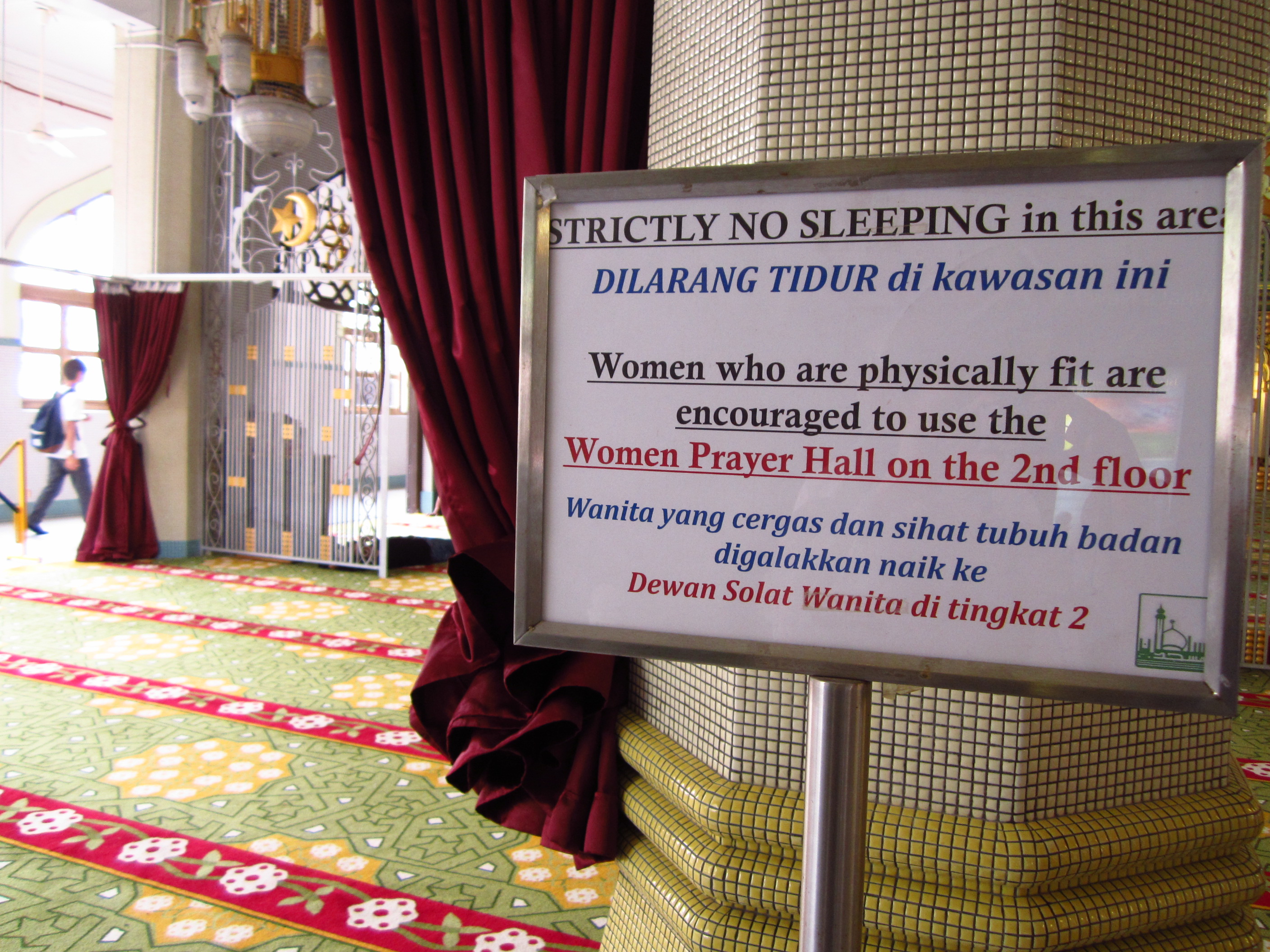
A sign found in Singapore’s Sultan Mosque encouraging fit and able-bodied women to use the second floor.

If Kamila were allowed access to this Yemeni mosque, where would her praying space be? In Singapore (and many other places), many of the women’s spaces are a floor or two above the main prayer hall. Without a lift, would Kamila have to crawl up the stairs every time she came to pray? In recent years, a historic mosque in Singapore has taken into account the needs of their aging congregation: a new tent-like space has been reserved on the main floor for women who are not able to climb the stairs to the second floor.

Surely we cannot continue to emphasise an individual’s determination in the face of barriers. We must take into account that disability and gender come together to produce unique sites of oppression. And mosques need to change to accommodate their congregation, too. 

Otherwise, who is the mosque for but only able-bodied men?

Monday, November 17, 2014

Watch: ‘Legendary Qariah’ Faridah Mat Saman

Given the unofficial title of qari’ah lagenda or a ‘legendary female Quran reciter’, Faridah Mat Saman participated in Tilawah al-Quran (International Quran Reading Competition) held in Malaysia, over several decades.

She was the overall female champion in 1964, the first year that the competition had a separate category for women. She went on to win in 1965, 1972, 1976, 1977, 1989, 1990, and 1991. Although retired, she made a guest appearance in the 2012 competition as shown in the video below:


Monday, October 27, 2014

One Muslim's furry initiative gets Malaysian religious authorities hot under the collar

A few days ago, the Dutchman killed a small mouse which had been living in our kitchen for some time (possibly a year, if it's the same one). He meant to trap it and release it but in a moment of panic he killed it (while apologising to it and that's why I married this dude). After the trauma of having experienced the senseless killing of an innocent animal, I lay in bed thinking about why I had such an irrational reaction to seeing the mouse crawl up and down my sofa (and coming so close to my baby!).

The only other time I do this is when I see a gecko. (Ugh, just saying the name makes me squirm). Not just any kind, but the house lizards that are found in Southeast Asia. I have such a phobia of them that I don't even want to elaborate anymore. Suffice to say, seeing one a few metres away is enough to get me hyperventilating and getting my ass out of the room, super fast.

I don't have the same reaction anything else. Insects like cockroaches, silverfish and ants? No problemo.

Right before I dropped off to sleep, I concluded that it was probably because I had had no close interactions with mice before. I didn't grow up with pet mice, or ever handle one. (I did handle hamsters though.) Plus, seeing mice in the context of a pest (going after noodles, pasta, oatmeal and paper in my house) instead of a pet has sure changed my previously neutral opinion of it.

Source: Facebook
And then it totally made sense why Muslims in my social media feeds were freaking out over an event where - duly summarised - a bunch of Muslims petted a bunch of dogs, took selfies, and washed their hands afterwards. (Most of the photos are of hijabis, because don't you know that Muslim women are the representatives of Islam?)

This event "I Want to Touch a Dog" happened in Kuala Lumpur, Malaysia on 19 October. From what I could read online, it was meant as a friendly introduction to mankind's best friend in a friendly and safe setting with many other dog-friendly Muslims around - a rare opportunity in a community whose Islam is mostly based on the Sunni Shafi'i school of thought. 
"I have seen cases of people running away at the sight of a dog, or throw stones at it. It broke my heart… How do people feel when they see an animal ill-treated, abused or knocked over?” [Source: A Big Message]
Did you notice I said "friendly" three times? It's because I believe that is the intention of the organiser Syed Azmi Alhabshi. Dogs carry a great deal of stigma in our Shafi'i Muslim community (I include Singapore, Brunei, Indonesia and Malaysia in this category); a stigma that extends to any Muslim that handles or owns a dog (see for example, dog trainer Maznah Yusof). Syed Azmi did well: he gave a heads up to the Selangor Mufti Department, invited an ustaz, Mohd Iqbal Parjin from UTM’s Centre for Advanced Studies on Islam, Science and Civilisation (Casis) to speak about the ruling on dogs and how participants could do sertu or ritually cleanse themselves, and provided facilities for washing. All bases covered, you'd hope.

This niqabi agrees. Source: Facebook
Alas, there was so much negative reaction to the event. People went berserk on Facebook, commenting under the images of hijabis carrying different kinds of cute puppies. Add to the mix a smattering of suspicion that the event is just part of a larger conspiracy to promote "liberalism" and "pluralism" in Muslim circles.
I organised this event because of Allah, not to deviate the people's faiths, try to change the Islamic rules of law, poke fun at the ulama or encourage pluralism." [Source: The Star]
Meanwhile, the evening news in Brunei broadcasted a press statement from the ministry of religious affairs that "even though Islam has the provision of sertu to cleanse after touching najis mughallazah [major impurity], this is not an excuse to touch such things on purpose. Doing so is akin to someone who commits a sin with the excuse that one can repent for it afterwards."

The response from religious authorities in Malaysia were a little more mixed. Here's a great summary about the official response from Zurairi AR for The Malay Mail:
"...the religious authorities were at a loss to deal with the younger set of Muslims who chafe at the way they are being “managed” and not allowed to question how their creed is practised here.
The authorities reacted the only way they know how. They insisted that within the country’s borders, not only is the Sunni denomination and the Shafi’i school of jurisprudence the only right way to practise Islam, but Muslims must also accept only Jakim’s interpretation of the religion.
...younger Malaysian Muslims with access to a wider pool of information on Islam today are finding they have less in common with the country’s muftis and ulamas. As such, the Islamic religious authorities are fast losing their relevance, and with it, their iron grip on the lives of Muslims nationwide."
I'll be the first to admit that I do have an inner Shafi'i when it comes to dogs. (Yes, I know that there is a variety of opinions in the different jurisprudential schools of thought, but I'm not going there in this post.) Since I don't know if a bark is friendly or snappy, my first tendency is to jump to the other side of the sidewalk when a dog starts getting too close to me me.

I react like this despite the fact that I know the Qur'an speaks positively about dogs: an animal caught by a hunting dog is halal (5:4) and in the story of the persecuted youth hiding in a cave, a dog is stretching its forelegs at the entrance (18:18). I react like this even though I have been surprised by a farmer's dog that followed me out into a field and hung around a few metres away as if to keep guard on me as I peed. 

I am well aware that my instinctive fearful reaction to dogs and mice comes from a fear of the unknown - I'm simply not used to these animals like I am to say, cats. For that, I'm grateful and happy that there was such an event to change the attitudes, at least in this group of a few hundred Muslims in Malaysia.

Dogfies! Source: Facebook

Thursday, October 9, 2014

Why you should talk about sex before marriage.

It’s time to clear the air and shame in our communities about sex education, sexual rights and chastity. By Sya Taha.
(Image: Fotolia)

The shame that surrounds sex in the Muslim circles I’ve encountered sometimes makes me think that talking about it is equivalent to the act itself. (Well, guess what – I’m going to open my mouth-vagina anyway.)

Sex and intimacy between Muslim couples is often a topic that is saved for the marital covers – with lots of nervous giggles (often coming from all parties including my middle-aged premarital counsellor). Couples may find this difficult and embarrassing to talk about, even if they find it necessary.

Much of this comes from the expectation that our spouses should be virgins, with zero experiences of sex or even affection like holding hands or hugging members of the opposite sex (also known as “halal dating”). But somehow, the moment we are pronounced man and wife, we’re expected to go from zero to sixty in as many seconds. Foreplay – that’s like, kissing, right?

The reality is that many young Muslims are having all sorts of sexual experiences. Even the definition of that is highly subjective. An Indonesian friend who interviewed several young Muslims about their sexual experiences found that some of them did not consider oral sex or intimacy with members of the same sex to be “sex” per se. Meanwhile, the obsession for abstinence-only sex education and the strict definition on virginity as the absence of penis-vagina intercourse means that some Muslims are engaging in anal sex, and without the knowledge and tools to keep themselves safe.

Before getting married, it’s worth discussing with your partner if he/she is a virgin or that he/she has previous sexual experiences. There’s no shame if both of you want to marry only strict virgins, or that both of you are fine if one of you has had experience. The point is, both of you have to be okay with it. If you want to remain a virgin while your partner has experience, then great. But if you know a thing or two but expect your partner to be totally innocent and clueless, then you might want to evaluate your expectations. Likewise if you feel you have to hide your “past” from your partner.

I once had a Muslim friend tell me that sex education was not necessary: women can learn from their husbands on their wedding day. When I asked her where the young men would have to learn about sex from, she was silent but we both knew the answer: pornography. Needless to say, I think this double standard is highly damaging to both husband and wife.

Pornography is highly staged and doesn’t reflect the real-life spectrum of sexual acts and experiences. Trying out porn moves on your wedding night is not the way you want to empower your marriage. Unless you seek out specifically feminist pornography, much of what you can find on the internet also focuses mostly on male pleasure and universalises ideas about what men and women like. Everyone is different and likes different things – it’s a lot better to get what you want and give what your partner wants.

There’s a dark side to talking about sex, too. Unfortunately, in many of our societies, any kind of sex-related act is seen as the ultimate lack of piety – including rape. This happened to a Muslim friend. She was raped by a then-suitor. The guy then insisted on marrying her, threatening to shame her as a “loose woman” if she refused to marry him. Eventually the threat of marring her family’s name overwhelmed her and she ended up marrying him. (Predictably – and thankfully – she is filing for divorce.)

Recently, I read a blog post written by a young (married) Muslim woman that talked about what to do if one wasn’t a virgin, without unpacking the concept of virginity or chastity. Predictably, she said we had to make lots of du’a, but what I found more distressing was that she conflated rape and consensual sex as being unlawful sexual acts in the eyes of God.

Rape can happen to anyone because it’s the rapist’s fault – hijab or no hijab, halal dating or not. Rape is an unspeakable crime and it’s not something for the victim to be ashamed about. There are many Muslims who see a previous sexual assault as a loss of virginity and carry the shame with it into their marriage. (These issues must be worked through with a licensed therapist.) But virginity and chastity are two different things.

Sex, on the other hand, should be consensual. More than that, it should be wildly enthusiastic. With this in mind, rape can also happen within a marriage – though many may think otherwise. Marital rape is when you do not consent to sexual intercourse. As a partnership of mercy and affection (30:21), marriage should be a safe space for mutual love, pleasure and respect, not for one party to mindlessly demand rights from the other, or to unquestioningly do something they don’t really want to, in the name of obligation.

Testing for sexually transmitted diseases (STDs) is also important. I can’t stress this enough, as it’s part of the things to consider before you commit to each other. You don’t want to be surprised with symptoms a few weeks after your wedding. We often think to test for major diseases like HIV/AIDS, but others like syphilis can be non-deadly but equally damaging (or at the very least, annoying). If one of you does have an STD, you will have to think about what you will do – would you treat it first and then marry? Or is it a deal-breaker? For common and incurable STDs like human papilloma virus (HPV), will you agree to use condoms and dental dams for the rest of your life, or are you okay with contracting it and learning to keep the virus under control?

Sure, the conversation is going to be uncomfortable at first. Many of us are not used to even using the proper words for our genitals (personally, in my native language, the words feel obscene and vulgar; proper texts use the Arabic equivalents instead). Many of us might grow up with shame around masturbation, which means that we may not know what feels good for us.

But at the risk of sounding cliche, communication is the most important tool. So starting slow and experimenting with different positions, places, props and moods can be a wonderful time for practising your sexual communication skills in your marriage. Open and matter-of-fact communication can also help in times of stress or bad health, as a rejection of sex doesn’t have to leave you feeling hurt. If you like wildly different things, communication means that you can find a compromise or a middle way.

The good news is that sex gets better the more you can talk to your partner about it, especially if you can let each other know what you’re enthusiastic about and can appreciate what your partner likes. Safe and healthy sex gets better with time. Have fun!


This post was originally published at Aquila Style

Monday, October 6, 2014

When you're being chased out of Eid ul-Adha prayer because of a baby

Hope everyone is having/had a blessed Eid ul-Adha 1435.

This was the first year that I was not alone in the women's section of the mosque, since being married. I'm largely unmosqued, mostly because I hate going to a mosque and then having to be separated from the Dutchman - with the exception of the Tokyo Camii (Mosque), where we prayed side-by-side in one of the first rows. (Being a musafir or traveller can buy you a lot of leeway, just plead ignorance.)

I know I'm not alone in having this sort of separation anxiety. Many other couples made up of one partner who is not raised Muslim, may similarly feel anxious being handed over to the 'sisters' or 'brothers' (ie total strangers) in a completely different part of the mosque. (I mean, somehow total strangers can be more helpful just because they are of the same sex?) That being said, I'm very proud of the Dutchman for being able to hold his own among these 'brothers' (after I prep him on what to expect).

This month marks the fourth year I've been in the Netherlands, and also four years of this blog! (So much for the initial title, A year in NL). It's also the fourth year that I've been going to the Indonesian mosque in my town. It's three storeys high, and the main prayer space is on the second floor (there's a complimentary balcony for women). The first floor houses some classrooms and a kitchen.

Spot the complimentary balcony
As with many other mosques that make space for women, during big congregations like the two Eids, this mosque repurposes the first floor classrooms into special rooms for women and children. All men go into the main area space, while the female congregation is split into four different spaces: the (complimentary) balcony, two or three saff or rows in the main hall, and two rooms on the first floor: one for women with children, and one for women without children.

I've always been a big supporter for equal and equally decent prayer spaces, and ever since I saw the room labelled 'women with children' four years ago I've told myself, hell no. By putting all the children into one room, it becomes extremely chaotic because the children don't see the imam and learn how to carry themselves during a congregation. Nothing against the need for children to play and run around - in which case why confine them to a room with women trying to get the best of both worlds? Just set aside a room dedicated to fun and games, get a few adults to watch them and ta-da, everyone's a winner. (By the way, this arrangement is exactly what several mosques in Singapore organised during tarawih sessions in Ramadan earlier this year.)

I rave about this mosque because of the low wooden barrier (lower than waist-height) that seems to nominally demarcate the male and female praying spaces in the main hall. But this year, with little Nootje I had to face the attitudinal barriers head on.

When we arrive at the mosque a good 30 minutes before the Eid ul-Adha prayer is due to start, I wave off the Dutchman into the main entrance and I go round to the side entrance. I saunter up the stairs to the main area space, carrying Nootje in my arms. I find a spot near the door ( to make a quick exit if he starts bawling) in the front row, look around for the Dutchman in case I decide to pass Nootje over to him, and settle down.

The takbir is being chanted over a booming microphone, which freaks out Nootje a bit. He unusually lets me carry and rock him in my arms, hardly moving (very rare since he doesn't like being held unless we're walking or bouncing him) since he's an hour overdue for a morning nap - I have high hopes that he will zone out through the noise or maybe even fall asleep (a mum can dream can't she!).

There's a mother on my left, with a 1.5 or 2 year old girl in a pink dress, who is sitting quietly. Not five minutes pass when one of the women who is working today as an usher for all the congregants tell me that babies are not allowed in the main hall. I decide not to point out the toddlers in the men's area, who are shrieking. The mother beside me quietly sneaks away to the second row and her little girl almost melts into the pipes along the wall - she's just as stealth as her mum!

I have so much to tell this woman who's trying to chase me down to the vrouw met kinderen room. 

Did she know that God loves the laughter of children? That the Prophet would shorten the prayer if he heard children crying in the congregation? That the Prophet's original mosque was relaxed and inviting? That if families were so highly regarded in our religion, they should be able to sit and worship together in the mosque, which is meant to symbolise society? That asking me to leave the area because I was holding a baby made me feel like a baby is unclean, unholy and unworthy?

Instead of all that, I fumble out an answer in half Indonesian and half English and respond to her order as if it was posed to me as an option: it's okay, I'm staying here. She looks confused and tries her command again, this time in Dutch, stressing that "it's the rules". Another woman chips in with English, because I'm beginning to look like a right tourist who doesn't understand anything anyone is saying.

By this time, another mother has taken the empty space to my left, and she has two children: one looks about 6 or 7 and the other is older. She helpfully tries to encourage me into leaving ("This is the first time I'm here [in the main hall]. All these years I've been downstairs.") but this only makes me determined to not banish myself.

I simply shrug and smile to both women and assure them that I'm not taking extra space and that Nootje will be quiet. Mosque lady is not satisfied, but happily she moves away to usher more women downstairs as the main hall is filling up. Woman to my right is ambivalent, and no one comes to my support. Clock is ticking... ten more minutes to prayer. I continue rocking Nootje and whisper the takbir in his ear.

Finally! The prayer starts, and it's an exercise in balancing a 8kg weight while bowing and prostrating without putting any hands on the floor. Takbir seven times with one hand, and hope that the communal and extra loud "Ameen" doesn't startle Nootje. He doesn't mind the shift in orientation during the ruku', and I make an almost-there prostration with him right under me. 

After the prayer ends, he is looking super tired (nap is two hours overdue by now) so I pop out a boob under my hijab to feed him. He contentedly nurses to sleep and I get to listen to 15 minutes of the sermon. And no one seems to mind the two toddlers running around in the men's section during the prayer. (The section which, by the way, had two extra rows free, which could have been filled up with women.)

The imam tells us the story of how when God created Adam, God told all the malaikat (angels) to prostrate to the first human being. They all did so, except Iblis. Iblis believed that being created from fire was better than being created from clay. Because Iblis disbelieved, he was sent out of Paradise for his arrogance (7:11-18).

(Side note: I'm often quoted this story from the Qur'an by those who think that whatever I write or post is controversial, or that I'm being arrogant and stepping over my God-given womanly boundaries, whatever those may be. Essentially, likening me to Iblis... stay classy, guys.)

But I love how the imam interprets this story. To him, the moral of the this parable is that even though God creates beings from clay, fire and light, all the creations lived in Paradise together. While we humans, all made out of earth and are all flesh and blood, can't even live together on Earth. 

Post-sermon selfie

Thursday, September 19, 2013

Do beauty pageants empower or objectify?

Some Muslims in Indonesia are unhappy about the finals of Miss World 2013 to be held in Bali this week. The event has sparked protests from conservative groups across Indonesia. As a response to classic beauty pageants, Rofi Eka Shanty founded the World Muslimah pageant in 2011. This annual event selects 20 finalists from over 500 candidates using an online selection process based on their proficiency in reciting the Qur’an, and sharing anecdotes of how they wear the hijab.

Shanty explains her reason for creating Indonesia’s alternative to Miss World: ‘We don’t just want to shout “no” to Miss World. We’d rather show our children they have choices. Do you want to be like the women in Miss World? Or like those in Muslimah World?’

This hints of a divisive us-or-them attitude towards the women who participate in Miss World as being immodest or having loose morals – a view supported by Indonesian protestors holding placards reading ‘Miss World Is Whore Contest’ and ‘Miss World Go To Hell’. Women in World Muslimah, in contrast, are pious and modest.

Often confused with other classic pageants such as Miss Universe (promoting intelligence and good manners) and Miss International (promoting world peace and goodwill), Miss World is the world’s oldest beauty pageant. It began in 1951 as a bikini contest, but added intelligence, personality and talent segments in the 80s as a response to protests by women’s liberation activists in the 70s. A more recent campaign to promote the concept of ‘beauty for a cause’ is the Philippines-based Miss Earth pageant (promoting environmental activism), which started in 2001 – an idea echoed by the World Muslimah pageant with its goal to show how ‘beauty can be a driving inspiration’.

Although not judging women’s (uncovered) bodies seems to be the main idea of the World Muslimah pageant, the event still includes a ‘parade of Islamic fashions’ to show that young Muslim women do not have to show their ‘immodest’ hair and bare shoulders in order to be considered beautiful. Indeed, wearing the hijab is one of the main (and most visible) requirements of the World Muslimah event, with photos of previous events showing a sea of elaborately-decorated hijabs. Demonstrating a hijab style is also one of the event’s segments.

Furthermore, before entering the grand final of World Muslimah 2013 on September 18, the 20 finalists have to participate in workshops covering spiritual subjects such as Qur’an memorisation, developing ‘humanitarian intelligence’, Islam’s challenges, how to be the best wife and mother in Islam; as well as practical subjects such as fashion photography, public speaking, presentation skills, beauty, style, fashion modelling and stage performance. This is in addition to reciting the Qur’an and performing both compulsory and optional evening prayers on the day of the finals.

I can appreciate the alternative criteria for the World Muslimah pageant, which includes academic and social achievements and certain markers of religiosity, as a means to promote positive role models for young Muslim women. It is also a way to make Islam more relatable to young people, as shown by a male version of an Islamic pageant in Malaysia called Imam Muda (Young Imam), although this television series did not include any physical markers of religiosity (eg keeping a beard) and judged young men based on their religious knowledge and skills.

However, the claim that World Muslimah is ‘Islam’s answer to Miss World’ begs the question: What was Miss World looking for? Miss World accepted Muslim women, even though the swimsuit segment of their competition often meant that they were excluded.

World Muslimah is mostly an Indonesian women’s pageant (14 out of 20 finalists are Indonesian). At its core, it is still about judging young, slim, educated women and what they wear and do. The crucial difference is that piety, the only thing that remains invisible and that only God can assess (53:32), is now reduced to markers like Qur’an recitation (not necessarily understanding it) and wearing hijab in fashionable ways. What about Muslim women who do a lot of social and humanitarian good, without necessarily being hijabis?

Women who participate in beauty pageants should not be accused of being immodest whores. There is no need to react to whatever we find degrading from the ‘West’ by making Islamic versions for hijabis. Let’s instead think twice about supporting the institution of pageantry that promotes the objectification and judging of women’s bodies and minds.

This post was originally published at Aquila Style

Wednesday, June 5, 2013

Why McDonald’s is Not Halal

This article was originally published in Aquila Style. 


I grew up in Singapore, where our minority Muslim community enjoys the benefits of the Islamic Religious Authority of Singapore (better known as MUIS), a semi-state institution that governs the collection and disbursement of zakat (social tax), and calculates times of prayer and important dates such as the start and end of Ramadan. Some of their tasks include ensuring that restaurants that serve halal food follow the required rules before being awarded certification, and allowing a round green ‘halal’ sticker on food products that follow the rules of halal (MUIS guidelines on halal food in general and meat in particular).


This green sticker plays a major role in helping everyday Muslims select food. Many Muslims I know will feel ‘was-was’ (doubtful) about eating at a Chinese vegetarian restaurant not because some vegetarian ingredients could be non-halal, but because there is no green sticker since the restaurant did not apply for official certification.

This makes food selection much simpler when in Singapore. But in many other countries without such a certification mechanism, Muslims have to make their own choices and decisions based on their knowledge and conscience. Perhaps because of the familiarity and pervasiveness of fast food corporations, coupled with fears of the unknown, I know many who will seek out McDonald’s familiar golden arches when overseas. Muslims who do so might only eat French fries and a Filet-o-Fish, in trying to avoid non-halal meat. Meanwhile, they forget the variety of real food that could be cooked in perfectly acceptable ways: pasta, rice, potatoes, fish, vegetables, fruits, and so on.

But a green sticker does not necessarily embody halal, and McDonald’s is a prime example of this.

In the Qur’an, food and drink are part of God’s blessings to humankind. The beautiful selection of good things to consume on Earth is a divine sign for us. Three recurrent themes when food and drink are mentioned in the Qur’an are that of i) quantity, ii) quality, and iii) ethical choices. Many aspects of fast food in general, taking McDonald’s as an example, do not follow the guidelines on food and drink as set out in the Qur’an.


Quantity

In the Qur’an, we are given examples of real food like fruits with ‘diverse tastes’ (eg olive, pomegranate) and meat (6:141). Together with another verse which also mentions food and drink (7:31), the concept of extravagance (tus’rifu) in eating is likened to the transgression of God’s laws.

This is because our body has certain divine laws: barring genetic diseases, eating well and exercising will result in health, and eating poorly and sitting around all day will result in diseases. Therefore, eating excessively or extravagantly is disobeying divine laws of physical wellbeing.

There are now laws in more and more countries that force McDonald’s to make their nutritional information available. Now there is no excuse not to know that food from McDonald’s is high in saturated fat, salt and sugar. One medium serving of French fries makes up almost a third of an average person’s daily fat allowance. And a 500ml cup of iced Milo is already a whopping 600 calories of pure sugar.

While many would eat entire meals at McDonald’s, it is possible to minimise the damage by limiting mealtimes at McDonald’s to one or two items at a time, and once every few weeks or months. I myself have not eaten at McDonald’s for more than three years.

Quality

In the Qur’an, halal simply means something that is permitted or lawful. When it comes to food and drink, the word toyyib, meaning good, clean, or pure, is used to describe what kinds of food are lawful (2:172, 20:81). In chapter Al-Maidah (meaning ‘The Table Spread with Food’), we are advised that whatever is toyyib is permitted and should not be made prohibited (5:5, 5:87). Therefore, food which is unclean, impure or bad in any way for our bodies and minds should not be on our to-eat list.

I want to specifically talk about the meats found in McDonald’s: its beef patties, chicken nuggets, and fried fish fillets. While ‘100% beef’ may sound healthy, it actually means that any part of the cow can be included – including tendons and muscle fibre, which are soaked in ammonium hydroxide before being churned and shaped.

Even though this beef is ‘halal’ slaughtered (with yet another certification), the requisite criteria is often ritualistic, only looking at the slaughter stage without consideration of how the animals were raised – which are sometimes curiously similar to non-halal meat production.

Chicken nuggets contain over 20 ingredients, including a range of chemicals and additives that we don’t even know for sure to be safe. Fish fillets may look like real fish, but in fact they are made from a combination of cheap, overfished and tasteless whitefish. To make it taste better, more chemicals are added.

It’s encouraging to see that there are choices for McDonald’s consumers to add more lettuce, tomatoes, corn and other real food to their food choices. However, the meat on the menu is highly processed and tastes nothing like a cut of real meat or fish from the butcher or fishmonger.

Ethical choices

All of our actions have consequences, and the Qur’an encourages us to do good works (23:51) instead of committing abuse (2:60) or oppression (20:81) when eating or drinking. This indicates that the source of our food and drink is important – it must not cause pollution or destruction of natural habitats, and it must not be produced by underpaid or exploited workers.

An invisible aspect of McDonald’s business is its supply chain. When you buy a company’s product, you are voting for their actions, because you contribute to their profits. Several activist groups have popped up over the last decade that highlight problematic points of McDonald’s supply chain: beef from cows raised on former rainforest land in Brazil, and sugar, meat fillers, and oil made from industrial and subsidised monocultured corn from the United States.


Workers at McDonald’s are paid the lowest out of all fast food restaurants in Singapore, at $3.50 to $4.00 an hour. The preference for young workers discriminates against older workers while trapping young people into an underpaid job with no healthcare benefits. People get excited over ‘localised’ items such as the ‘Prosperity Burger’ aimed at Chinese New Year, perhaps forgetting that it discourages people from eating their healthier traditional foods.

What now?

The innocuous green halal sticker on almost every product including vegetables and soy milk encourages simple decision-making. It discourages us from making our own choices, rooted in knowledge and guided by our conscience and easy-to-follow Qur’anic principles.

Halal is not simply the absence of bacon and the presence of ritually-slaughtered meat. Disregarding situations of emergency, halal must encompass the concept of toyyib and the fair and ethical treatment of workers and the Earth.

For those inclined to read labels, ‘organic’, ‘fair trade’ or ‘sustainable’ are arguably more useful labels than the simple ‘halal’ sticker. We can make a start by choosing real food from our own traditional cultures that our grandparents can recognise, cooked by people, and eaten with gratitude.

Friday, May 17, 2013

What is awra?

In mainstream Islam, aurat/awrah is taken to mean 'private parts' of women and men. This word comes from fiqh or jurisprudence; it does not appear in the Quran. This word is then used as a guideline for how women should dress, in addition to indications from hadith (and you all know how I feel about them by now: guidance, not law).

The verses from the Quran often used to explain awra actually contains words like zeena, furuj, and sawa. Awra as it is used today conflates these three concepts in the Quran. Awra does appear in the Quran (33:31) but! let's analyse how it are used.

Awra

The root 'a-w-r (ain-waw-ra) appears only 4 times in the Quran in the same form of a noun, each time referring to different things.

The al-Ahzab verse (33:13) talks about a situation of war and unrest, known as the Battle of the Trench/Clans (Ahzab). Some believers were scared and wanted to flee from Yathrib (Madinah), by claiming that their houses were awra. However, such an argument made them bi'awratin. According to this interpretation, this group claimed that their houses were vulnerable. But by not showing solidarity with everyone else in Yathrib, they exposed their own cowardice and hypocrisy. (How you can use this verse to explain hijab is beyond me.)

Source

But! The other verse in al-Ahzab (33:59) is even more interesting. This verse is in the context of war, and the Prophet was told to tell women to wear jalbab in public, so that they would be recognised and not harassed. The verses before had been talking about hypocrites and other people in society who were out to make trouble. Wearing an outercoat/loose-fitting garment was supposed to help identify these women as believers, and therefore not to be harmed.

(A little bit like how more Afghan women started wearing the full burqa in times of political instability under the Taliban and occupation. Not so much that women are responsible for not being harassed or raped -- more on that in another post.)

It's important to note that awrat in al-Ahzab (33) was used to refer to houses and people's character, not to women being exposed or not.

Another verse in an-Noor (24) talks about 3 times of the day -- before dawn, at noon, and after isha' -- that are times of awra for anyone. At noon especially, it mentions that it is a time when we 'put away our garments', perhaps to rest or take a nap. The period before dawn and after the night prayer is also commonly the time we sleep, have sex, or rest. So what does it mean that these moments are awra? It can be translated as 'moments of privacy', since children below puberty should ask permission before meeting someone at these moments (24:58).

The last verse is giving guidelines on the different levels of undress that women are allowed in front of different groups of men (24:31). There is no harm for a woman to reveal her zeena in front of helpers, attendants, and children who do not yet know awra-t-al-nisa, translated as the 'private aspects of women'. To understand this verse better, we must look at zeena (seriously, click and read this before reading on.) furuj and sawa.

Sawa

The root s-w-a (sin-waw-hamza) appears 167 times in the Quran. The most common verses used to explain awra is the disgrace of the first two humans in Paradise. When Adam and his wife ate from the forbidden tree, their sawa was revealed to them when it was previously hidden (7:20). Saa  is something evil/harmful that causes distress (4:22, 4:38, 4:97, 4:115, 5:66, 6:31...). Sayyia  are bad deeds that are despicable because they cause harm to others (2:271, 3:193, 4:18, 5:12...) Sawata refers to a dead body (5:31).

Source
Taking the meanings as a whole, I think that the sawa revealed to Adam and his wife go beyond simply their nakedness. I think it refers to their ability to do evil, when in Paradise they were only able to do good; and also to be mortal, since they were tempted into being immortal (7:20, 20:120). An alternative interpretation: when Adam and his wife (metaphor for humanity) ate from the Tree of discord, they tried to covered themselves with righteous behaviour, but it was too late -- humanity had already split themselves into factions and started committing harmful deeds towards each other.

Sawa refers to the ability of human beings to have free will and do good and evil. It could mean nakedness, but it's still in the context of a specific story, possibly full of deeper meanings.

Furuj

The root f-r-j (fa-ra-jim) appears 9 times, referring to a rift or breaking open of the sky (77:9, 50:6) and chastity. Maryam is taken as an example of one who guarded her chastity (21:91, 66:12). Chastity and related modesty (as opposed to openly promiscuity) is part of virtuous behavior for men and women (23:5, 24:30-1, 33:35, 70:29).

Clearly, chastity is not something to be covered physically. When we are told to 'guard our chastity', it doesn't mean we literally wear a chastity belt. It means we control our actions. Whether what we wear helps us to control our own carnal desires or not, it's in our minds, not in our genitalia.

Summary

As a summary, awra in the Quran has only been used to refer to 'moments of privacy' (24:58) and 'private aspects of women' (24:31). What is often meant by awra in the conventional sense is actually zeena, furuj and/or sawa. Zeena talks about a women's beauty in an abstract sense, furuj is about chastity, and sawa is about our humanly characteristic to do good and evil.

Taking awra to mean a conflation of these concepts does not only mean that we currently have a weak understanding of the Quran (because no one can even point out the error of citing 33:59!), it also means that we confuse ourselves with the dominant, orthopraxic teachings, when the Quran has made these three concepts so rich and so useful for our daily living and spiritual sustenance.

Why reduce it to whether you are supposed to cover this or that, in front of whoever?

What is zeena?

The root z-y-n (zai-ya-nun) appears 46 times. It appears almost half as zayyana meaning beautified/made attractive and the other half of the time as zeena. For example, the earth has been adorned and made beautiful (10:24), with the sky and stars for example (37:6), often translated as beauty, decoration or adornment. Beauty and other niceties of this world are provided by God for us to enjoy and can be a form of worship (18:7, 7:31) and should not be made forbidden because it is a mere taste of what believers can enjoy in the afterlife (7:32). Examples are gold (20:59), horses (16:8), wealth and children (18:46, 57:20), and festivals (20:59).

We are encouraged to look moderately nice at the masjid (7:31). But we shouldn't be excessive, as Pharaoh (10:88), and lead ourselves astray with it (11:15, 18:28). Disbelievers will be attracted to worldly life (2:212, 3:14, 33:28, 28:60) and just like every other community, be pleased with their wrongdoings (6:43, 6:108, 6:122, 8:48, 9:37, 10:12, 13:33...).

So most of the time, zeena is referring about something beautiful, aesthetic, and enjoyable, than can be enjoyed in moderation. It only becomes harmful when taken to excess.
And tell the believing women, they should lower their gaze, guard their private parts, and not display their zeena except what is apparent of it. And draw their khumur over their bosoms, and not display their zeena except to their husbands... (list of un-marry-able men here)... or their women, or what their right hands possess, or male attendants with no physical desire, or children who are not aware of the awra of women. And don't let them strike their feet to make known what they conceal of their zeena. And turn to Allah altogether believers, so that you may succeed. (24:31)
There is no harm for a woman to reveal her zeena in front of helpers, attendants, and children who do not yet know a women's awra (24:31). There is also no harm for older women with no more sexual desires, to remove some of her clothes, but without revealing zeena (24:60). Women should not reveal their zeena except what is zahara or apparent/obvious/dominant (24:31). But we still don't know what zeena is. Some say hair is naturally apparent and thus the exception which can be revealed. Some say it's what you cannot control when it rains, the wind blows, etc.

So what is zeena?
  • It comes from the root meaning beauty, adornment, ornamentation and attractiveness.
  • It can be revealed in front of certain groups of men.
  • It can cause desire in front of unrelated and marriageable men (although arguably men can still feel desire for their marriageable female relatives, so for me it's weird to lump husbands and all the other men together)
  • It can cause desire in the sexually-mature / who are aware of the 'private aspects of women'.
  • It can be exposed when the feet are stamped / struck e.g. catwalk?

Perhaps a clue: Women should draw their khumur or (head) coverings across their bosoms/ cleavage, and not display their zeena. If zeena is referring to breasts or cleavage, then it makes sense that revealing it in front of attendants or young children is acceptable, in the case of nursing or caregiving. That older women who are relaxing their dress code around men should still not reveal breasts makes total sense. As for 'what is apparent', this could refer to whatever is out of the women's control.

But it doesn't make sense that one could reveal breasts among related and marry-able men. I certainly wouldn't!!

Perhaps zeena is hair then, as the mainstream argument goes? Some argue that a woman's zeena is her beauty (pretty vague), and according to various schools of thought, include her hair, neck, cleavage, feet, or voice. Some even say the entire woman is zeena and therefore cover completely. The vagueness of the concept, and the contested authenticity of its hadith, means that there is still no certain answer.

But then it wouldn't make sense that hair causes desire in only certain men, or that you are allowed to show your hair to children because hair causes desire in sexually mature people?? However, you could walk in a way that shows off your hair.

I don't think it zeena refers to only one or a few body parts, I think it refers to something more abstract that is beyond me for now. Perhaps it has been left vague, perhaps because it is culturally constructed. What is suitable for women to reveal in front of these men differs in each social context.

Taking everything into account, it seems to be referring to a collection of behaviours that are aesthetic and can cause desire in sexually mature people. I can't say I know for certain the definition of zeena. Perhaps in some other I'll read something else and understand it better, inshallah.