Pages

Showing posts with label hijab. Show all posts

Saturday, September 10, 2016

Openseam - "Teacher, are you Chinese or Malay?"

This article was first published on Openseam.

--
Happy Teachers' Day!

Today's post comes from Aliya Yeoh, an English teacher in Penang, Malaysia. She previously wrote about how she celebrated Chinese New Year. A Chinese Muslim, she reverted at the age of 35, after postponing her earlier plan to do so for 10 years. You can read more of her experiences and thoughts in her blog, Musings of a Mualaf.


"Teacher, do you understand Tamil?" asked Revathi.

I was with a small group of Indian students, on relief duty for an absent teacher.

"No, I don't understand Tamil," I smiled. I knew they just wanted reassurance that I would not eavesdrop on their conversation.

"Would you understand if I speak Chinese?" I asked. Revathi's turn to smile.

"Teacher, you can speak Chinese?" 

"Teacher is Chinese la," Ramanan answered for me.

"Really? I thought you're a Malay."

"I am a Chinese," my smile grew wider. She looked puzzled.

"But... you are wearing tudung?"

"I am a Chinese Muslim... born in Malaysia. I grew up as a Chinese and later..."

"You converted?" Shanti chipped in.

"That's right. I wear the tudung because I am a Muslim woman. But I am still a Chinese and I can speak and understand Chinese." I explained slowly.

"Ohhh..." Revathi nodded slowly.

I've been in this school since 2010. I taught these same students two years ago and strangely, they have not realised that I am a Chinese lady. The reason? I am wearing a hijab, or tudung.

Students, like most Malaysians, associate this garb with Islam and being Malay. In many minds, if you wear a tudung, then you must be a Malay.

And in their minds, if you happen to wear a long tudung, then you must be an especially religious Malay. They associate our clothing with religion.

It's bad enough that Muslim and non-Muslim students are always separated during religious activities. It would be havoc among other non-Muslim teachers if a non-Muslim student were to sit in the hall with other Muslim students, listening to a ceramah (sermon) by an ustaz.

So I can't blame them for their lack of understanding of Islam. They don't know much because we, the Muslims, don't do much. Sometimes we, as adults, are not allowed to.
Students learn best when they mix with their own friends. Which is why our teenagers need to be exposed to doing Islamic dakwah work, and not be scolded nor discouraged just because they 'lack knowledge'.

I wouldn't be surprised if non-Muslim students think that China is made up of only Buddhist people. I used to think that way too, when in reality there are more Chinese Muslims in China than there are Malay Muslims in Malaysia.

Once, I was told, in hushed tones, that there was a Chinese student who was interested in Islam. The ustazah didn't know what to do. Till today, I'm still waiting for her to approach me.

It's always fun watching how Chinese students react when I speak Chinese dialects or Mandarin to them. One day when I scolded a sleepy Chinese lad in Hokkien, his mother tongue, and he was so surprised that he actually sat up straight.
And the Malay students?

They might suddenly realise that it's a fact that there are other Muslims in this country who are not Malay or Mamak.* That there are other once-kafir (non-Muslim) people who have embraced Islam and are now their brothers and sisters in Islam. Because I'm living and walking proof among them.

"So teacher, are you a Malay or a Chinese now?"

"I am a Chinese... and my religion is Islam. There are more than 60,000 Chinese Muslims in Malaysia today, did you know?"

Ahhh, life is never boring as a Chinese Muslim. Xie xie, wo ai ni,** Allah.

*Mamak: local slang to refer to people of Indian ethnicity.
** Mandarin for 'Thank you, I love you'.

Wednesday, May 11, 2016

"Do you work here?"

Institutional racism means that when you are Brown, you're taken to be a low-wage worker. Not that you might want or desire such a job, but that these are the opportunities open to you.

Institutional racism means that when you're in a clothing store, some White people will assume that you work there. You might be holding a few pieces of clothing over your arm, as you look through the shelves and racks. These are not things that you're browsing for and that you can afford to buy, but items that were already tried on or misplaced and it's your $5-per-hour job to fold and put them back.

Institutional racism means that when you are seeking something more beyond the 9-to-5 grind, some Rich people assume that you're unemployed and would be grateful for any job offered to you. You may have been privileged enough to get a degree, but educational qualifications are invisible. A rich person may look at your skin colour, and the skin colour of their loyal chauffeur and secretary, and offer you those jobs. These are not jobs you are necessarily interested in, but you are supposed to be grateful that you were offered them at all.

Institutional racism means that when you send out dozens of resumes with your Arabic-sounding Malay name, some White people will offer you a secretarial or administrative job, if it's not a cleaning job. Some White people will offer you unpaid internships. Some Rich people will, during your interview, tell you that they are glad you are not wearing hijab, because women that wear hijab "think differently". Institutional racism means that when you hyphenate your father's name to your husband's Dutch family name, you get an interview and you are assumed to be of mixed parentage.

Institutional racism means that when you find yourself too close to a person who has more privilege, other people might mistake you as the domestic worker of the person you are helping. You might be just offering a wet wipe to a Chinese woman who fell down, or helping a wheelchair-user buy something or get somewhere.

Institutional racism means that when you're doing anything resembling manual labour, some Chinese people will assume that you are the cleaner of the premises humbly doing your job. You might be moving boxes and equipment because you train with athletes in this hall everyday. It's your last day in this place and you have to pack everything to be picked up the next day. You know the Malay pakciks and Indian aunties that set up and put away sports equipment and furniture in this hall. Institutional racism means that a Chinese person may see you as just another Brown menial worker.

So the first thing he asks you is, "Do you work here?"

Thursday, March 10, 2016

Indonesian fashion brand gets halal status, ruffles hijabs of many


Earlier this month, the appearance of Indonesia’s first halal-certified hijab, sold and promoted by Indonesian fashion company Zoya, provoked equal parts protest and support. According to the certification given by the Indonesian Ulama Council (MUI), Zoya’s hijabs are ‘halal’ because the fabrics are produced with the use of only plant-based emulsifiers, and not those made from pig gelatin. Zoya has also erected a billboard in a few major towns with the tagline “Are you sure that your hijab is halal?“


Online, some responded with incredulous sarcasm. Some said that if the fabric for hijabs had to be halal, then every article of clothing (including underwear) had to be halal as well. Others pointed out that if there were ‘halal hijabs’, then, there must necessarily be ‘haram hijabs’ existing from the beginning of time until Zoya. Some questioned if the halal certification would not be completely unnecessary after washing the hijab, especially before wearing it for the first time? And some contended that many women, after their umrah and haj, still buy abaayas made in China, which are more likely to be washed with pig gelatin-based emulsifiers.

A hijab that is clearly ‘halal’, while its competitors are not, is an example of strong product differentiation. Instagram celebrity and hijabi blogger Fifi Alvianto sees this ‘halal hijab’ as a marketing tactic. She explains, “In the religion [Islam] there hasn’t been discussions on halal fabrics, at least not as clearly as halal food.” However, Zoya’s creative director Sigit Endroyono said that their intention was only to help consumers feel confident and at peace with their hijabs. “As sellers, we are responsible for our customers’ tranquility. We try to fulfil the right of our customers by ensuring the permissibility of our clothes and headscarves.”

Despite these non-pecuniary motivations, the company’s sales manager Chandra Rahmad, admitted that the controversy surrounding their ‘halal hijab’ has resulted in an “unintentional” but “extraordinary increase” in the sales of Zoya’s products. Zoya has since retracted their advertisements on Instagram, as well as all but one billboard, and apologised in a press meeting.

It is perhaps not a surprise that Zoya chose to embark on such an aggressive marketing campaign, especially in the light of the recent introduction of a hijab and abaya collection from Dolce and Gabbana. This comes after several years of one-off and aurah-friendly Ramadan collections from DKNY, Tommy Hilfiger, and Oscar de la Renta caftans. Even more affordable brands like Uniqlo and Mango have kept up.

I appreciate the critical response from certain segments of Indonesian society. While there were certainly people who bought Zoya’s hijabs after they were certified halal, there were also others that spoke out against the absurdity of ensuring that hijabs — a non-consumable — were also halal.

Hijab designer Rani Hatta admits to being confused by the halal certification for hijab fabrics, “I thought all along that clothes that cover the aurah, are loose-fitting and don’t show the shape of the body could be worn.” Famous Indonesian designer Dian Pelangi also echoes Rani’s opinion, “Cosmetics and beauty products are absorbed into the skin, so we need to make sure that the products we use are halal.”

However, I do feel disappointed that none of the critics mentioned fair trade or ethical working practices play a role in determining whether a fabric is ‘halal’ or not. The director of MUI’s department of Food, Medicines and Cosmetics Research (LPPOM) Lukmanul Hakim clarified that the Zoya brand is not halal as a whole — just its fabric. He mentions other processes but unfortunately, his discourse remains at the superficial material level and does not go deeper to address social practices, “Zoya claims its [hijabs] to be halal […] They say that it’s because they use halal materials. But doesn’t fabric need to be sewn? Is their thread halal too? We don’t know that yet.”

MUI’s head of Halal Information Farid Mahmud said that there are now many companies that submit applications for halal certification. Companies that produce shoes, belts, paper and even social organisations have applied:
“Some laundromats provide soap and water that are guaranteed to not contain ‘najis’ [ritual impurities]. The biggest paper factory in Indonesia also submitted an application because their paper is used for printing Qur’ans […] Consumers just want to make sure that although not for eating, these materials are not contaminated with najis. Producers consider it as an obligation in accordance with Islamic law.”
In the production of cotton for example, there are several political issues related to ‘halal’ we could choose to educate ourselves on, such as Genetically Modified (GM) cotton reduces biodiversity; intensive farming uses pesticides, insecticides and fertilisers; cotton-picking in some countries like Uzbekistan is still done by hand and allegedly by children; textile processing uses high amounts of water and energy. Meanwhile, many synthetic fabrics are non-biodegradable and use harmful chemicals during processing.

Elsewhere I have written that the Qur’an encourages us to do ‘good works’ instead of committing abuse and oppression when eating or drinking — which we could reasonably extend to whatever else we consume.”[…] the source of our food and drink is important – it must not cause pollution or destruction of natural habitats, and it must not be produced by underpaid or exploited workers.”

The controversy of a ‘halal hijab’ has opened a discussion into what makes a thing halal or not. Unfortunately it seems that for Indonesia at least, Muslim discursive circles on ‘halal’ have yet to intersect with social justice discourses on fair trade, organic farming or sustainability.

All quotes have been translated from Bahasa Indonesia.

Monday, February 29, 2016

Not Between Her and Allah: Hijab-shaming in Malaysia

This article was first published on Muslimah Media Watch.


Tunku Tun Aminah. Source
Hijab-shaming is a favourite activity for some Muslims, both on-and offline. In fact, just last month I attended a religious class where the teacher spent a good half hour doing just that (I had to stop going for my mental health).

While meeting up with a girlfriend last week, she regaled me with the details of a religious class where the female teacher showed examples of “improper hijab” from a selection of hijabi Instagram users – young women who were obviously oblivious to the use of their photos for such educational purposes.

Social media gives a degree of anonymous bravado that makes it easier than ever to degrade and shame Muslim women for not wearing the hijab – the sixth pillar of Islam. (Oh wait, it isn’t? Funny, it sometimes does seem like it is…)

Last week, Bank Negara Malaysia (the central bank, or BNM) awarded a handful of prestigious scholarships to underprivileged students from around the country. 18-year-old Nur Hajar Asyiqin Abdul Zubir was one of the four to receive the award, after several rigorous rounds of assessment.

Currently studying for her ‘A’ Levels in Negeri Sembilan state, she dreams of studying chemistry at Oxford University in the UK – a “golden opportunity” that this scholarship will be able to fund without worrying her parents, who work as meat suppliers. The youngest of five children in the family, Hajar had scored 9 A+s in her secondary school examinations last year and learned about the scholarship through a motivational programme for underprivileged students in the country.

Source
Malaysia is a multiethnic country, where the indigenous Malays form the majority alongside Chinese and Indian minorities. Instead of pride in her excellent academic results, several Malay men on Facebook chose to criticise the fact that Hajar does not wear a tudung, or hijab.

One man said it was a “pity the aurat is not covered” and that “her father bears the sins”. Another man similarly qualified his congratulatory message with a snarky proclamation that “Allah hates His servants who do not cover” and dismissed the role of Hajar’s own intellectual efforts with the remark “we succeed not because we are clever”. Yet another man even suggested that the hijab should be a requirement for a scholarship awarded for academic excellence.

While one website described this online activity as “chiding”, I disagree: shaming is more accurate. It’s easy to shame Hajar because she is a young girl from a poor family, with no social standing. But it looks like women with a higher status in society are still not exempt. Case in point: a princess from another Malaysian state.

While deriding others is an attempt of the actor to give himself moral or psychological power, it only reveals his own internal crisis of masculinity.

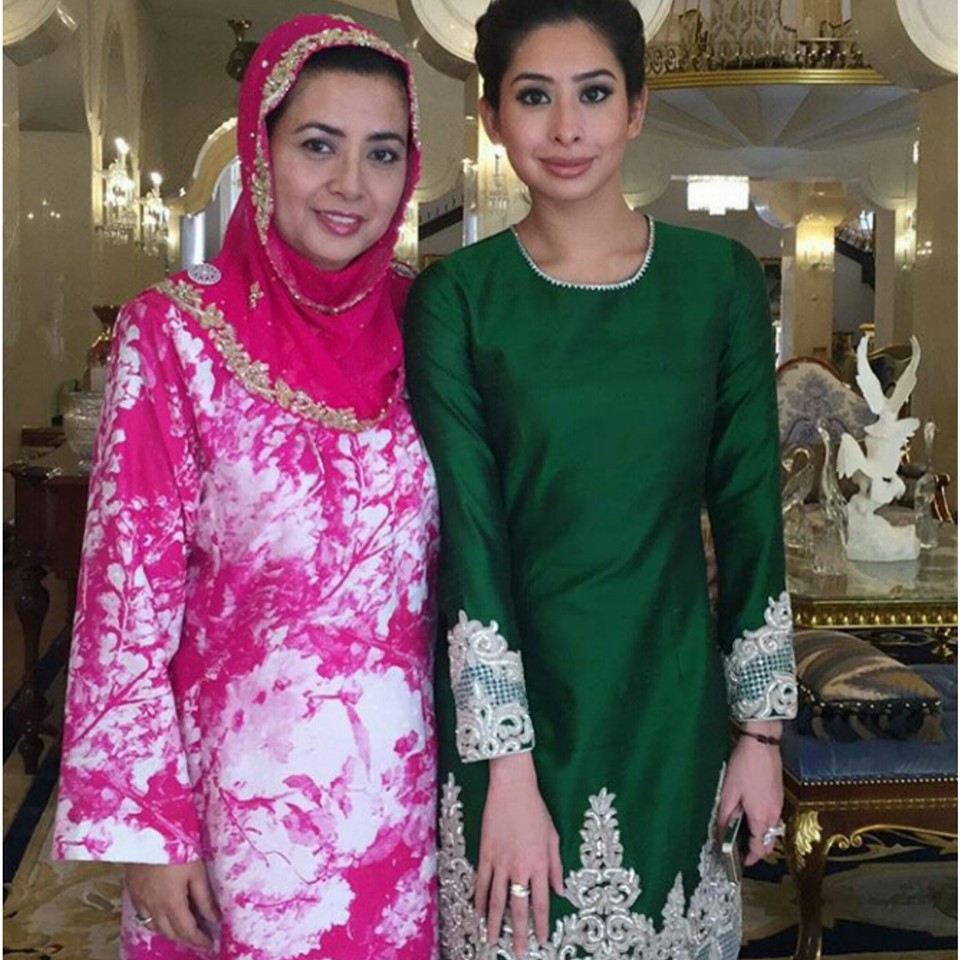
Tunku Tun Aminah Maimunah Iskandariah was recently the target of negative comments on photos posted on Instagram by herself and her brother, Tunku Idris, which shows her without a tudung – her habitual look.

The only daughter among the six children of the Johor sultan and his wife, the fashionable 28-year-old still keeps an Instagram “fashion diary” (@ttaootd), which is heavily monitored for negative comments.

While her brother claims that Tunku Aminah had shut down her Instagram account much earlier and for reasons unrelated to the comments on her lack of hijab, he admits that such comments do “tick [him] off.”

He defends his sister by posting several photos and comments on his account on not being judgemental of how others look. He even vouched for what he knows of his sister’s spirituality, like praying and covering her hair at religious events: “Is that not good enough? Isn’t it between her and Allah?”

It’s such a simple – almost rhetorical – question, yet it is one that is difficult for many of us to answer. These people are shaming Hajar and Tunku for not fitting into their narrow ideas of what it means to be an ideal (Malay) Muslim woman. While deriding others is an attempt of the actor to give himself moral or psychological power, it only reveals his own internal crisis of masculinity.

Sunday, February 28, 2016

Book review: Jewels of Allah by Nina Ansary

This article was first published on Muslimah Media Watch.


When I first heard the title of Dr. Nina Ansary’s latest book, Jewels of Allah, on the life of women in Iran, I must admit I had to restrain myself. In general I’m pretty wary about labelling women as two-dimensional objects, whether in a negative (‘lollipops’) or positive (‘pearl in its shell’) way. Ansary explains that the title is “meant to convey that women, who have been ordained as inferior [by hardline conservative factions] are in fact the jewels of the Creator”.

The book promises to tell the “untold story of women in Iran,” and it doesn’t disappoint in some ways. The first chapter begins with a determined tracing through centuries of history aiming to correct misconceptions about the popular narratives about women’s lives in Iran over the last 40 years. The popular narrative, according to Ansary, is one that creates a dichotomy between the free/modern/active/miniskirt-wearing Iranian woman during the Pahlavi monarchy and the gender-segregated/restricted/veiled Iranian woman in post-1979 Islamic Revolution Iran under Ayatollah Khomeini.

I feel optimistic when Ansary writes, “The real story is usually much more complicated, nuanced and less tidy.” These are the misconceptions she addresses in her book (one point per chapter):
  1. Before the Pahlavi monarchy, Persian women were always suppressed by the religious and political establishment.
  2. Iranian women didn’t advocate for their freedom until recently.
  3. During the Pahlavi era, all women were liberated.
  4. During the Khomeini era, women were totally oppressed.
  5. There is a lack of common ground between secular and religious women in Iran.
  6. There is not much of a women’s movement in modern-day Iran.

Chapter 2 looks at Ancient Persia and the then prevailing religion of Zoroastrianism, which she describes as egalitarian and progressive. Then, the 7th century Arab invasion and the “eventual infusion of Islamic values” into Persian society results in the loss of women’s equal status with men and their social separation, loss of educational opportunities. In the chapter, one hadith about women’s “brains [being] incapable of retaining knowledge” is quoted as if it were a widespread Islamic belief. Next, the chapter argues that women were granted a brief respite from oppression under the Iranian and Turkic dynasties from 9th to 13th centuries. However, the Safavid dynasty brought back the patriarchy, packaged in conservative Shia doctrine and persisting to this day.

Chapter 3 and 4 look at the nuances (as promised!) behind the Pahlavi and Khomeini eras. She argues that (conservative) rural women were not empowered under Pahlavi because their families kept them at home from school, while under Khomeini, a “failed gender ideology” resulted in women being empowered through education, despite legal and social efforts to oppress them. Chapter 4 contains a few rather extensive analyses of gender roles in elementary school textbooks, which read like standalone research essays.

Chapter 5, 6 and 7 look at the ups and downs of alliances between secular and religious feminists by tracing the development of various feminist publications and magazines.

The good

In the epilogue, Ansary highlights about 100 historical and contemporary Iranian women, over centuries, who espoused the feminist ideology of their times (these were previously posted on her Facebook page from March 2014 to May 2015). These women include scientists, artists, professionals and even a Paralympic athlete; this incredible collection is great for showing that Iranian women are not oppressed, have done many amazing things, and come from all walks of life – in short, they’re real people.

I also liked that she started the book with a story of her two grandmothers. Bringing in the personal helps give more context and motivation for why she wrote the book, something that authors should but rarely do.

Chapter 5 also includes a great explanation of Islamic feminism, and how religious and secular feminists in Iran work within a religious framework to advocate for women’s rights. A list of “Iran’s Islamic feminist movement” includes professor Dr. Jamileh Kadivar, journalist Parvin Ardalan, human rights activist Mehrangiz Kar, Nobel Laureate Shirin Ebadi and founder of Zanan magazine Shahla Sherkat. Other scholars mentioned include Nayereh Tohidi, Afsaneh Najmabadi, Haleh Afshar, Valentine Moghadam and Ziba Mir-Hosseini. A selection of quotes from these women indicates that they differentiate Islam as a religion from interpretation of Islamic laws and regulations – a point which is not so clear in the rest of the book.

The bad
One problem is the romanticisation of history and, in particular, of Zoroastrian culture as being a gender utopia. Further, the framing of the Arab invasion and Safavid dynasty as being severely gender unequal serves to frame the empires in between as seemingly more egalitarian. In reality, analyses of these periods deserve just as much nuance (based on other intersectionalities such as sex, race/tribe, class) given to the Pahlavi and Khomeini eras. While there were certainly female leaders and commanders in Persian cities and states in 6th century BC, what class of women could reach these ranks? Most probably educated women of noble lineage.

Walter Benjamin wrote in On the Concept of History (1940) about a painting called Angelus Novus by Klee. The painting teaches us that our view of history as a sequence of events only serves to justify a certain narrative.

“Where we see the appearance of a chain of events, he sees one single catastrophe, which unceasingly piles rubble on top of rubble and hurls it before his feet (…) The storm drives him irresistibly into the future, to which his back is turned, while the rubble-heap before him grows sky-high. That which we call progress, is this storm.”

Furthermore, there were other problematic themes that kept popping up throughout the book. One was the framing of women who ‘veil’ as being conservative and those who don’t veil as being free. One of the first notable women Ansary features in her book is Sadiqeh Dowlatabadi (1882-1961), “one of the most distinguished advocates for female education” (p.28). She reportedly said on her deathbed: “I will never forgive anyone who visits my grave veiled”. This quote is not explained or given any further context or nuance, leaving the reader to conclude that veiling can only be an unfeminist and unempowered act. (In her epilogue she also features Masih Alinejad, creator of My Stealth Freedom Facebook page for women to post photos of themselves without a headscarf.)

Compare this to a description of ‘Rejected Princess’ Naziq al-Abid, Syria’s first female general in history, and for whom going veil-less was also a big part of her life.

“She’s seen here ripping off a veil, since going veil-less was a big part of her life. Not that there’s anything wrong with choosing to wear a veil — she just didn’t have that choice for the most part, although she wanted it badly.”

The conspicuous lack of context is odd, as Ansary seems aware that there is more symbolism to the veil than the oppression-freedom dichotomy. The book shows that she is aware that there are other bigger factors that determine a women’s empowerment, such as laws and educational opportunities. This is evident in how she describes Khomeini’s ‘Islamic Government’:

“a misogynistic regimen […] embedded in a constitution reinforcing the primacy of the Sharia (Islamic law) over civil law and the absolute leadership of a Shiite jurist over popular sovereignty.” (p.200)

So it is puzzling why she does not give more nuance where it is so crucially needed.

This lack of linkage to larger political factors and global processes can result in readers making problematic conclusions. Gina B Nahai, in her review of the book, laments the lack of a “satisfying explanation” as to why “an estimated million women actively took part in the overthrow of the Shah and the return of the ayatollahs to Iran”. Nahai ends up blaming Islam as a monolithic patriarchal force, and Allah as a patriarchal god, for the problems of Iranian women. (Perhaps she didn’t read the final chapters where religious and secular Iranian women show how they are able to articulate gender equality in laws within an Islamic framework, through an ideology otherwise known as Islamic feminism.).

The final chapter also comes to an odd conclusion as to how women in Iran can achieve equality. It mainly argues for a reform of Islam based on “theological reform in Western nations”, based on the work of German priest Martin Luther and Friedrich Nietzsche. There is no mention at all of Islamic laws in other countries that do not have the same outcomes as Iran. Even a cursory look at other Muslim majority countries such as Tunisia or Indonesia could show how gender equality is not solely determined by laws or religion, but also other factors like increased employment or improvement in standards of living.

A public relations sheet that came with the book highlighted some publications and organisations that have featured her book. One organisation that stood out was The Clarion Project, which has infamously produced several Islamophobic films, the most recent being Honor Diaries. This rightwing organisation aims to “challenge extremism”, but in reality it provides a simplistic view of ‘Muslim extremism’ in order to perpetuate a cruel and oppressive image of an all-monolithic Islam. 

Despite this, in her interview with The Clarion Project, I think Ansary has bravely attempted to include some nuance about Iran’s gender inequality, highlighting that the West has its own gender inequality issues too.

Final thoughts

The language in Ansary’s book is easy to read, but it is held back by its pace. I felt like I was reading different essays cobbled together: some delving into too much detail in some topics (analysis of elementary textbooks) and some skimming over topics that needed more analysis (tracing of feminist alliances, Muslim reformers from within).

Most importantly, when I finished the book, I realised that state-sponsored terror existed under both Pahlavi/free and Khomeini/oppressed regimes. Not many readers may know that under Pahlavi, police beat up veiled women and forcibly removed their veils. Today, the basij or religious police do the same to women who are ‘improperly’ veiled. It’s an authoritarian state that imposes a regime on its people that creates oppression, not religion or a veil.

While Ansary extensively looks at the actions of the Iranian state (censorship of feminist magazines, changing of laws, the overall impression that her book gives is that patriarchy/male supremacy/culture/religion is to blame for the oppressive and misogynist laws in Iran’s history. I think she could have done a better job in differentiating Islam as a belief system from Islam as a set of legal interpretations that vary across time and space. Similarly, I think Ansary should have clearly explained that there are a multitude of meanings behind a veil or hijab; that women may wear it for many reasons that are not immediately visible from the outside.

This book may be useful to those looking for historical references and a simple discussion of Iran’s political environment; however, the book can be heavily critiqued from various feminist perspectives and is a limited contribution to the work of Islamic and Muslim feminists.

Monday, November 17, 2014

“Camel hump” hijab-shaming reveals more than meets the eye

A few years ago, I was chatting to a friend from university in her dorm room. She was raised in an East African Muslim family, but she didn’t wear hijab and I had no idea of her own religious convictions. We somehow mentioned an Arab hijabi friend in passing, and she remarked that this hijabi wore a bump at the back of her head (which I had always assumed was her ponytail). But according to her, “this is haram”.

Bewildered, I got home and innocently Googled “hijab”, “hump” and “haram”. I had never heard about this ruling taught by any religious teacher (and I’ve had my fair share of them) in the last 20 years. When I used to wear hijab, I found my own ponytail hump a rather useful spot for a pin to stop the entire scarf from moving around my head. Or was this whole hump business just not a big deal in my home region at the time, Southeast Asia?

Needless to say, the internet is full of wonderful things. I came up with fashion tutorial videos on how to do a Khaleeji-style hijab, amateur graphics blanking out faces of women done in Microsoft Paint with arrows pointing to the offending hump, and stern warnings for innocent Muslim(ah)s wondering the same thing as me. And I discovered the hadith that seemed to form the basis for this ruling: women whose heads look like camel humps “will not enter Jannah and they will not smell its fragrance.”[i]

Let’s temporarily put aside the argument that Abu Huraira is not the most reliable of narrators, and that many of the 5,300 hadith he supposedly remembered of the three years he spent in the Prophet’s company are some of the most misogynistic ones you could find in the four main Sunni hadith collection.[ii]

When I wore the hijab growing up in Singapore, a bump at the back of a hijabi’s head was simply a normal hair bun or ponytail. Today, young women use oversized scrunchies or clips resembling flowers to create volume. For brides that choose an “Arab” style outfit, their hijab also includes a characteristic hump as a fashion statement. In Turkey for example, many hijabis have proven resistant to the multitude of new hijab styles; the most popular style for some time has been a colourful silk scarf that is neatly wound around the neck and – yes – a bump at the back. In the Gulf where a large hump is the height of style, women wear it as a fashion statement.

Just like the “jilboobs” phenomenon of shaming women who are not wearing hijab in a style the accuser finds “proper”, finding fault with the way that some women choose to dress is a characteristic feature of patriarchy. In religious patriarchy, a layer of shame works especially well. With the hijab especially, there can always be a reason to shame women into dressing differently; what they wear is never good enough.

A woman wearing modest clothes in the street can be told to wear hijab; a hijabi is told that her outfit is too colourful or too flashy or her hair is showing; a niqabi is flirting with her eyes; and finally, a completely covered woman in public causes fitna, or chaos with simply her presence. I’m not exaggerating. At least once in my life, I have been told one version or another of these reasons for covering up.

While I would raise my own children to follow their own conscience and take responsibility for their actions, I also believe that the attitude of others towards us does leave an impact on our own self-image. Shame is one of the most painful human emotions. If we are told consistently that how we dress is sinful or the space we occupy is unimportant, then we think of ourselves as worthless nobodies. When we speak out against injustice and are told that our points are moot because we haven’t spent X years studying at Y university, then we think that we are disgraced failures.

Young women making fashion tutorials are constantly told that their makeup and hijab styles are unIslamic, while young men are driven to depression because of their tattoos. Instead of pointing out each other’s flaws, let’s aim to see the best in one another. How can we raise strong, self-confident Muslims if there is a constant beating down of their decisions – sartorial or otherwise?

[i] Narrated by Abu Huraira, in Riyad as-Salihin, available here
[ii] Raja Rhouni, Secular and Islamic Feminist Critiques in the Work of Fatima Mernissi, p.220, available here


--

This article was originally published at Aquila Style

Sunday, November 10, 2013

Tudung or Not Tudung?: Hijabis in Singaporean Workplaces


In Singapore, the hijab is more commonly referred to with the Malay word ‘tudung’, which simply means a covering. In October this year, a petition was started on Avaaz.org by a “Syafiqah K.” to allow Muslim women in Singapore to wear tudung (hijab) in the workplace. It aimed to reach 20,000 signatures, but was closed down recently with about 7600 signatures short of its goal. It was originally planned to be sent to several figures in the government.

As of today, the Singapore government has what appears to be an almost arbitrary policy on Muslim women wearing hijab in the workplace. According to political rhetoric, the hijab is not allowed in “front-line positions” that require daily contact with other Singaporeans, including non-Muslim ones. However, there is no law that details this specifically.

According to my observations, there are professions that involve contact with people (thus appearing to be rather “front-line” for all intents and purposes) and yet allow hijabs. Examples include public transport companies, teachers, doctors (except when in scrubs), and politicians. In the government, for example, hijab is allowed as long as it doesn’t involve the “front-line” (case in point: my sister works in the tax authority wearing a hijab). Examples of professions that totally do not allow hijabs include police, military and navy officers, and nurses. As for private companies, their dress code is left to their own discretion.

This petition sparked a public debate in the mainstream and social media, for the second time. The first time (that I know of, at least) was in February 2002, when four little girls were banned from government primary schools after their parents sent them to school in hijabs and modified school uniforms (with lengthened sleeves and skirts). The then-mufti of Singapore (who is considered a civil servant because the Islamic authority is considered a government body) declared that “education is more important [than the hijab]” and urged their parents to comply with the school uniforms.

A glaring omission in this past debate was the voices of those girls. Note that their parents packed them off to school with hijabs when they were only seven years old. As hijab was not even obligatory on them, it appeared to me that their parents politicised the issue of hijab to highlight their own concerns that Malays, as the indigenous people of Singapore, were being marginalised in public policies. As for the government, the stock answer is that maintaining harmony between a Chinese majority and a Malay minority is hard work.

Facebook image created by anonymous artist to show solidarity with Singaporean Muslim women
Source

This theme surfaced again in the recent hijab debate: the “integration” of Malays into the Chinese majority. Malay (and presumably Muslim) nominated member of parliament* Zulkifli Baharudin’s opinion is that Muslims need to integrate better, and “not expect others to accomodate them all the time”. He attributes the “strong religiosity” of Singaporean Muslims to something primitive, and resistant to the “years of progress, education and Westernisation”. His views echo the sentiments of Singapore’s minister mentor** in his book ‘Hard Truths’ (2011), when he said:
“I would say, today, we can integrate all religions and races, except Islam… Be less strict on Islamic observances and say, ‘Okay, I’ll eat with you’.”
Predictably, the Malay community feels attacked by the continual belittling of their customs and faith by the state apparatus and the Chinese majority.

The current mufti of Singapore, Mohamed Fatris Bakaram, has framed the issue in a way at least one blogger thinks is correct: that the hijab should not be seen as problematic to integration or racial and religious harmony, and that Muslim women who feel inclined to wear hijab on the basis of religious conviction should be allowed to do so in any profession, just as Muslim women who do not feel inclined to not wear hijab should be able to do so as well.

What about the voices of Muslim women? Their lack of visibility and voice is lamented in the public debate. On one hand, the thousands of Muslim women who signed the petition were dismissed by an MP Zaqy Mohamad, as engaging in a strategy of “astro-turfing” which he implied as being illegitimate and not constructive.
“The initiator has not identified himself or herself. So no one knows who initiated it, or whether the response is real.”
On the other hand, the handful of hijabi Muslim women who work within the state apparatus, such as Speaker of Parliament Halimah Yacob, are pressured into giving her stand. I don’t find it surprising that she is hesitant to do so, because she is part of the state and she cannot openly counter its official stance, just as MP Zaqy Mohamad has to push official rhetoric in order to remain in office.

Personally, I believe the inconsistent hijab policy in Singapore has allowed a space for Muslim women to practise their personal convictions through different strategies. For example, I know one long-time hijabi who wanted to stop wearing hijab by deciding to become a police officer, thus avoiding social pressure. Another works as a nurse, and wears her hijab going to and leaving from the hospital. Yet another hijabi trained as a nurse, but decided to become a teacher after she realised she could not wear her hijab.

So what do we make of this debate?

It’s difficult to raise our voices in restrictive political conditions. In the semi-authoritarian state of Singapore disguised as a liberal democracy, there is no room for petitions and referendums. The inconsistent policy of allowing hijab in certain professions means that the issue can be used by both the state and the people to point out how much and how little freedom Muslims have, respectively.

At the same time, it is not to say that only democratic societies are able to handle such debates. Perhaps the blurred lines of the policy means that it is possible to have dialogue and debate in society about this issue. One profession at a time, it may be possible for Muslim women in Singapore to freely choose their career and how they practise their faith.


* NMPs are a uniquely Singaporean political creation, consisting of politicians who are chosen by the president to enter parliament, and do not represent any political party or electorate.

** Again, another uniquely Singaporean position for the man to whom much of the country’s development is credited under his authoritarian rule, Lee Kuan Yew.

Monday, November 4, 2013

Little Hijabis: To Wear Or Not To Wear?

This article was first published in Muslimah Media Watch on 4 Oct 2013.

Recently, a series of online shopping sites were brought to my attention: at first glance, they seemed to be the garden-variety online hijab shops. Some even had blanked-out faces – again, nothing that I hadn’t seen before. However upon a closer inspection, I noticed that the hijabi models on the website were smaller than usual – they were little girls.
My immediate reaction was that of uneasiness. Even though in Singapore where I grew up, it is common for parents to dress their pre-pubescent daughters in hijab (as young as just one year old), I only recently found out that it’s not the norm in other countries with Muslim communities. I myself wore it to kindergarten at the age of five, and I remember wearing it during Eid at the age of seven onwards. My mother thought it was harmless and she never forced it on me because she thought it would be better for me to get used to it in the most pleasant way possible.
It was only when I travelled to Morocco about five years ago, where I met young girls who were allowed to wear anything they wanted, and it was only after reaching puberty that they would usually wear a hijab when leaving the house. This made sense to me, because even the most oft-cited hadith that provides the guidelines for hijab mentions menstruation, or puberty, as the starting point.
However, I could also understand why parents would want their young daughters to start wearing hijab or cover up at an early age, even though this was not a religious requirement. The reason usually given is that it is easier to make them get used to wearing it. I even heard one of my aunts suggest that parents should dress their girl infants with headbands so that they would get used to having something on their head, which would make wearing hijab easier later on.
This forced socialization has its drawbacks, for example, when girls are old enough to question why they have to wear the hijab. In fact, this was exactly the question posed to me by a nine-year-old girl, who had come to the mosque where I volunteered by giving tours, as part of her weekend religious class activities.
Because women (she was not a woman) have to cover up their beauty (‘beauty’ as a euphemism for sexual appeal) in the presence of men they are not related to (is mahramrelevant for a child?) and can only show it to men she is related to, like her husband (she was decades away from having one): all my stock answers simply fell short of satisfying her innocent curiosity.
This little girl’s question eventually led me to a long journey of researching about hijab, especially for myself.
Another concern I have with making little girls wear hijab is that it is prematurely socializing them into worrying about their looks, especially in the context of the male gaze. Take a look at the models on some of these online shops:
Source: Little Zee
Source: KidsMii
Some of these outfits are too complicated (not to mention impractical in hot weather) for these girls to be doing everything they would want to go, like playing freely outside.
Another common reason given for dressing little girls modestly is that it counters the sexualized girl outfits that come from “the West”. I agree that these shops provide some very lovely and simple alternatives, with no glittery slogans like “Cutie Pie” emblazoned across the chest.
But hijab sexualizes its wearer in its own way, because in a social setting it indicates that the wearer has the ability to give off sexual appeal in the first place. (Sometimes at a glance, it can even make the wearer look older than she really is.) One of the shops even showcases a fashion runway of young girls in various styles of hijab and clothes that cover all their limbs – what’s the difference, exactly?
I truly believe in wearing the hijab for spiritual reasons. I also acknowledge that hijab has social reasons, for which some women wear it as well. The bottom line is, the informed decisions that grown women make, with their own research and knowledge, is something to laud. But let’s allow our children to choose for themselves when they are old enough.

Thursday, September 19, 2013

Do beauty pageants empower or objectify?

Some Muslims in Indonesia are unhappy about the finals of Miss World 2013 to be held in Bali this week. The event has sparked protests from conservative groups across Indonesia. As a response to classic beauty pageants, Rofi Eka Shanty founded the World Muslimah pageant in 2011. This annual event selects 20 finalists from over 500 candidates using an online selection process based on their proficiency in reciting the Qur’an, and sharing anecdotes of how they wear the hijab.

Shanty explains her reason for creating Indonesia’s alternative to Miss World: ‘We don’t just want to shout “no” to Miss World. We’d rather show our children they have choices. Do you want to be like the women in Miss World? Or like those in Muslimah World?’

This hints of a divisive us-or-them attitude towards the women who participate in Miss World as being immodest or having loose morals – a view supported by Indonesian protestors holding placards reading ‘Miss World Is Whore Contest’ and ‘Miss World Go To Hell’. Women in World Muslimah, in contrast, are pious and modest.

Often confused with other classic pageants such as Miss Universe (promoting intelligence and good manners) and Miss International (promoting world peace and goodwill), Miss World is the world’s oldest beauty pageant. It began in 1951 as a bikini contest, but added intelligence, personality and talent segments in the 80s as a response to protests by women’s liberation activists in the 70s. A more recent campaign to promote the concept of ‘beauty for a cause’ is the Philippines-based Miss Earth pageant (promoting environmental activism), which started in 2001 – an idea echoed by the World Muslimah pageant with its goal to show how ‘beauty can be a driving inspiration’.

Although not judging women’s (uncovered) bodies seems to be the main idea of the World Muslimah pageant, the event still includes a ‘parade of Islamic fashions’ to show that young Muslim women do not have to show their ‘immodest’ hair and bare shoulders in order to be considered beautiful. Indeed, wearing the hijab is one of the main (and most visible) requirements of the World Muslimah event, with photos of previous events showing a sea of elaborately-decorated hijabs. Demonstrating a hijab style is also one of the event’s segments.

Furthermore, before entering the grand final of World Muslimah 2013 on September 18, the 20 finalists have to participate in workshops covering spiritual subjects such as Qur’an memorisation, developing ‘humanitarian intelligence’, Islam’s challenges, how to be the best wife and mother in Islam; as well as practical subjects such as fashion photography, public speaking, presentation skills, beauty, style, fashion modelling and stage performance. This is in addition to reciting the Qur’an and performing both compulsory and optional evening prayers on the day of the finals.

I can appreciate the alternative criteria for the World Muslimah pageant, which includes academic and social achievements and certain markers of religiosity, as a means to promote positive role models for young Muslim women. It is also a way to make Islam more relatable to young people, as shown by a male version of an Islamic pageant in Malaysia called Imam Muda (Young Imam), although this television series did not include any physical markers of religiosity (eg keeping a beard) and judged young men based on their religious knowledge and skills.

However, the claim that World Muslimah is ‘Islam’s answer to Miss World’ begs the question: What was Miss World looking for? Miss World accepted Muslim women, even though the swimsuit segment of their competition often meant that they were excluded.

World Muslimah is mostly an Indonesian women’s pageant (14 out of 20 finalists are Indonesian). At its core, it is still about judging young, slim, educated women and what they wear and do. The crucial difference is that piety, the only thing that remains invisible and that only God can assess (53:32), is now reduced to markers like Qur’an recitation (not necessarily understanding it) and wearing hijab in fashionable ways. What about Muslim women who do a lot of social and humanitarian good, without necessarily being hijabis?

Women who participate in beauty pageants should not be accused of being immodest whores. There is no need to react to whatever we find degrading from the ‘West’ by making Islamic versions for hijabis. Let’s instead think twice about supporting the institution of pageantry that promotes the objectification and judging of women’s bodies and minds.

This post was originally published at Aquila Style

Friday, July 26, 2013

In Their Own Words: The Ups and Downs of Fasting Abroad

This post was originally published in Aquila Style, 18 Jul 2013.
--
Whether by choice or compulsion, sometimes we spend Ramadan away from family. Four Singaporean Muslim women speak to Sya Taha on their experiences fasting overseas.

For most of my life, I have spent Ramadan in my native Singapore. Since my family members have differing schedules, Ramadan was one of the rare periods in the year where we were able to eat together at least once a day.

While many Singaporeans try to spend Ramadan and Eid together, some may have to fast in other countries due to work assignments. Nadia, 27, a young Chinese woman, has experienced fasting a few days each in Hong Kong and Sweden:
The wonderful thing about fasting overseas is the high level of energy and enthusiasm I feel throughout the day, despite the lack of food or drink. Somehow the experience of being in a foreign land assuages any hunger or thirst or lethargy I may otherwise feel.
The variety of women who observe Ramadan abroad mirrors the diverse experiences they have. Syah, 24, a young Malay woman who did her undergraduate degree in Canada, saw her experiences change over the four years she spent in Vancouver:
It was very different from the first year I was here until now. The first year, I was pretty much alone in the dorms. It was winter so the hours were shorter. The dorms had a cafeteria which had this system of giving food from the previous day as the morning meal for those who fasted. But for sahur, I would just eat some cereal since there wasn’t a kitchen. My roommate was really nice and would often eat her dinner when I broke fast so I wouldn’t have to eat alone.
Syah started out rather isolated from Vancouver’s Muslim community, its ethnic segregation making it hard for her to connect. Now engaged to marry a white Canadian Muslim man, she says the difficulties largely persist, despite having eased somewhat:
Now, I’m a bit more connected to the Muslim community for Ramadan since I’ve made Muslim friends. Even so, I still pretty much fast alone otherwise, just with my fiancé because the Muslim community is still pretty rigid in terms of who they accept, [especially] us as an interracial couple. The Muslim community here in Vancouver is very divided along racial lines and there tends to be racial exclusivity in mosques, events, and so on.
On the other, young Malay women who have studied and lived in countries that have similar cultures and customs find a Muslim community that is welcoming. The presence of similar foods also makes for a more comforting Ramadan spent away from home.

Masaini, 29, did her undergraduate degree in Bandar Seri Begawan, the capital of the small nation of Brunei on the island of Borneo. With more than 60 percent of Brunei’s population being Muslim, she found comfort in the similar foods that were available during iftar such as air kathira (a sweet milk drink with coloured syrup and basil seeds), and rice porridge with meat. Despite the similar Malay culture, Masaini found something different in Brunei:
My fondest memory was the Islamic atmosphere and ambience. I could feel the strong spiritual aura that is not present in Singapore.

Likewise, Liyana, 28, who spent Ramadan in Kuala Lumpur while she studied there, enjoyed the widespread availability of air kathira, halal-certified food and the company of Muslim students from the Middle East and African countries like Eritrea:
My friends and I always enjoyed the luxury to choose where to break our fast. The mosque in our campus always surprised us with different types of food every single day. There would always be a pool of students, both local Malaysians and internationals, who swamped the mosque area in the evening, filling up the seats while waiting for the adzan to break their fast. That was when I got the chance to get to know other students whom I had not met before.
Liyana has fond memories of the generosity of student associations in her university who sponsored food for iftars, and warmheartedly recalled discovering a surprising benefactor behind one of these iftars:
My friends and I were on our way to the campus bazaar to buy food for iftar when we were stopped by an Arab man who encouraged us to break our fast at the campus canteen. He told us to sit down while he continued to prepare the food. I saw huge portions of food being served: rice with lamb, salads, desserts and drinks. We were also given a Qur’an each. Exhilarated, I asked the man if he knew who had sponsored this iftar. He told me it was the courtesy of an anonymous Palestinian man. I was stunned and touched at the same time, to think of how much most Palestinians had gone through but that this had never stopped them from radiating blessings in the lives of others. It was a great reminder to myself.
Despite not looking like a typical Muslim, especially with her Chinese appearance, Nadia also points to experiencing the kindness of strangers when fasting overseas:
One of the things I’ve noticed about being a foreigner in a strange land during the fasting month is how warm and welcoming local Muslims always are towards their fellow Muslims who are travelling and fasting away from home. At times I’d even receive offers to break the fast with these locals, indulge in their local cuisines and join in congregational salat with them in a show of shared solidarity for a fellow fasting Muslim. Such occasions are both memorable and precious. I’m very much aware that I may not have been privy to such offers or opportunities had it not been for my status as a Muslim, and the occasion of the fasting month.
Thanks to such overwhelmingly positive experiences, even after all these years, Liyana sometimes longs to spend Ramadan again in her former university, where she had the chance to befriend many women from all over the world:
One of those moments that I truly miss during Ramadan is getting to know women from various countries and cultures in my campus mosque. Most of the married women would bring their children to the mosque, and they would get request any sister in the mosque who was free to help take care of their children while they were doing the tarawih prayer. Every sister would help each other. It was a place for Muslim women to befriend other Muslim women – each had her own story on how she ended up in Malaysia. It was a wonderful gathering of women.

Overall, the experience of fasting overseas was a learning experience for these young Muslim women. Despite the cultural similarities or differences of the places they found themselves fasting, they were able to derive social and spiritual benefits from being with another of God’s many nations and tribes (49:13). While it can be comforting to spend Ramadan together with our family, spending it outside our native countries also brings an array of benefits.

Thursday, July 25, 2013

The Challenges of FWM (Flying While Muslim)

This post was originally published in Aquila Style, 20 Jul 2013.
--
Having to fast in the summer months for the second year in a row, I’m escaping to the tropics towards the end of this Ramadan. After about 20 days fasting for 19 hours each day in the Netherlands, I’ll be over the moon thinking about fast for a duration that I am most used to: 13 hours in Singapore.

I realise that this is a privilege on my part, to be able to fly halfway across the world. I’m not doing it just for the shorter hours, though; I’m also looking forward to being with my family during what I consider to be the most special celebration of my entire year. I have explained it to fellow Dutch people that Ramadan and Eid ul-Fitr in combination is just like Christmas for them (perhaps a weak analogy seeing how Christmas and Easter celebrations have been secularised for most of the country, but it will have to do).

Today’s travel times are much shorter than what the 7th-century travellers mentioned in the Qur’an had to deal with. We can travel almost anywhere in the world in a matter of a few days. Some things, however, remain the same. Here are some things to consider if you are flying during Ramadan:

1. Fasting

Travellers are exempt from fasting during a journey (2:184-5), but some will want to anyway. Those whose work involves travel may decide to fast some days instead of missing out on the whole month.

For example, my friend works as an air stewardess and crosses time zones every three days. When Ramadan comes around, she eats a meal on board for sahur, and breaks her fast when the sun sets at the plane’s destination – wherever that might be, and however long her fast may be. At the end of the month, she tallies the total number of days and pays back a few days later in the year to make up 29 or 30 days.

2. Conserving energy

During Ramadan my energy levels are lower than usual, so I don’t want to deal with the extra hassle of luggage. I pack only the bare minimum and try to travel as light as possible. While I may have to carry on a heavy item like my laptop, I try to check in as much of my other belongings as possible.

As much as possible, I make use of online check-in (if available) so that I only have to drop off my luggage at the airport. This is often a separate and shorter line, or for some airlines a completely automatic process with the use of drop-off luggage machines. No more standing in long queues!

3. In-flight meals

As I booked my ticket for this upcoming journey, my husband realised that the flight was at 10pm – just after iftar time. I didn’t know if the airline would serve dinner so late at night, so I sent them a quick email. Happily, the airline responded that they would serve meals in time for iftar and sahur to any passenger that wanted it, throughout Ramadan.

If in doubt, ask in advance. Many airlines are happy to accommodate their passengers’ needs even though Ramadan may not be in their calendar. If there are no meals served, it is also possible to bring your own dates and meals onboard, and water is always available upon request.

4. Prayers

While this may not be a concern specific to Ramadan, it’s still helpful to know that many airports have a meditation or prayer room (specific or interfaith) in at least one of their terminals (even where you least expect it). While such rooms are expected and abundant in airports of Muslim-majority countries such as Qatar and the United Arab Emirates, I have been to prayer rooms in Charles de Gaulle airport in Paris, Suvarnabhumi airport in Bangkok, Madrid Barajas airport, Schiphol airport in Amsterdam and, of course, Changi airport in Singapore.

I was once in Paris’ main airport, where there were separate Christian, Jewish and Muslim prayer rooms. When I peeked into the Muslim room, it was full of men in congregational prayer. Intimidated, I tiptoed over to the empty Jewish room. I opened the door tentatively and ready to explain myself, but there was no one there. It was also spacious and clean and I could do my prayer in total silence. Thank Allah!As for praying on the plane, while I have seen some passengers pray in the aisles in their best approximation of the direction of Mecca, I usually pray unobtrusively in my seat. By checking the ‘live’ flight path on your inflight entertainment screen (if available) or visualising the airplane’s general flight path, it is also possible to approximate the direction to Mecca from your seat.


The Qur’an also gives travellers the option to shorten their prayers when in unusual circumstances (4:101-3). The Shafi’i school of thought elaborates on how to do this through the use of qasar (shortening) and jama’ (combining) prayers. The Qur’an also gives the option of doing tayammum (dry ablution) in special circumstances (5:6). If water is available, one may also do only the obligatory ablution (5:6) – washing hands, face, arms, hairline, and feet, only once – to save on time and public water resources. Make the most out of these exemptions.

5. Security checks

I’ve been asked to remove my headscarf and cardigans at security checks. I’ve also had friends recount to me their unpleasant experiences being asked to remove their hijab or their dupatta. I have also been detained, without any explanation, in a room at Houston Airport, while my name (well, more probably my father’s name which contains ‘Muhammad’) was run through a database. I have also had immigration officers ask me unnecessary questions because of my name.

These experiences are indeed extremely unpleasant and I wish no one had to go through them. However, I try my best to get around the situation with excuses such as ‘I am bald and would rather not remove it’, ‘I’m not wearing anything else underneath’, or simply say ‘I cannot remove this’. Depending on the country I fly from, I have varying degrees of success when doing this!

I also try to get past security checks and get to the boarding area as soon as I can. This gives me some quiet moments to myself and also reassures me that if I ever fall asleep, someone will wake me up to make sure I board the plane!

Whether one travels for work or pleasure during Ramadan, I hope that it can be a pleasant experience for everyone. I believe that the reason God gives us exemptions while travelling is because it can indeed be difficult and God understands us best.

Sunday, July 7, 2013

Fatima Hamed Hossain: Politician or Jihadist?

This post first appeared on Muslimah Media Watch on 3 Jul 2013.
--
A few weeks ago, I attended the Critical Muslim Studies summer school in Granada, Spain. One of the speakers, Fatima Hamed Hossain, a lawyer, spoke to us about the social and political participation of Muslim women in Spain.
There are about one million Muslims who currently reside in Spain, with an estimated number of about 50,000 converts, and the rest being mostly of Moroccan, Syrian, Lebanese and South Asian origins. Immigration and growing rates of conversion of Spaniards from the late 1970s are the two biggest factors for the growth of Islam in Spain.
Fatima Hamed Hossain was born in Ceuta, and was trained as a lawyer. She currently practises as a civil and commercial mediator. In 2006 she joined the political party Democratic Union of Ceuta (UDCE) because she wanted to help marginalized groups, having grown up in a marginalized neighbourhood of Ceuta herself, and also because it was symbolically important:
“I have to say that for me it was a challenge, and I felt that despite all the difficulties and criticism it was necessary; it was about time to involve Muslim women in politics.”
She contends that the media creates a particular idea of Muslim women as being illiterate and submissive.
“My main motivation, in addition to fighting for social justice, is to break the prejudices and stereotypes that have been built on some Muslim women: we are not ignorant nor uneducated nor submissive. We rebel like any other woman against injustice and wearing the hijab does not prevent this. It shows my faith, my culture and my background that I’m very proud.”
She refutes the construction of Spanish liberal values as being superior as a recent phenomenon. This was because under Franco’s administration, married women needed their husband’s permission for all economic activities such as working or owning property. It was only in 1975 that this permiso marital (marital permission) was abolished.
Fatima was the first Muslim woman to be elected to the legal assembly of Ceuta in 2007.Her election became a question of national news – reported by the national newspaper El Pais. However, she is not the first Muslim woman with hijab to sit on a regional parliament: four years earlier, Salima Abdesalam was elected into the regional parliament of Melilla.
To conclude her short talk, she speculated that the newspaper El Pais had included a discreet message in reporting her new political position.
In an El Pais article after Fatima was sworn into the assembly, a photo of her is front and centre, with the accompanying headline below. “With the hijab and the constitution” implied that there was a need to reconcile her Spanishness with her own religiosity, given that she wore a visible marker of Islam, a religion that was different to the Catholicism associated with Spain.
The most telling message, according to Fatima, was the headline right next to her face, which said “Police warn of threat of second generation jihadists”. This clearly implied that she was such a threat, which – whether intentionally or unintentionally – aimed to bring down her political worth.
Despite such setbacks, Fatima states that her biggest task is to normalise the participation of Muslim women in social and political life in Ceuta, commenting, “If just one person changes their perception about Muslim women, my job is done.”

Wednesday, May 29, 2013

Dutch Muslim Women Make a Mark on Society

This article was first published in Aquila Style.
--
A few months ago, the former Queen Beatrix (who is now known as Princess Beatrix) of the Netherlands announced that she would abdicate the throne on April 30, and her son Willem-Alexander IV would be the new king (and the first since 1890!).

Also known Koninginnedag, or Queen’s Day, this date is a much-loved holiday for Dutch people involving dressing up in orange, flea markets, street performances and making merry.


Many Dutch companies responded with special offers and discounts on their goods to celebrate this last Queen’s Day. Al Nisa, an organisation for Dutch Muslim women, saw this as an opportunity to promote their organisation and send a message of appreciation and thanks to the royal family. Al Nisa’s warm relationship with the royal family has been expressed in the form of invitations to dinners and New Year gatherings, to recognise and acknowledge the importance of the organisation’s work.

But one incident in particular made the deepest mark on Al Nisa. In 2012, Queen Beatrix made a diplomatic visit to the United Arab Emirates and Oman, where she visited some mosques. As a mark of religious respect for these places of worship, she wore bright blue and red headscarves over her trademark wide-brimmed hats.

In a debate in the Dutch parliament after her return, right-wing politician Geert Wilders claimed that she was ‘legitimising women’s oppression’ by wearing a headscarf. Queen Beatrix was said to have heaved ‘a deep sigh’ and in a most politically incorrect way, dismissed these comments as ‘nonsense’ – a highly exceptional response that was much appreciated by Al Nisa. The Dutch prime minister, Mark Rutte, supported her actions as a mark of respect for a house of worship.

Al Nisa’s campaigns have historically aimed to react quickly to comments made by politicians in the public domain, to avoid a negative political climate by clearing up misconceptions in an informative and unique way. Previous campaigns have focused on the debates to ban the burqa (‘Get Real’), and the mistrust and misconceptions surrounding Muslim women (‘Real Dutch’ and ‘Do You Know Me?’)

Al Nisa hoped that the new monarch, King Willem Alexander, and his wife, Queen Maxima, would continue the open-minded attitude of his mother. So they decided to send them a message to bring society together with a new campaign.


A change of royal rule is usually characterised by issuing a new set of coins or stamps. The new king has just been celebrated with his own set of stamps. How crazy would it be to see a stamp with a Muslim woman, majestically radiating with a vision?

Al Nisa got a designer to make a Moroccan dress known as a kaftan, with silver details on the buttons and belt. For the colour, they chose orange – the colour of the Dutch royal family. In the final image, the model wears a bright orange hijab complete with a tiara. She looks off into the distance, arms akimbo, with confidence and poise.

The stamps were launched on April 30 to celebrate the royal abdication and coronation, as the country celebrated nationwide. The royal family also received a set of stamps as a sign of appreciation from Al Nisa.

In the first few days of the campaign, there was an immense wave of positive comments through social media. The campaign was covered by local Dutch newspapers and radio, and did not escape attention from Austrian and French media as well.

One thousand two hundred-fifty stamps have been sold so far, with orders still being taken. One supporter is even planning to use these stamps for his wedding invitations!

With only a few weeks to work on and execute their pro-bono campaign, Al Nisa inspires us to see just how much can be achieved with the creativity, passion and commitment of a few Muslim women.

--

If you’d like to buy some stamps to support this campaign, send an email to info@alnisa.nl.